CSS Past Paper 2016 General Science and Ability Descriptive (Part 2)
CSS | Past Paper | Compulsory | 2016 | Part 2 | Descriptive
Below is the solution to PART-II (COMPULSORY) of the CSS Past Paper 2016 General Science and Ability Descriptive (Part 2).
Question 2
(a) What were the main objectives of Clean Development Mechanism? Also explain the reasons for the criticism on Koyoto Protocol by the developed countries.
The 20th century witnessed an unprecedented rise in greenhouse gas emissions due to industrialization and urbanization. As a result, climate change has emerged as the gravest threat to humanity. To address this, the Kyoto Protocol was signed in 1997 in Japan under the UNFCCC framework. It was the first legally binding international treaty that committed industrialized nations to reduce emissions. One of its most innovative instruments was the Clean Development Mechanism (CDM), which sought to bridge the gap between developed and developing countries through cooperation in climate-friendly projects. While progressive in design, it was not without criticism, especially from developed countries.
Objectives of the CDM
- Promoting Sustainable Development in Developing Nations
- CDM aimed to assist developing countries in achieving sustainable development goals by funding projects such as renewable energy plants, afforestation, and energy-efficient technologies.
- This objective recognized that developing countries, though not responsible for historical emissions, needed help in adopting cleaner paths to industrial growth.
- Helping Developed Nations Meet Targets Cost-Effectively
- Developed countries often faced high domestic costs in reducing emissions. CDM allowed them to invest in projects abroad and earn Certified Emission Reductions (CERs), which they could count towards their reduction commitments.
- This flexibility reduced the economic burden on industrialized nations.
- Carbon Credit and Trading System
- CDM institutionalized the concept of carbon credits, creating a global market where emission reductions became tradable commodities.
- This was the first step towards linking environmental action with economic incentives.
- Technology Transfer
- By promoting investment in clean projects in developing nations, CDM facilitated the transfer of advanced, eco-friendly technologies from North to South.
- Global Partnership
- CDM was envisioned as a win-win mechanism: developing countries gained investment and technology, while developed countries gained affordable emission reductions.
Criticism on the Kyoto Protocol
Despite its ambitious vision, the Kyoto Protocol faced strong criticism:
- Exemption of Developing Countries
- Major emitters like China, India, and Brazil were not bound by reduction targets.
- The USA withdrew from the treaty, arguing that exempting developing nations created unfair economic competition.
- Economic Burden on Developed Nations
- Industrialized countries complained of high compliance costs, which could reduce industrial competitiveness and shift jobs abroad.
- Ineffective Emission Reduction
- Many critics argue that Kyoto achieved little in terms of real emission cuts. CDM became a loophole for “outsourcing” responsibility rather than implementing genuine reforms at home.
- Fraudulent Practices
- Several CDM projects were accused of corruption. Some industries deliberately increased emissions of harmful gases just to later reduce them and earn extra credits.
- Short-Term Commitments
- Kyoto’s first commitment period (2008–2012) was considered too short to address the long-term nature of climate change.
- Lack of Enforcement
- The protocol lacked strong enforcement mechanisms. Countries could ignore targets without facing meaningful penalties.
The Clean Development Mechanism under Kyoto was a historic innovation that tied together global climate action and sustainable development. Yet, it was criticized as being inequitable, ineffective, and riddled with loopholes. While imperfect, it paved the way for later agreements like the Paris Agreement (2015), which addressed many of Kyoto’s shortcomings by making all nations responsible for emissions reduction.
(b) Differentiate between Sanitary and Industrial Landfills, also describe the land selection criteria for Landfills.
Waste management has become a major challenge due to urbanization, population growth, and industrial development. Improper waste disposal pollutes land, air, and water and creates severe health hazards. Landfills are engineered sites where waste is safely buried. They are of two main types: sanitary landfills for municipal solid waste and industrial landfills for hazardous industrial waste.
Sanitary Landfills
- Primarily for municipal solid waste (household garbage, food scraps, plastics, paper).
- Waste is compacted and covered with soil to reduce odor, pests, and disease.
- Equipped with liners to prevent groundwater pollution and gas collection systems to capture methane.
- Purpose: Provide safe, hygienic, and environmentally controlled disposal of daily waste.
Industrial Landfills
- Designed for industrial and hazardous waste like chemicals, heavy metals, and solvents.
- Require double liners, leachate treatment, and groundwater monitoring due to high contamination risk.
- More expensive and regulated than sanitary landfills.
Differences
| Aspect | Sanitary Landfills | Industrial Landfills |
| Waste type | Household & municipal waste | Industrial & hazardous waste |
| Design complexity | Moderate | Advanced with double protection |
| Risk factor | Medium | Very high |
| Example | City garbage disposal sites | Chemical waste treatment facilities |
Criteria for Site Selection
- Distance from Population Centers
- Must be far from residential and agricultural areas to minimize health risks.
- Soil Characteristics
- Clay-rich soils are ideal due to low permeability.
- Hydrology
- Groundwater levels should be deep.
- Sites in flood-prone or earthquake-prone zones must be avoided.
- Accessibility
- Should be close to transportation networks for cost-effective waste transfer.
- Environmental Impact
- Must not disturb wetlands, wildlife habitats, or protected ecosystems.
Sanitary and industrial landfills are critical tools for managing waste in modern societies. While sanitary landfills handle household waste, industrial landfills require advanced engineering to contain hazardous materials. Site selection must be guided by scientific, health, and environmental considerations to ensure sustainability and safety.
Question 3
(a) Write a short note on artificial intelligence.
Artificial Intelligence
Artificial Intelligence (AI) is the ability of machines to simulate human intelligence, learn from data, and make decisions. Once considered science fiction, AI is now a transformative technology shaping medicine, defense, industry, and everyday life.
Principles of AI
- Machine Learning (ML): Algorithms that improve with experience.
- Deep Learning and Neural Networks: Replicate human brain-like structures to solve complex problems.
- Natural Language Processing (NLP): Enables machines to understand and respond in human language.
- Computer Vision: Interprets images and visual data.
Applications
- Healthcare
- AI diagnoses diseases earlier than doctors.
- Used in robotic surgery and drug discovery.
- Defense and Security
- Drone technology, cyber defense, biometric identification.
- Business and Economy
- Fraud detection in banks.
- Predictive analytics in stock markets.
- Daily Life
- Virtual assistants (Siri, Alexa, ChatGPT).
- Autonomous cars and smart homes.
Advantages and Challenges
- Advantages: Accuracy, speed, reducing human error, replacing humans in dangerous jobs.
- Challenges: High cost, job losses, ethical dilemmas, potential misuse in warfare.
Artificial Intelligence is both an opportunity and a challenge. If guided by ethics and regulation, it will become the backbone of future societies.
(b) Write short notes on:
i. Fibre Optics
Fibre optics is a breakthrough in communication technology. It uses thin strands of glass or plastic to transmit data as light pulses, enabling fast and reliable data transfer.
Working Principle
- Operates on total internal reflection.
- Light signals bounce inside the core, ensuring minimal loss.
- Transmitter encodes signals, fiber transmits them, and receiver decodes.
Applications
- Telecommunications: Internet backbone and submarine cables.
- Medical: Endoscopy and minimally invasive surgeries.
- Military: Secure lines of communication.
- Others: Cable television, decorative lighting.
Advantages and Limitations
- Advantages: High bandwidth, fast speeds, immune to interference.
- Limitations: Expensive installation, fragile nature.
Fibre optics has revolutionized global communication, making high-speed internet and globalization possible.
ii. Global Positioning System
GPS is a satellite-based navigation system that pinpoints exact location and time anywhere on Earth. It was developed by the US military and became operational in 1995.
Working Mechanism
- A constellation of 24 satellites orbits Earth.
- Each satellite sends signals to receivers on Earth.
- Position is calculated through triangulation of signals from at least four satellites.
Applications
- Navigation: Cars, ships, aircraft.
- Military: Precision-guided weapons, troop coordination.
- Science: Earthquake monitoring, climate studies.
- Civilian: Mobile phones, ride-hailing apps, logistics.
Strengths and Weaknesses
- Strengths: High accuracy, 24/7 availability, global coverage.
- Weaknesses: Prone to jamming, signal loss in tunnels/caves, dependency on US.
GPS has transformed navigation, communication, and science, making the world interconnected like never before.
Question 4
(a) What are vaccines? Classify these and discuss DNA vaccines in detail.
Vaccines
A vaccine is a biological preparation that provides immunity against a particular disease. Vaccines stimulate the body’s immune system to recognize and fight pathogens such as viruses or bacteria without causing the disease itself. The history of vaccines dates back to Edward Jenner’s smallpox vaccine (1796), and today, vaccines remain one of the most effective tools in public health, saving millions of lives every year.
Classification of Vaccines
- Live Attenuated Vaccines
- Contain weakened but living organisms that cannot cause disease.
- Example: Measles, Mumps, Rubella (MMR), Oral Polio Vaccine (OPV).
- Inactivated (Killed) Vaccines
- Made from pathogens that are killed by heat or chemicals.
- Example: Inactivated Polio Vaccine (IPV), Rabies vaccine.
- Subunit Vaccines
- Contain only specific parts of the pathogen such as proteins or polysaccharides.
- Example: Hepatitis B vaccine, HPV vaccine.
- Toxoid Vaccines
- Made from inactivated toxins produced by bacteria.
- Example: Tetanus toxoid, Diphtheria toxoid.
- DNA Vaccines (New Generation)
- Made from a small, circular piece of DNA (plasmid) containing genes that code for antigens.
- Injected DNA enters human cells, instructing them to produce antigens that trigger immunity.
DNA Vaccines in Detail
- Working Mechanism
- Plasmid DNA is injected into the body.
- Human cells absorb the DNA and begin producing antigen proteins.
- These antigens are displayed on cell surfaces, activating B-cells and T-cells of the immune system.
- Immunity is generated without exposure to live pathogens.
- Advantages
- Easy to produce and stable at room temperature.
- Safe because no live pathogens are involved.
- Capable of inducing both humoral (antibody) and cellular immunity.
- Rapidly modifiable, useful in pandemics (e.g., COVID-19).
- Examples
- ZyCoV-D (COVID-19 vaccine developed in India).
- Research ongoing for malaria, HIV, and cancer vaccines.
- Limitations
- Limited use in humans until recently due to delivery challenges.
- Requires advanced biotechnology infrastructure.
Vaccines are a cornerstone of preventive medicine. From traditional live vaccines to cutting-edge DNA vaccines, the science of immunization has evolved to meet new global health challenges. DNA vaccines, in particular, represent the future of vaccination because of their safety, adaptability, and ability to combat emerging diseases.
(b) What are causative organism and vector for dengue, enlist possible ways of prevention from dengue.
Dengue is a rapidly spreading mosquito-borne viral disease that threatens more than 100 tropical and subtropical countries, including Pakistan. Seasonal outbreaks cause thousands of cases and significant mortality, particularly during and after monsoon seasons.
Causative Organism
- Dengue is caused by the Dengue Virus (DENV).
- There are four serotypes (DENV-1, DENV-2, DENV-3, DENV-4). Infection with one type provides lifelong immunity to that type but not to the others.
Vector
- The disease is transmitted primarily by the Aedes aegypti mosquito.
- Aedes albopictus can also spread dengue in some regions.
- These mosquitoes bite during the day, particularly early morning and late afternoon.
Possible Ways of Prevention
- Vector Control
- Eliminate stagnant water (flower pots, tyres, water containers) where mosquitoes breed.
- Spray insecticides in high-risk areas.
- Use mosquito nets and repellents.
- Personal Protection
- Wear long-sleeved clothing.
- Apply mosquito repellents, especially during peak biting hours.
- Community Measures
- Public awareness campaigns.
- Fumigation in urban areas during dengue season.
- Medical Measures
- No specific antiviral treatment exists.
- Supportive therapy includes hydration, fever control, and platelet monitoring.
- Vaccine (Dengvaxia) is available in some countries but limited in effectiveness.
Dengue remains a serious public health concern, particularly in South Asia. Since there is no specific cure, prevention through mosquito control and personal protection is the most effective strategy. Coordinated community action and government efforts are essential to reduce outbreaks.
Question 5
(a) Comment, ‘liver is the chief chemist in human body’.
The liver is one of the largest and most vital organs in the human body, weighing about 1.5 kg in adults. It is located in the upper right quadrant of the abdomen. The phrase “liver is the chief chemist of the body” is justified because the liver acts as the central biochemical laboratory, performing hundreds of chemical functions necessary for life. From metabolism to detoxification, the liver is constantly working to maintain homeostasis.
Functions of the Liver as a “Chief Chemist”
- Metabolism of Carbohydrates
- The liver regulates blood sugar by storing glucose as glycogen (glycogenesis) and breaking it down when needed (glycogenolysis).
- It also converts non-carbohydrates (like amino acids) into glucose (gluconeogenesis).
- Metabolism of Proteins
- The liver synthesizes plasma proteins such as albumin, clotting factors, and globulins.
- It also deaminates amino acids, converting nitrogen into urea for excretion.
- Metabolism of Fats
- The liver synthesizes cholesterol, phospholipids, and lipoproteins.
- It produces bile salts that emulsify fats for digestion.
- Detoxification
- The liver neutralizes toxins such as alcohol, drugs, and metabolic waste products.
- Harmful substances are converted into water-soluble forms for excretion.
- Storage Functions
- Stores vitamins (A, D, E, K, B12) and minerals like iron and copper.
- Serves as a reservoir of glycogen and blood.
- Immune Functions
- Contains Kupffer cells that engulf bacteria and foreign particles from blood.
The liver justifies its title as the “chief chemist” because no other organ performs such a vast array of chemical and metabolic functions. Without the liver, the human body cannot survive, highlighting its irreplaceable role as the body’s biochemical laboratory.
(b) What is Cholesterol? Discuss its importance, normal blood level and dangers of elevated levels with reference to the health and disease in humans.
Cholesterol
Cholesterol is a waxy, fat-like substance present in all human cells. Although often viewed negatively, cholesterol is vital for life because it forms the structural component of cell membranes, produces hormones, and aids in digestion. However, excessively high cholesterol levels in the blood can be dangerous, leading to heart disease and stroke.
Importance of Cholesterol
- Structural Role
- Maintains the stability and fluidity of cell membranes.
- Hormone Production
- Precursor for steroid hormones such as estrogen, testosterone, cortisol, and aldosterone.
- Vitamin D Synthesis
- Sunlight converts cholesterol in the skin into Vitamin D.
- Bile Acid Formation
- Cholesterol is used to make bile acids, which are essential for fat digestion.
- Insulation and Nerve Function
- Cholesterol is a key component of myelin sheath around nerves.
Normal Blood Levels of Cholesterol
- Total Cholesterol: < 200 mg/dL (desirable)
- LDL (Low-Density Lipoprotein – “bad cholesterol”): < 100 mg/dL
- HDL (High-Density Lipoprotein – “good cholesterol”): > 40 mg/dL (men), > 50 mg/dL (women)
- Triglycerides: < 150 mg/dL
Maintaining these levels is essential for cardiovascular health.
Dangers of Elevated Cholesterol (Hypercholesterolemia)
- Atherosclerosis
- LDL cholesterol deposits in arterial walls, forming plaques.
- Causes narrowing and hardening of arteries.
- Coronary Artery Disease
- Plaques reduce blood flow to the heart, causing angina and heart attacks.
- Stroke
- Blockages in brain arteries can lead to ischemic stroke.
- Peripheral Artery Disease (PAD)
- Reduced blood flow to limbs, causing pain and tissue damage.
- Gallstones
- Excess cholesterol in bile can crystallize into gallstones.
Prevention and Management
- Dietary Changes
- Reduce saturated fats and trans fats (butter, fried food).
- Increase fiber, vegetables, and fish oils.
- Lifestyle Modifications
- Regular exercise increases HDL (good cholesterol).
- Avoid smoking and excessive alcohol.
- Medical Treatment
- Statins and other lipid-lowering drugs.
- Regular cholesterol monitoring.
Cholesterol is a double-edged sword. While essential for cell function, hormones, and digestion, elevated levels pose severe threats to cardiovascular health. The key lies in balance: maintaining normal cholesterol levels through diet, lifestyle, and medical care ensures health and prevents life-threatening diseases.
Question 6
(a) What do you know about the Remote Sensing Techniques? Explain resolution and write down the names of its various types?
Remote Sensing
Remote sensing refers to the science of obtaining information about objects, areas, or phenomena from a distance, usually using satellites, aircraft, or drones. Instead of physically touching the object, sensors collect reflected or emitted energy (mostly electromagnetic radiation) to study Earth’s surface and atmosphere. Remote sensing has revolutionized fields like geography, agriculture, meteorology, defense, and disaster management.
Working Principle of Remote Sensing
- Energy Source: The Sun or artificial sources emit electromagnetic radiation.
- Interaction with Object: Radiation interacts with Earth’s surface (absorbed, reflected, or transmitted).
- Detection by Sensor: Sensors on satellites or aircraft capture the reflected or emitted radiation.
- Data Transmission: Collected data is transmitted to ground stations.
- Image Processing: Data is processed into maps, images, or models for analysis.
Resolution in Remote Sensing
The quality of remote sensing images is determined by resolution. There are four types:
- Spatial Resolution
- Refers to the size of one pixel in the image.
- High spatial resolution (1 m or less) captures more detail (used in urban mapping).
- Low resolution (1 km) shows only general features.
- Spectral Resolution
- Ability of a sensor to distinguish different wavelengths (bands).
- Example: Landsat satellites detect multiple bands like visible, infrared, and thermal.
- Radiometric Resolution
- Sensitivity of a sensor to detect small differences in energy.
- Higher radiometric resolution means better detection of subtle variations in brightness.
- Temporal Resolution
- Frequency with which a satellite revisits and collects data of the same area.
- Example: MODIS provides daily coverage, Landsat every 16 days.
Types of Remote Sensing
- Optical Remote Sensing
- Uses visible and infrared light.
- Example: Landsat imagery for vegetation monitoring.
- Thermal Remote Sensing
- Detects emitted heat energy.
- Used in volcano monitoring, forest fire detection.
- Microwave Remote Sensing
- Uses radar waves, which can penetrate clouds and darkness.
- Used in weather forecasting and military surveillance.
- Active Remote Sensing
- Sensors emit their own radiation (like radar, LiDAR).
- Example: LiDAR used for topographic mapping.
- Passive Remote Sensing
- Sensors detect natural radiation (like sunlight).
- Example: Most Earth-observing satellites.
Applications of Remote Sensing
- Agriculture: Crop health, soil moisture detection.
- Forestry: Deforestation monitoring.
- Disaster Management: Floods, earthquakes, and wildfire monitoring.
- Urban Planning: Land use and population density mapping.
- Military: Reconnaissance and surveillance.
Remote sensing is rightly called the “eye in the sky”. By using different resolutions and sensing techniques, it provides crucial data for development, disaster control, and scientific research.
(b) What is hydrological cycle? Discuss its importance.
Hydrological Cycle
The hydrological cycle, also known as the water cycle, is the continuous movement of water between the Earth’s surface, atmosphere, and underground reservoirs. It is driven by solar energy and gravity. Without the hydrological cycle, life on Earth would not be sustainable, as water is essential for agriculture, ecosystems, and human survival.
Processes of the Hydrological Cycle
- Evaporation and Transpiration
- Water from oceans, rivers, and lakes evaporates into the atmosphere.
- Plants release water vapor (transpiration).
- Condensation
- Water vapor cools and condenses into clouds.
- Precipitation
- Water returns to Earth in the form of rain, snow, or hail.
- Infiltration and Percolation
- Some precipitation infiltrates into the soil and recharges underground aquifers.
- Runoff
- Water flows over land into rivers, lakes, and back into oceans.
Importance of the Hydrological Cycle
- Maintains Water Supply
- Ensures continuous availability of fresh water for humans, plants, and animals.
- Agriculture and Food Security
- Rainfall supports crop growth. Irrigation systems rely on groundwater recharge.
- Climate Regulation
- Evaporation and cloud formation help regulate Earth’s temperature.
- Hydropower Generation
- Flowing rivers from precipitation are used for electricity generation.
- Groundwater Recharge
- Essential for sustaining wells and underground water reserves.
- Ecosystem Balance
- Supports wetlands, forests, rivers, and marine life.
- Disaster Control
- Understanding the hydrological cycle helps predict floods, droughts, and storms.
Human Interference and Challenges
- Deforestation reduces transpiration and rainfall.
- Urbanization increases runoff and reduces groundwater recharge.
- Climate Change intensifies storms and droughts, disturbing the natural cycle.
The hydrological cycle is the lifeline of Earth. It recycles water, supports agriculture, regulates climate, and maintains ecosystems. Protecting this cycle through sustainable practices such as reforestation, water conservation, and climate action is crucial for the survival of present and future generations.
Question 7
(a) What is tsunami? How the tsunamis generated and what are their characteristics?
Tsunami
A tsunami is a series of large ocean waves usually caused by undersea earthquakes, volcanic eruptions, or landslides. The word tsunami is of Japanese origin, meaning “harbor wave”. Unlike ordinary sea waves produced by wind, tsunamis are generated by the sudden displacement of a massive volume of water. They are among the most destructive natural disasters in coastal regions, capable of causing widespread devastation and loss of life.
How Tsunamis are Generated?
- Undersea Earthquakes
- The most common cause of tsunamis.
- When tectonic plates suddenly shift, the seafloor rises or falls, displacing huge amounts of water.
- Example: 2004 Indian Ocean Tsunami (Sumatra Earthquake, magnitude 9.1).
- Volcanic Eruptions
- Explosive eruptions or the collapse of volcanic islands can generate tsunamis.
- Example: Krakatoa eruption of 1883.
- Submarine Landslides
- Landslides under the ocean triggered by earthquakes or volcanic activity displace water, creating tsunamis.
- Meteorite Impacts
- Rare but possible; a large asteroid impact in the ocean would generate massive tsunamis.
Characteristics of Tsunamis
- Long Wavelengths
- Can exceed 100 km in open ocean.
- High Speed
- Travel at speeds of 500–800 km/h in deep oceans.
- Small in Open Sea, Large at Shore
- In the deep ocean, tsunami waves may be less than 1 meter high, but as they approach shallow coastal waters, their height increases dramatically, sometimes reaching 30 meters or more.
- Multiple Waves
- Tsunamis often arrive as a series of waves, with the second or third wave being the largest.
- Immense Energy
- Unlike wind waves, tsunamis involve the movement of the entire water column, giving them enormous destructive power.
Tsunamis are among nature’s deadliest forces. Their generation through earthquakes, volcanoes, and landslides demonstrates the dynamic nature of Earth’s crust. Effective early warning systems, coastal planning, and public awareness are essential to mitigate the catastrophic impact of tsunamis.
(b) What is an earth quake? Discuss Richter Scale in this context. What was the intensity of the earth quake in Pakistan dated 26 October 2015 and where was the locus?
Earthquake
An earthquake is the sudden shaking of the Earth’s surface caused by the release of energy stored in the Earth’s crust due to tectonic plate movement. Earthquakes can cause destruction of buildings, loss of life, and trigger secondary disasters like landslides and tsunamis. The measurement of earthquakes is crucial for assessing their severity and preparing for disaster management.
Richter Scale
- Developed in 1935 by Charles F. Richter.
- It is a logarithmic scale that measures the magnitude of an earthquake (the energy released at the source).
- Each whole number increase on the scale represents a tenfold increase in wave amplitude and approximately 32 times more energy release.
- Example: A magnitude 7 earthquake releases about 32 times more energy than a magnitude 6 earthquake.
- The scale ranges from very small earthquakes (<2.0, often not felt) to massive quakes (>8.0, capable of catastrophic damage).
Pakistan’s Earthquake: 26 October 2015
- Magnitude: 7.5 on the Richter Scale.
- Epicenter (Locus): Hindu Kush region of Afghanistan, near Jurm.
- Depth: About 210 km below the Earth’s surface.
- Impact in Pakistan:
- Strong tremors were felt in Khyber Pakhtunkhwa, Punjab, Gilgit-Baltistan, and Islamabad.
- More than 250 people lost their lives in Pakistan.
- Thousands of houses were damaged, especially in KP and FATA.
- Infrastructure like roads and communication lines were disrupted.
Earthquakes, like the October 2015 disaster, remind us of the vulnerability of South Asia due to active tectonic plates. The Richter Scale provides an essential scientific method for measuring earthquake intensity, but preparedness, resilient infrastructure, and early warning systems are equally important to minimize damage.
Question 8
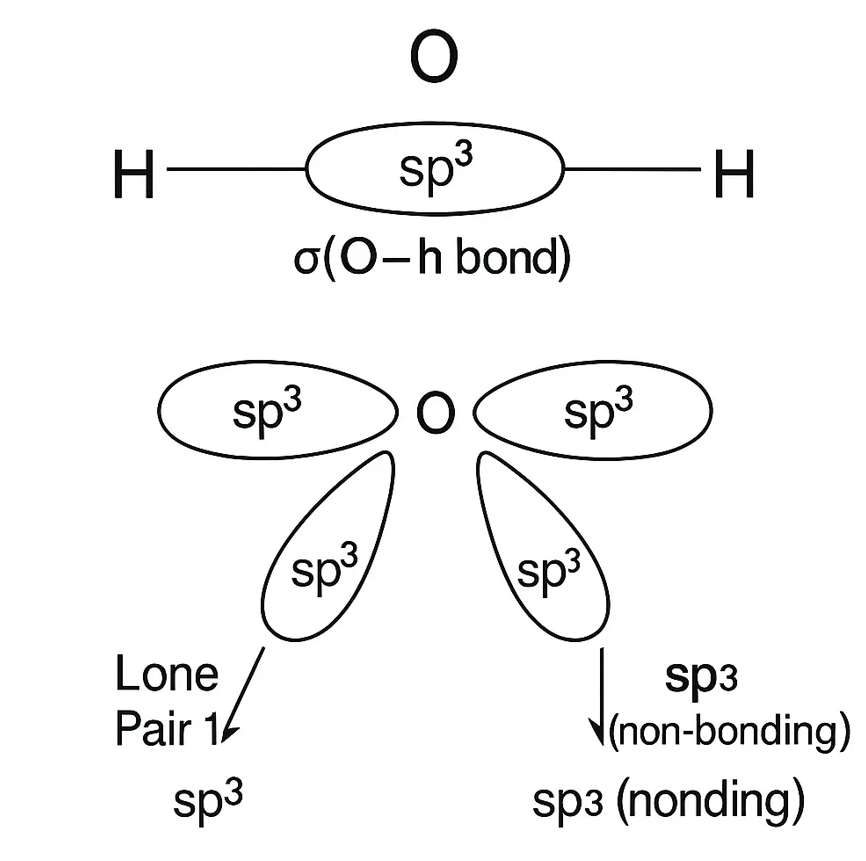
(a) Explain the shape of water molecule with the help of Molecular Orbital Theory, also draw its orbital diagram.
The water molecule (H₂O) is the most essential compound for life. Understanding its shape is important because the geometry of water is responsible for its unique physical and chemical properties, such as high boiling point, polarity, hydrogen bonding, and ability to act as a universal solvent. The shape of H₂O can be explained using Molecular Orbital Theory (MOT) along with Valence Shell Electron Pair Repulsion (VSEPR) concept.
Electronic Structure of Oxygen
- Atomic number of Oxygen = 8
- Electronic configuration: 1s² 2s² 2p⁴
- The outermost shell (2s² 2p⁴) has six valence electrons.
When oxygen bonds with two hydrogen atoms (each contributing 1 electron), it forms two sigma bonds, leaving two lone pairs on oxygen.
Orbital Hybridization and Shape
- Oxygen undergoes sp³ hybridization.
- Four sp³ hybrid orbitals are formed:
- Two occupied by lone pairs.
- Two used for sigma bonding with hydrogen 1s orbitals.
- This gives water a tetrahedral arrangement of orbitals, but because two positions are occupied by lone pairs, the molecular shape is bent or V-shaped.
Bond Angle
- Ideal tetrahedral angle: 109.5°.
- In H₂O, lone pair–lone pair repulsion is greater than bond pair–bond pair repulsion, reducing the angle to 104.5°.
Molecular Orbital Diagram
- Hydrogen’s 1s orbital overlaps with oxygen’s sp³ hybrid orbitals.
- Two sigma bonds are formed (O–H).
- Two orbitals remain filled with lone pairs.
- Diagram would show:
- Central oxygen with 4 sp³ orbitals.
- Two orbitals overlapping with H (1s).
- Two orbitals containing lone pairs.
Properties Due to Shape
- Water is polar, with partial negative charge near oxygen and partial positive charge near hydrogens.
- Leads to hydrogen bonding, high boiling point, and solvent properties.
Molecular Orbital Theory reveals that water has a bent structure with 104.5° bond angle due to sp³ hybridization and lone pair repulsions. This unique geometry explains why water is such an extraordinary molecule, essential for all forms of life.
(b) What are the gamma rays? Explain their applications.
Gamma Rays
Gamma rays are the highest-energy form of electromagnetic radiation. They have wavelengths less than 0.01 nanometers and frequencies above 10¹⁹ Hz. Unlike visible light or radio waves, gamma rays are highly penetrating and can pass through most materials, including the human body. They are produced during radioactive decay, nuclear reactions, and cosmic events.
Sources of Gamma Rays
- Radioactive Isotopes – e.g., Cobalt-60, Cesium-137.
- Nuclear Reactions – in reactors and bombs.
- Cosmic Phenomena – supernovae, black holes, pulsars.
- Medical Equipment – linear accelerators.
Properties of Gamma Rays
- No mass, no charge.
- Travel at the speed of light.
- Very high penetration power (blocked only by thick lead or concrete).
- Ionizing radiation – can damage living tissues and DNA.
Applications of Gamma Rays
- Medical Applications
- Cancer Treatment (Radiotherapy): Gamma rays kill cancerous cells by damaging DNA.
- Sterilization of Medical Equipment: Used to sterilize syringes, gloves, surgical instruments.
- Industrial Applications
- Non-Destructive Testing (NDT): Gamma rays detect structural flaws in metals, pipelines, and aircraft.
- Food Preservation: Gamma irradiation kills bacteria, parasites, and extends shelf life of food.
- Scientific Research
- Study of nuclear structure and high-energy physics.
- Space exploration: Gamma-ray telescopes observe cosmic phenomena.
- Agriculture
- Induce mutations in plants to produce disease-resistant varieties.
Hazards of Gamma Rays
- Exposure can cause radiation burns, cancer, and genetic mutations.
- Workers in nuclear plants and hospitals require protective shielding.
Gamma rays, though dangerous in uncontrolled doses, are among the most useful forms of electromagnetic radiation. From cancer treatment and food sterilization to industrial testing and space research, they are a powerful tool in science and technology. Strict safety protocols ensure their benefits outweigh their risks.
Question 9
(a) Discuss importance of preservatives and antioxidants in food.
Food is highly perishable and prone to spoilage due to microbial growth, oxidation, and environmental factors. To maintain food quality, safety, and shelf life, preservatives and antioxidants are widely used in the food industry. They not only prevent food wastage but also ensure that nutritional value and flavor are retained until consumption.
Preservatives
Definition
Preservatives are chemical or natural substances added to food to inhibit microbial growth, prevent spoilage, and extend shelf life.
Examples
- Sodium benzoate (soft drinks).
- Sorbic acid (bakery products).
- Sodium nitrite (processed meats).
- Salt and sugar (traditional preservatives).
Importance
- Prevent growth of bacteria, fungi, and molds.
- Reduce food wastage and economic loss.
- Maintain freshness, texture, and flavor.
- Enable global trade by keeping food stable during transport.
Antioxidants
Definition
Antioxidants are substances that prevent oxidation of food components, particularly fats and oils, thereby delaying rancidity and loss of nutritional quality.
Examples
- Vitamin C (ascorbic acid).
- Vitamin E (tocopherols).
- Butylated Hydroxyanisole (BHA).
- Butylated Hydroxytoluene (BHT).
Importance
- Prevent rancidity in oils, ghee, butter, and snacks.
- Preserve natural color and flavor of food.
- Protect vitamins and nutrients from oxidation.
- Improve shelf life and consumer safety.
Preservatives and antioxidants are indispensable in modern food technology. While natural preservatives like salt and lemon have been used for centuries, modern chemical preservatives have made global food distribution possible. When used within safe limits, they play a vital role in ensuring food security and preventing spoilage.
(b) Comment, Green House Effect is a blessing. Also discuss Enhanced Green House Effect and its relation with global warming.
Greenhouse Effect
The greenhouse effect is a natural process by which certain gases in the Earth’s atmosphere trap heat, maintaining Earth’s average temperature at around 15°C. Without this effect, the planet would be too cold (about -18°C) for life to exist. However, human activities have intensified this natural process, leading to enhanced greenhouse effect and global warming.
Greenhouse Effect as a Blessing
- Maintains Earth’s Temperature
- Keeps the planet warm enough for life.
- Supports Agriculture and Ecosystems
- Provides stable climatic conditions necessary for plant growth and biodiversity.
- Maintains Water Cycle
- Heat trapped ensures evaporation and precipitation cycles continue.
- Sustains Human Civilization
- Without greenhouse effect, Earth would resemble a frozen planet like Mars.
Enhanced Greenhouse Effect
Definition
The enhanced greenhouse effect occurs when human activities add excessive greenhouse gases to the atmosphere, trapping more heat than necessary.
Major Causes
- Burning of fossil fuels → Carbon dioxide (CO₂).
- Agriculture and livestock → Methane (CH₄).
- Fertilizers and industries → Nitrous oxide (N₂O).
- Refrigerants and aerosols → CFCs.
Consequences
- Global Warming
- Average global temperature rise by ~1.1°C since pre-industrial times.
- Melting of Polar Ice Caps
- Rising sea levels threaten coastal cities.
- Extreme Weather Events
- Heatwaves, droughts, cyclones, floods.
- Biodiversity Loss
- Coral bleaching, extinction of species.
- Human Health Impacts
- Spread of vector-borne diseases (malaria, dengue).
Relation with Global Warming
- The enhanced greenhouse effect directly contributes to global warming.
- The more greenhouse gases in the atmosphere, the more heat is trapped, leading to long-term climate change.
- It is responsible for the ongoing crises of rising sea levels, desertification, and unpredictable climate patterns.
The natural greenhouse effect is a blessing, as it makes life possible on Earth. However, the enhanced greenhouse effect, caused by human overexploitation of resources, has turned this blessing into a threat. Global cooperation, renewable energy adoption, afforestation, and climate-friendly policies are the only ways to restore balance.
Question 10
(a) Define and draw the following:
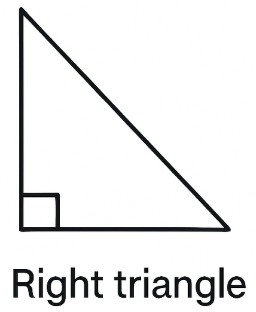
i. Rightangle triangles
Definition
A right-angle triangle is a triangle in which one of the angles is exactly 90°. The side opposite the right angle is called the hypotenuse, which is also the longest side of the triangle.
Properties
- One angle = 90°.
- Pythagoras theorem applies: a2+b2=c2.
- Used in trigonometry.
Diagram
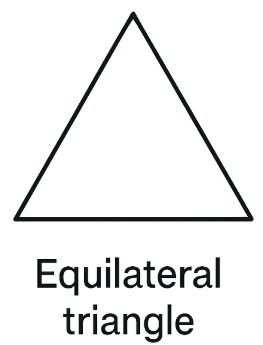
ii. Equilateral triangles
Definition
An equilateral triangle is a triangle in which all three sides are equal in length and all three angles are equal (each = 60°).
Properties
- All sides equal.
- All angles equal to 60°.
- Symmetrical in shape.
Diagram
(b) There are nine students in a group having ages 15, 15, 16, 16, 16, 17, 17, 18, 19. Calculate mean, medium, mode and range of their ages also define the above mentioned terms.
Given Data
Ages of nine students = 15, 15, 16, 16, 16, 17, 17, 18, 19
Definitions
- Mean (Average):
The sum of all observations divided by the total number of observations.
Mean=Sum of all ages/Number of students - Median:
The middle value when data is arranged in ascending order. If even number of terms, average of two middle values. - Mode:
The value that occurs most frequently in the dataset. - Range:
The difference between the largest and the smallest observation.
Step-by-Step Solution
- Mean
Sum of ages=15+15+16+16+16+17+17+18+19=149
Mean=149/9≈16.56
Answer: Mean age = 16.6 years (approx.) - Median
Number of students = 9 (odd).
Median = 5th value in ordered data.
Ordered data: 15, 15, 16, 16, 16, 17, 17, 18, 19
Answer: Median = 16 years - Mode
Frequency:
15 appears 2 times
16 appears 3 times
17 appears 2 times
18 appears 1 time
19 appears 1 time
Most frequent = 16
Answer: Mode = 16 years - Range
Range=Highest value−Lowest value=19−15=4
Answer: Range = 4 years
Final Results
- Mean = 16.6 years
- Median = 16 years
- Mode = 16 years
- Range = 4 years
The analysis of the students’ ages shows that the central tendency (mean, median, mode) revolves around 16 years, meaning most students in the group are around this age. The range of 4 years indicates relatively low variation, suggesting the group is age-homogeneous.
Question 11
(a) A distribution company provides households to departmental stores within a 50 kilometers radius. The table below shows how far each departmental store is from the godown of the distribution company.
| Distance from the godown of the distribution company | Number of Stores |
| 10 kilometers or less | 03 |
| 11 to 20 kilometers | 15 |
| 21 to 30 kilometers | 26 |
| 31 to 40 kilometers | 20 |
| 41 to 50 kilometers | 16 |
i. How many stores does the distribution company serve?
Add all frequencies:
3+15+26+20+16=80
Answer: The company serves 80 stores.
ii. What is the most common distance of stores from the company’s godown?
In grouped data, the “most common” is the modal class (the class with the highest frequency).
Highest frequency = 26 in the 21–30 km group.
Answer: 21–30 km is the most common distance (modal class).
(Concept): The mode for grouped data is reported as the class with the largest frequency unless you are asked to compute the exact modal value using the grouped-mode formula.
iii. How many stores are 35 Km or more from the godown?
All stores in 41–50 km qualify → 16 stores. In 31–40 km (20 stores), only those ≥35 km qualify (i.e., the subset 35–40 km within that class).
Because the data are grouped, the exact count within 31–40 can’t be known without raw data. A standard exam assumption is uniform distribution within a class. Under that:
- Class width (31–40) = 10 km.
- Segment ≥35 km is 35–40 (5 km) → half of the class width.
- Estimated stores ≥35 km within this class ≈ 20×510=10.
Total estimated stores ≥35 km ≈ 10 (from 31–40) + 16 (from 41–50) = 26.
Answer:
- Exactly can’t be determined from grouped data.
- Estimated (uniform assumption): ≈ 26 stores are 35 km or more from the godown.
(If your examiner expects a conservative count using only whole classes ≥35 km, you may write “at least 16” and note the limitation. The uniform estimate is commonly accepted in such questions).
iv. What percentage of stores are 31 Km or more from the godown?
Here, whole classes apply:
- 31–40 km: 20
- 41–50 km: 16
Total ≥31 km = 36.
Percentage: 3680×100=45%
Answer: 45% of stores are 31 km or more from the godown.
(b) Read the following carefully and answer the questions following:
Ahmad, Ali, Akbar, Nasir and Shehbaz are students of a college having different heights and weights. Ahmad weighs thrice as much as Ali and Ali weighs 5 times as much as Akbar. Akbar weighs half as much as Nasir and Nasir weighs half as much as Shehbaz.
Statement (Relationships)
- Ahmad weighs thrice as much as Ali → A=3 Ali.
- Ali weighs 5 times as much as Akbar → Ali=5 Akbar.
- Akbar weighs half as much as Nasir → Akbar=12 Nasir ⇒ Nasir=2 Akbar
- Nasir weighs half as much as Shehbaz → Nasir=1/2 Shehbaz ⇒ Shehbaz=2 Nasir.
Let Akbar = x (a positive unit). Then:
- Ali = 5x
- Ahmad = 3×5x=15x
- Nasir = 2x
- Shehbaz = 2×Nasir=4x
So, the five weights, in terms of x:
Ahmad=15x, Ali=5x, Shehbaz=4x, Nasir=2x, Akbar=x.
i. Who is the heaviest in weight?
Largest value is 15x → Ahmad.
Answer: Ahmad.
ii. Who is the is the lightest in weight?
Smallest value is x → Akbar.
Answer: Akbar.
iii. Shehbaz is lighter in weight than which of the two students?
Compare Shehbaz = 4x with others:
- Ahmad 15x > Shehbaz
- Ali 5x > Shehbaz
- Nasir 2x and Akbar x are lighter than Shehbaz.
Answer: Shehbaz is lighter than Ahmad and Ali.
iv. Shehbaz is heavier than which of the two students?
From the same comparison:
Answer: Shehbaz is heavier than Nasir and Akbar.
v. Show the descending order of weights of the students?
Answer: Ahmad > Ali > Shehbaz > Nasir > Akbar
(Tip for exams: picking a base variable like x and expressing all others in that unit makes such chain-ratio problems quick and error-free.)
Question 12
(a) Classification of blood groups is based on the presence or absence of inherited antigenic substances on the surface of red blood cells. In a survey of British population the blood group distribution among 1000 people was as follows: 300 had blood group A, 325 had blood group B, 250 had O and 125 AB. Out of this group a person was selected at random, calculate his probability of having blood group AB.
Solution
Data from Survey of 1000 people in Britain
| Blood Group | No. of People |
| A | 300 |
| B | 325 |
| O | 250 |
| AB | 125 |
| Total | 1000 |
Definition of Probability
Probability of an event:
P(E)=Number of favorable outcomes/Total number of outcomes
Applying Formula
Here, favorable outcome = Person with blood group AB = 125.
Total outcomes = 1000.
P(AB)=125/1000=0.125
Final Answer
The probability that a randomly chosen person has blood group AB = 0.125 or 12.5%. This means that in Britain, on average, about 1 in every 8 people has blood group AB.
(b) Five friends Ahmad, Ali, Akbar, Nasir and Shehbaz went on summer vacation to five cities namely V, W, X, Y and Z by five different modes of transport, that is by bus, train, aeroplane, car and boat from point A. Akbar went to Y by car and Ali went to X by air. Nasir travelled by boat whereas Shehbaz went by train. For X and W there is no bus service. The person who went to X did not use boat to travel. Now answer the following questions.
Given Information
- Akbar → City Y by Car.
- Ali → City X by Aeroplane.
- Nasir → by Boat (city not yet known).
- Shehbaz → by Train (city not yet known).
- Ahmad → unknown (to be found).
- Constraint 1: For cities X and W, there is no bus service.
- Constraint 2: The person who went to X did not use boat (already Ali → X by air, so satisfied).
Step 1: Fill Known Assignments
- Akbar → Y (Car)
- Ali → X (Aeroplane)
- Nasir → ? (Boat)
- Shehbaz → ? (Train)
- Ahmad → ? (to be deduced)
Remaining cities to be assigned = V, W, Z.
Remaining transports to be assigned = Bus, Train, Boat.
Step 2: Analyze Constraints
- Nasir already fixed with Boat.
- Shehbaz already fixed with Train.
- That leaves Bus for Ahmad.
So:
- Ahmad must have travelled by Bus.
Step 3: Which City for Ahmad?
Now look at city restrictions:
- X and W have no bus service.
- Ahmad is using Bus, so he cannot go to X (already taken) or W.
- Cities Y and X are already occupied (Akbar → Y, Ali → X).
- Remaining cities are V, W, Z.
- Since Ahmad cannot go to W (no bus service), he must have gone to Z.
So:
- Ahmad → Z (Bus).
i. How did Ahmad travel and where did he go?
Ahmad travelled by Bus and went to Z city.
ii. Which mode of transport was used by the person who travelled to X city?
Ali went to X, and his mode was Aeroplane.
Question 13
(a) Differentiate between primary and secondary mental abilities. How the general mental ability scales differ from IQ test.
Human intelligence is not a single entity but a combination of multiple abilities. Psychologists have classified these abilities into primary and secondary categories to study intelligence more scientifically. Similarly, different tools like general mental ability (GMA) scales and IQ tests are used to measure intelligence, but they differ in scope, depth, and application.
Primary Mental Abilities
- Defined by Louis Thurstone.
- Represent the basic, independent abilities that make up intelligence.
- They are relatively simple and foundational.
Major Primary Mental Abilities include:
- Verbal Comprehension – understanding words, vocabulary.
- Numerical Ability – handling numbers and arithmetic.
- Spatial Ability – visualizing shapes and objects.
- Memory – recalling information.
- Reasoning – solving problems logically.
- Perceptual Speed – quickly recognizing patterns or symbols.
Example: Solving a simple math sum or remembering a short list.
Secondary Mental Abilities
- These are broader combinations or clusters formed by grouping several primary abilities.
- More complex, covering higher-order cognitive skills.
- They often overlap and integrate several primary abilities.
Examples:
- Fluid Intelligence: Ability to reason and solve new problems (uses reasoning, perception, and memory together).
- Crystallized Intelligence: Accumulated knowledge and skills (uses verbal comprehension, memory, and reasoning).
Difference Between General Mental Ability Scales (GMA) and IQ Tests
| Aspect | General Mental Ability Scales | IQ Test |
| Scope | Broad measure of multiple abilities (reasoning, comprehension, memory, etc.) | Narrower, usually focuses on problem-solving and reasoning |
| Purpose | Predict academic achievement, job performance, and overall potential | Measures relative intelligence level of an individual |
| Measurement | Uses scales for verbal, numerical, logical, spatial tasks | Produces a single score called Intelligence Quotient (IQ) |
| Output | Gives profile across abilities (strengths and weaknesses) | Gives overall intelligence rank (average = 100) |
| Application | Education, aptitude testing, workforce selection | Clinical, educational, and psychological assessment |
Primary abilities are the building blocks of intelligence, while secondary abilities represent higher-level clusters. General mental ability scales are broader and multi-dimensional, whereas IQ tests provide a single quantitative measure. Both are important but serve different psychological and practical purposes.
(b) Y = mX + C is an equation of straight line. Draw a graph showing relationship between X and Y and relate the equation to the slope and intercept on the graph.
The equation Y=mX+C represents the general form of a straight line in coordinate geometry. It is used extensively in mathematics, physics, and economics to express linear relationships between two variables.
Explanation of Term
- X and Y: Variables (independent and dependent).
- m: Slope or gradient of the line.
- Measures the rate of change of Y with respect to X.
- Formula: m=ΔY/ΔX.
- C: Intercept.
- The point where the line cuts the Y-axis (when X = 0).
Graphical Representation
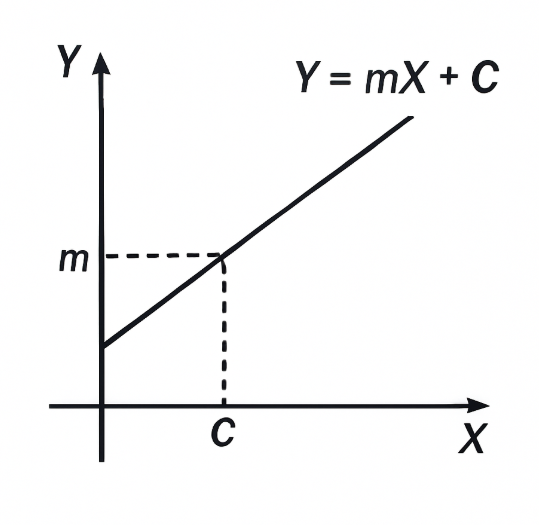
- Draw coordinate axes (X horizontal, Y vertical).
- Mark the intercept C on the Y-axis.
- From that point, draw a straight line with slope m.
- If m > 0, line rises upward (positive slope).
- If m < 0, line slopes downward (negative slope).
- Example: If Y=2X+1, slope = 2, intercept = 1. Line starts at (0,1) and rises steeply.
Relation of Equation to Slope and Intercept
- Slope (m):
- Indicates how much Y increases for each unit increase in X.
- Example: If m = 2, then for every 1 increase in X, Y increases by 2.
- Intercept (C):
- The starting value of Y when X = 0.
- Example: If C = 1, then line crosses Y-axis at point (0,1).
- General Form:
- The straight line is fully determined by slope and intercept.
- Changing slope tilts the line, changing intercept shifts it up/down.
Applications of Straight-Line Equation
- Economics: Demand and supply curves.
- Physics: Uniform motion (distance vs. time).
- Statistics: Regression line showing relationship between variables.
- Engineering: Calibration curves, stress-strain relations (linear region).
The equation Y=mX+C is fundamental in mathematics and sciences. The slope (m) defines the steepness or rate of change, while the intercept (C) gives the initial value of Y. Together, they describe a linear relationship that can be applied in diverse fields.
📘 Benefits of Practicing This Descriptive Paper
- ✅ These CSS Past Paper 2016 General Science and Ability Descriptive questions are compiled from authentic FPSC CSS past papers, following the real written exam format.
- 💬 Attempting this CSS Past Paper 2016 General Science and Ability Descriptive helps students master structured writing and analytical skills for CSS exams.
- 🧾 Every question in this CSS Past Paper 2016 General Science and Ability Descriptive strictly follows the official CSS exam syllabus approved by FPSC.
- 📊 Students preparing for CSS 2016 can rely on this CSS Past Paper 2016 General Science and Ability Descriptive to practice time management and topic selection.
- 🔍 The solved CSS Past Paper 2016 General Science and Ability Descriptive contains concise explanations to improve conceptual understanding and writing clarity.
- 🎯 Regular revision of this CSS Past Paper 2016 General Science and Ability Descriptive builds confidence and strengthens your preparation for the CSS written paper.
- 🏆 This CSS Past Paper 2016 General Science and Ability Descriptive is essential for mastering exam techniques and achieving success in the FPSC CSS examination.
🏁 Final Note
Keep revising these CSS Past Paper 2016 General Science and Ability Descriptive to strengthen your grip on important concepts and improve accuracy in upcoming CSS exams. Regular practice with these CSS Past Paper 2016 General Science and Ability Descriptive will help you score higher and build full command over the CSS exam syllabus.
📰 Check out other years’ past papers of General Science & Ability.
🔗 Check FPSC past papers directly from the official FPSC website.