CSS Past Paper 2017 General Science and Ability Descriptive (Part 2)
CSS | Past Paper | Compulsory | 2017 | Part 2 | Descriptive
Below is the solution to PART-II (COMPULSORY) of the CSS Past Paper 2017 General Science and Ability Descriptive (Part 2).
Question 2
(a) What are the factors responsible for environmental pollution?
Environmental pollution is one of the most serious challenges of the modern age. It refers to the introduction of harmful substances or energy into the natural environment, causing adverse changes in air, water, and soil quality. Pollution affects not only human health but also biodiversity, climate, and the overall balance of ecosystems. The problem is particularly severe in developing countries like Pakistan where industrial growth, rapid urbanization, and weak environmental laws have worsened the situation.
Factors Responsible
- Industrialization
- Factories release untreated smoke containing sulfur dioxide, nitrogen oxides, and carbon monoxide.
- Industrial effluents flow directly into rivers, making water unfit for drinking.
- Example: Tanneries in Kasur and Sialkot release chromium-laden waste into streams.
- Urbanization and Vehicular Emissions
- Increased population in cities leads to traffic congestion.
- Vehicles emit large quantities of carbon dioxide, nitrogen oxides, and particulate matter.
- Lahore’s smog in winters is a direct example of vehicular and industrial emissions.
- Agricultural Activities
- Use of chemical fertilizers and pesticides pollutes soil and water.
- Burning of agricultural residue increases air pollution.
- Runoff from farms enters canals and rivers, causing eutrophication.
- Deforestation
- Forests act as natural absorbers of carbon dioxide. Their destruction increases greenhouse gases.
- In Pakistan, forest cover is less than 5%, far below the global average of 25%.
- Soil erosion and loss of biodiversity result from deforestation.
- Waste Mismanagement
- Lack of proper waste collection systems leads to open dumping of garbage.
- Plastic bags choke sewerage systems and pollute oceans.
- Hospital and hazardous waste add toxic chemicals to the environment.
Environmental pollution is a multidimensional problem arising from unchecked human activities. Only strict enforcement of environmental laws, promotion of renewable energy, waste management, and awareness campaigns can reduce this menace.
(b) Briefly explain the main reasons of water-logging in Pakistan.
Waterlogging is a condition where the water table rises too close to the soil surface, saturating the land and making it unfit for agriculture. In Pakistan, waterlogging is a persistent problem in the Indus Basin, particularly in Sindh and southern Punjab, where millions of hectares of land are affected.
Causes of Waterlogging
- Excessive Canal Irrigation
- The Indus Basin Irrigation System is the largest in the world.
- Continuous supply of canal water without proper drainage raises the underground water table.
- Seepage from Unlined Canals
- Pakistan has thousands of kilometers of canals, many of which are unlined.
- Water seeps into the soil, raising groundwater levels.
- Flat Topography
- Sindh and lower Punjab are mostly flat plains.
- Lack of natural slope hinders water runoff, encouraging accumulation.
- Over-irrigation by Farmers
- Farmers, unaware of modern water-saving techniques, flood fields unnecessarily.
- Rice and sugarcane crops require huge amounts of water, adding to the problem.
- Construction of Barrages and Dams
- While essential for agriculture and electricity, these structures have changed natural river flows.
- As a result, drainage systems have been disrupted.
Consequences
- Reduced soil fertility due to lack of aeration.
- Salinity increases as water evaporates, leaving salts behind.
- Decline in crop yields, causing food insecurity.
Waterlogging in Pakistan is mainly man-made. Proper lining of canals, adoption of modern irrigation systems like drip irrigation, and development of drainage systems are necessary to combat this threat.
(c) What do you mean by Ozone depletion and how we can prevent its depletion?
The ozone layer, located in the stratosphere, is vital for life on Earth as it absorbs harmful ultraviolet (UV) radiation from the sun. Depletion of this protective shield exposes life to dangerous UV rays, leading to health and environmental hazards.
Causes of Ozone Depletion
- Chlorofluorocarbons (CFCs): Used in refrigerators, air conditioners, and aerosols.
- Halons: From fire extinguishers.
- Industrial gases: Nitrous oxides from industries and agriculture.
- Jet emissions: High-flying aircraft release ozone-depleting substances directly into the stratosphere.
Effects
- Skin cancers, cataracts, and suppressed immunity in humans.
- Reduced crop yields due to damage to plant tissues.
- Disturbance in marine ecosystems, especially plankton.
Prevention
- Implementation of the Montreal Protocol (1987), banning CFCs.
- Development of ozone-friendly technologies.
- Plantation campaigns to absorb pollutants.
- Awareness programs about eco-friendly products.
Ozone depletion is a global issue, but with international cooperation and strict enforcement of environmental agreements, the ozone layer can be restored, as recent satellite data show signs of healing.
(d) What is an Acid Rain and how it is produced. Briefly describe the dangers associated with it?
Acid Rain
Acid rain is precipitation with acidic components, mainly sulfuric acid (H₂SO₄) and nitric acid (HNO₃), formed when sulfur dioxide (SO₂) and nitrogen oxides (NOx) react with water vapor in the atmosphere.
Causes
- Emission of SO₂ from coal-based power plants.
- NOx emissions from vehicles and factories.
- Volcanic eruptions and natural processes also contribute.
Dangers
- Agriculture: Damages crops, reduces soil fertility by removing nutrients like calcium and magnesium.
- Aquatic Life: Acidifies lakes and rivers, killing fish and amphibians.
- Buildings and Monuments: Corrodes marble and limestone. The Taj Mahal in India is under threat from acid rain.
- Human Health: Causes respiratory diseases, skin irritation, and weakens immunity.
- Forests: Damages leaves and soil nutrients, leading to large-scale forest decline.
Acid rain is a silent environmental hazard with global consequences. Only reduction in fossil fuel use, promotion of renewable energy, and international cooperation can mitigate its effects.
Question 3
(a) Explain in detail the common causes of Heart Attack.
A heart attack, medically termed myocardial infarction, occurs when the blood flow to a portion of the heart muscle is blocked, depriving it of oxygen and nutrients. If not treated promptly, this can cause permanent damage or death. In Pakistan, heart disease is one of the leading causes of mortality, reflecting a mix of lifestyle changes, poor diet, and genetic predisposition.
Main Causes
- Atherosclerosis
- Deposition of cholesterol and fatty substances inside arteries forms plaques.
- These plaques narrow blood vessels, restricting blood supply.
- Hypertension (High Blood Pressure)
- Persistent high pressure damages artery walls.
- Increases workload on the heart, making it prone to failure.
- High Cholesterol Levels
- Low-density lipoproteins (LDL, “bad cholesterol”) accumulate in arteries.
- Leads to clot formation, a major trigger for heart attack.
- Obesity and Diabetes
- Obesity increases cholesterol and blood pressure.
- Diabetics are 2–3 times more likely to suffer from heart disease.
- Smoking and Alcohol
- Smoking damages arterial linings and lowers oxygen content in blood.
- Alcohol abuse raises blood pressure and weakens the heart.
- Sedentary Lifestyle and Stress
- Lack of exercise leads to weight gain and poor circulation.
- Stress triggers hormonal changes, increasing clot risks.
Heart attacks are largely preventable with lifestyle modifications. Balanced diet, regular exercise, avoiding smoking, and medical checkups reduce risks significantly.
(b) Differentiate between drug addiction and drug abuse.
Drugs are substances that alter body functions physically or psychologically. Their misuse has become a serious social and health problem worldwide. While drug abuse and drug addiction are often used interchangeably, they represent two different stages of dependency.
Drug Abuse
- Improper or excessive use of drugs for non-medical purposes.
- May be experimental, recreational, or occasional.
- Example: Using sleeping pills without doctor’s advice, occasional marijuana use.
- Effects: Short-term euphoria but long-term health decline and social issues.
Drug Addiction
- A chronic, relapsing disorder characterized by compulsive drug-seeking behavior.
- Body becomes physically and psychologically dependent on the drug.
- Severe withdrawal symptoms occur when drug use stops.
- Example: Heroin, cocaine, methamphetamine dependence.
Key Differences
| Aspect | Drug Abuse | Drug Addiction |
| Nature | Improper/occasional use | Compulsive, chronic dependency |
| Control | User may still control use | User loses self-control |
| Impact | Temporary damage, social stigma | Severe physical, mental, and social breakdown |
| Example | Recreational smoking | Heroin dependence |
Drug abuse can be seen as the first step toward drug addiction. Proper awareness, rehabilitation programs, and counseling are essential to stop abuse before it develops into addiction.
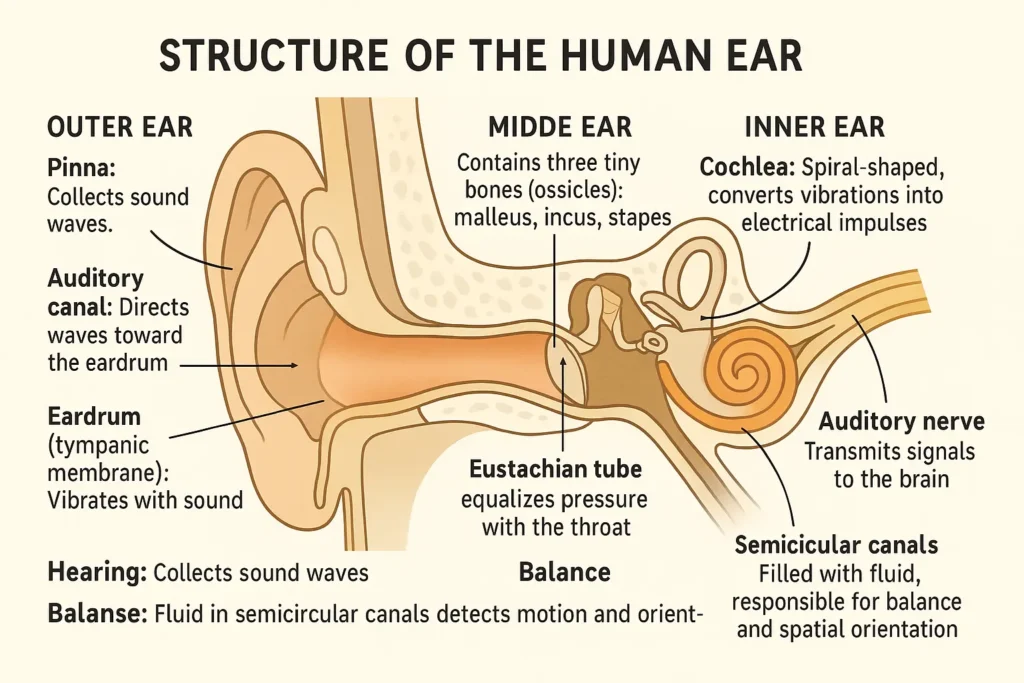
(c) Draw the structure of human ear and briefly explain its functions.
The ear is one of the most complex sensory organs of the human body. It performs two crucial functions: hearing and balance. Its design ensures that sound waves are converted into electrical signals that the brain can interpret.
Structure
- Outer Ear
- Pinna: Collects sound waves.
- Auditory canal: Directs waves toward the eardrum.
- Eardrum (tympanic membrane): Vibrates with sound.
- Middle Ear
- Contains three tiny bones (ossicles): malleus, incus, stapes.
- Function: Amplify sound vibrations.
- Eustachian tube equalizes pressure with the throat.
- Inner Ear
- Cochlea: Spiral-shaped, converts vibrations into electrical impulses.
- Semicircular canals: Filled with fluid, responsible for balance and spatial orientation.
- Auditory nerve: Transmits signals to the brain.
Functions
- Hearing: Conversion of sound waves → mechanical vibrations → electrical impulses → brain perception.
- Balance: Fluid in semicircular canals detects motion and orientation.
The ear is a delicate organ, and damage from loud noises, infections, or trauma can cause hearing loss. Protecting it is essential for communication and quality of life.
(d) What is the significance of Vitamins? Describe the sources, uses and deficiency symptoms of fat soluble vitamins.
Vitamins are essential organic compounds needed in small amounts for growth, immunity, and metabolism. Fat-soluble vitamins (A, D, E, and K) dissolve in fats and are stored in the liver and fatty tissues, unlike water-soluble vitamins which must be taken daily.
Vitamin A
- Sources: Carrots, spinach, fish liver oil, milk.
- Uses: Maintains healthy vision, immune system.
- Deficiency: Night blindness, dry eyes, weak immunity.
Vitamin D
- Sources: Sunlight, egg yolk, fish oil.
- Uses: Absorption of calcium and phosphorus, bone development.
- Deficiency: Rickets in children, osteomalacia in adults.
Vitamin E
- Sources: Nuts, seeds, vegetable oils.
- Uses: Acts as an antioxidant, protects cell membranes, maintains skin health.
- Deficiency: Infertility, muscular weakness, neurological problems.
Vitamin K
- Sources: Green leafy vegetables, cabbage, broccoli.
- Uses: Essential for blood clotting.
- Deficiency: Prolonged bleeding, hemorrhage.
Fat-soluble vitamins are vital for maintaining body functions. A balanced diet ensures proper intake, while deficiencies can lead to serious health issues. Supplementation should be considered only under medical advice.
Question 4
(a) What is a mirage? Describe in detail the creation of mirage.
Mirage
A mirage is an optical illusion that occurs in deserts or hot roads during summer. It is not the presence of real water but a trick of light caused by the refraction of sun rays in layers of hot and cool air. Travelers often see what looks like water shimmering in the distance, but when they approach, it disappears.
Scientific Explanation
- Light travels faster in hot, less dense air and slower in cool, denser air.
- When the ground is heated intensely by the sun, the air just above it becomes much hotter than the air above.
- Light rays coming from the sky bend (refract) when passing through these layers.
- At a certain angle, the rays undergo total internal reflection and bend upwards to the eyes of the observer.
- The brain interprets this bent light as if it is coming from the ground, creating an illusion of water.
Types of Mirages
- Inferior Mirage: The common desert mirage where water-like images appear below the horizon.
- Superior Mirage: Occurs in polar regions or cold seas where objects appear elevated or inverted.
Examples
- Shimmering water patches on highways in summer.
- Desert travelers chasing false water illusions.
A mirage demonstrates the laws of refraction and the effect of temperature gradients on light. It is a natural phenomenon but has misled travelers for centuries.
(b) Differentiate between the occurrence of Lunar and Solar Eclipse?
Eclipses are fascinating celestial events resulting from the alignment of the Sun, Earth, and Moon. They are broadly of two types: lunar and solar eclipses.
Lunar Eclipse
- Occurs when the Earth comes between the Sun and the Moon.
- The Earth’s shadow falls on the Moon, making it appear darkened or reddish.
- Happens only during full moon.
- Types: Total, Partial, and Penumbral lunar eclipses.
- Safe to view with naked eye.
Solar Eclipse
- Occurs when the Moon comes between the Sun and Earth.
- The Moon’s shadow blocks sunlight from reaching Earth.
- Happens only during new moon.
- Types: Total, Partial, and Annular solar eclipses.
- Requires protective glasses for viewing to prevent eye damage.
Key Differences
| Aspect | Lunar Eclipse | Solar Eclipse |
| Occurrence | Full moon | New moon |
| Position | Sun–Earth–Moon | Sun–Moon–Earth |
| Duration | Several hours | Few minutes |
| Safety | Can be viewed directly | Not safe without protection |
Eclipses are not signs of bad luck, as old myths suggest, but natural astronomical events. They help scientists study the motion of celestial bodies and the dynamics of our solar system.
(c) Briefly explain what effects are produced due to Rotation & Revolution of Earth?
The Earth is constantly in motion. It rotates on its axis once every 24 hours and revolves around the Sun once every 365¼ days. These motions have profound effects on time, climate, and life on Earth.
Effects of Rotation (24 hours)
- Day and Night: Rotation causes alternate light and darkness.
- Coriolis Effect: Influences wind and ocean currents, making them deflect right in the northern hemisphere and left in the southern.
- Time Zones: The Earth is divided into 24 time zones based on its rotation.
- Apparent Motion of Celestial Bodies: Sun and stars appear to rise in the east and set in the west.
Effects of Revolution (365 days)
- Seasons: Tilt of Earth’s axis (23.5°) combined with revolution causes summer, winter, spring, and autumn.
- Variation in Day Length: Longer days in summer, shorter in winter.
- Equinoxes and Solstices: Mark the start of seasons and important astronomical dates.
- 21 June: Longest day in Northern Hemisphere (Summer Solstice).
- 21 December: Shortest day (Winter Solstice).
The Earth’s rotation and revolution are fundamental to the existence of life. They create rhythmic cycles of day and night, regulate climate, and govern agricultural patterns.
(d) Most of the household appliances utilize ‘DC’ then why we generate ‘AC’ at power stations?
Electricity is generated in two forms: Alternating Current (AC) and Direct Current (DC). Power stations almost universally generate AC because of its technical and economic advantages.
Reasons for Using AC
- Transmission Efficiency: AC can be transmitted over long distances with minimal energy loss.
- Use of Transformers: Voltage can be easily increased or decreased using transformers. High-voltage AC reduces energy loss during transmission.
- Cost-Effectiveness: AC systems require simpler and cheaper equipment compared to DC.
- Flexibility: AC can power both small household appliances and large industrial machines.
- Historical Development: Nikola Tesla’s AC system proved more practical for large-scale power supply than Edison’s DC system.
Limitations of DC in Power Stations
- DC cannot be stepped up or down easily.
- Transmission over long distances is highly inefficient and costly.
AC is the backbone of modern electricity supply because of its efficiency, cost advantages, and adaptability. While DC has limited use in electronics and batteries, AC remains the practical choice for large-scale power generation.
Question 5
(a) Differentiate between RAM and ROM.
Memory is the backbone of a computer system. Without memory, a computer cannot store data or instructions for processing. Two fundamental types of memory are RAM (Random Access Memory) and ROM (Read-Only Memory). Though both are essential, they differ in structure, function, and usage.
RAM (Random Access Memory)
- Definition: Temporary, volatile memory that stores data and instructions while the computer is running.
- Function: Provides workspace for CPU to process information.
- Characteristics:
- Volatile: Data lost when power is turned off.
- Read-write memory: Both reading and writing allowed.
- Speed: Very fast, improves system performance.
- Types:
- DRAM (Dynamic RAM): Slower, cheaper.
- SRAM (Static RAM): Faster, used in cache.
- Example: Opening multiple tabs in a browser uses RAM.
ROM (Read-Only Memory)
- Definition: Permanent, non-volatile memory that stores critical instructions for booting and hardware communication.
- Function: Provides essential startup instructions.
- Characteristics:
- Non-volatile: Data remains even after shutdown.
- Data is written once by manufacturer.
- Cannot be modified easily.
- Types:
- PROM, EPROM, EEPROM.
- Example: BIOS (Basic Input Output System) stored in ROM.
Comparison Table
| Aspect | RAM | ROM |
| Volatility | Volatile | Non-volatile |
| Function | Temporary workspace | Permanent instructions |
| Access | Read/Write | Mostly Read-only |
| Example | Running software | Boot program |
RAM is like the working desk of a student, while ROM is like the notebook of permanent instructions. Both complement each other and are vital for a functional computer.
(b) Name three basic buses employed in a computer and explain what each is used for.
In a computer system, different components (CPU, memory, input/output devices) need to communicate. This communication is carried out through buses, which are sets of parallel wires or channels that transfer data, instructions, and control signals.
Types of Buses
- Data Bus
- Transfers actual data between CPU, memory, and peripherals.
- Bidirectional: Can send and receive.
- Width (e.g., 32-bit, 64-bit) determines the amount of data transferred at once.
- Example: Reading a file from hard disk uses data bus.
- Address Bus
- Carries memory addresses of data or instructions.
- Unidirectional: From CPU to memory.
- Width determines maximum addressable memory (e.g., 32-bit bus can access 4 GB).
- Example: CPU specifies memory location of a variable using address bus.
- Control Bus
- Transfers control signals to coordinate activities.
- Examples: Read, write, clock, interrupt signals.
- Ensures CPU knows whether it is reading data or writing.
Together, data, address, and control buses act like the nervous system of a computer, coordinating movement of information efficiently.
(c) Draw a basic computer block diagram and briefly explain the function of each part.
A computer is a digital electronic machine designed to perform calculations and process information. Its functioning can be understood using a block diagram, which shows the relationship between input, processing, memory, and output units.
Components of Block Diagram
- Input Unit
- Devices like keyboard, mouse, scanner.
- Function: Convert human-readable information into machine-readable form.
- Central Processing Unit (CPU)
- Arithmetic Logic Unit (ALU): Performs mathematical and logical operations.
- Control Unit (CU): Directs data flow between units.
- Registers: Small storage units for immediate data.
- Memory Unit
- Primary memory: RAM and ROM.
- Secondary memory: Hard disk, SSD.
- Stores instructions and data.
- Output Unit
- Devices like monitor, printer, speakers.
- Converts machine results into human-readable form.
Diagram
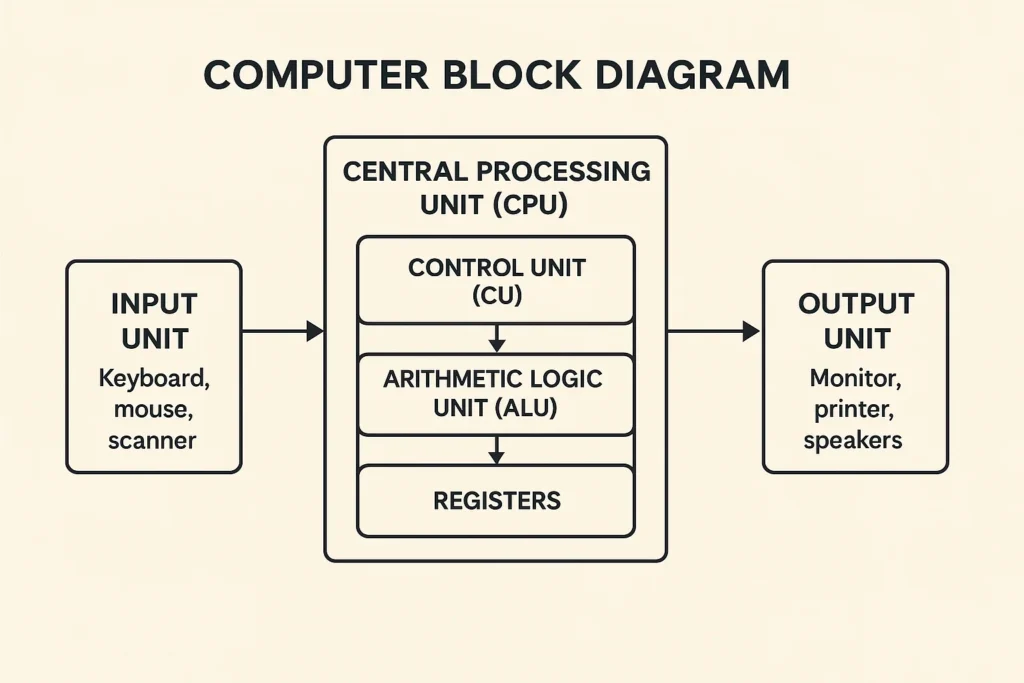
The block diagram shows the simple cycle of input–process–output. This architecture is universal across all modern computers, from supercomputers to smartphones.
(d) Describe various types of computers classified on the basis of size, memory, capacity and speed.
Computers are categorized based on their size, speed, processing capacity, and applications. With technological advancement, different types of computers serve various domains, from scientific research to personal use.
Types
- Supercomputers
- Most powerful, capable of trillions of calculations per second.
- Used in weather forecasting, nuclear research, and artificial intelligence.
- Example: Fugaku (Japan), Summit (USA).
- Mainframe Computers
- Very large, handle thousands of users simultaneously.
- Used in banks, insurance companies, and government organizations.
- Example: IBM Z series.
- Minicomputers
- Smaller than mainframes but larger than personal computers.
- Used in medium-sized businesses.
- Now mostly replaced by servers.
- Microcomputers
- Personal computers, laptops, and desktops.
- Most common, affordable, and versatile.
- Used for education, business, and entertainment.
From supercomputers to microcomputers, the classification reflects the diversity of computing power. Each type has its unique role in modern society, making computers indispensable to human progress.
Question 6
(a) Differentiate with examples between a “Pictogram” and “Histogram”.
Graphs and charts are powerful tools to present data in a simplified, visual manner. Among them, pictograms and histograms are widely used in statistics and research. Although both deal with representation of numerical data, they differ in design, purpose, and level of detail.
Pictogram
- A pictogram uses pictures or symbols to represent numbers.
- Each symbol corresponds to a certain frequency or value.
- Very useful for presenting information to a general audience with little statistical background.
- Example: To show fruits sold in a market, each picture of an apple may represent 10 apples.
Advantages of Pictogram
- Attractive and easy to understand.
- Ideal for young learners or non-specialists.
- Good for comparisons at a glance.
Limitations of Pictogram
- Not suitable for large or complex data.
- Accuracy can be lost if symbols are not scaled properly.
Histogram
- A histogram is a bar graph representing the frequency distribution of continuous variables.
- Data is divided into class intervals, and each bar represents the frequency of that interval.
- Example: Distribution of students’ marks in a class (0–10, 11–20, etc.).
Advantages of Histogram
- Provides clear picture of data distribution.
- Useful in detecting patterns like normal distribution, skewness.
- Helps in statistical analysis.
Limitations of Histogram
- Requires continuous quantitative data.
- Interpretation needs statistical understanding.
Key Differences
| Aspect | Pictogram | Histogram |
| Data type | Simple, categorical | Continuous, numerical |
| Representation | Pictures/symbols | Bars |
| Audience | General/public | Statisticians, researchers |
| Accuracy | Less precise | Highly accurate |
While pictograms are simple and appealing, histograms provide deep insights into statistical data. Both serve different audiences and purposes but are essential tools of data visualization.
(b) The teachers of a certain school were asked to indicate the average number of hours they spend on marking students assignments each day. The following set of data was obtained:
| 6 | 4 | 3 | 1 | 2 | 2 | 3 | 1 | 4 |
| 1 | 2 | 5 | 3 | 4 | 5 | 2 | 2 | 3 |
| 3 | 1 | 2 | 2 | 3 | 1 | 4 | 2 |
Construct a frequency table and draw a Histogram illustrating the results.
Statistical data becomes meaningful only when organized systematically. A frequency table arranges raw data into intervals with corresponding frequencies. A histogram further visualizes this frequency distribution using bars.
Step 1: Frequency Table
The table shows how many teachers spend 1 hour, 2 hours, etc., on marking.
| Hours (per day) | Frequency |
| 1 hour | 5 |
| 2 hours | 8 |
| 3 hours | 6 |
| 4 hours | 4 |
| 5 hours | 2 |
| 6 hours | 1 |
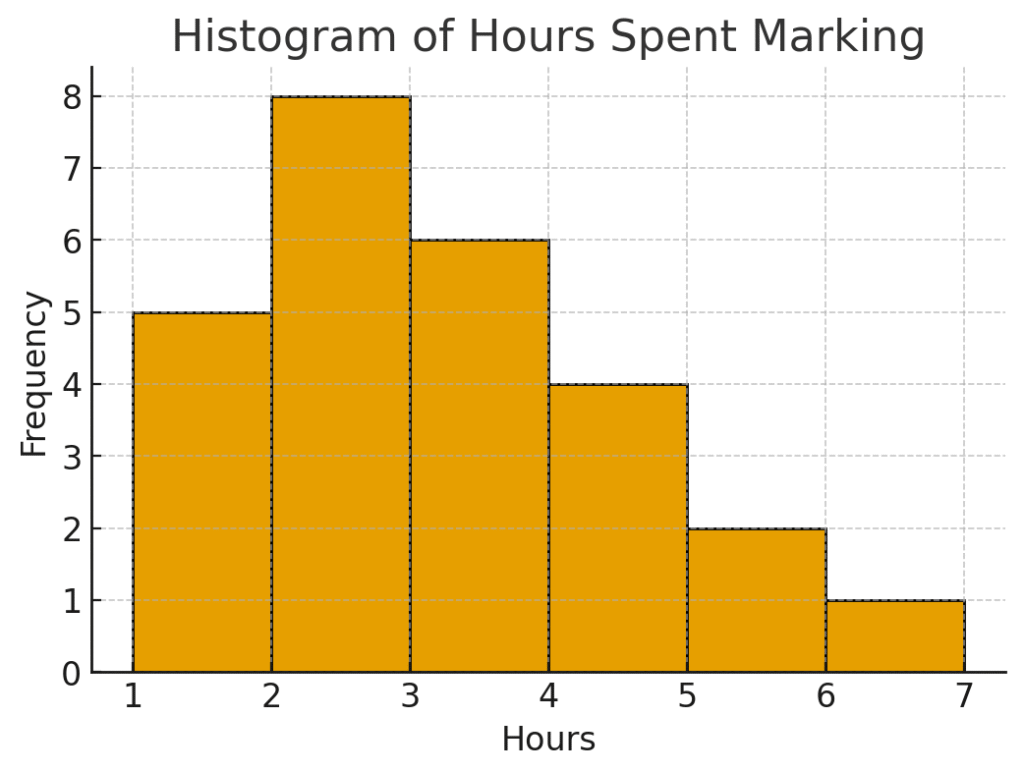
Step 2: Histogram
- X-axis: Number of hours (1–6).
- Y-axis: Frequency (0–8).
- Draw bars for each interval: height equals frequency.
- At 2 hours, the tallest bar appears with a frequency of 8.
- The bar for 3 hours is the second tallest with frequency 6.
Interpretation
- Most teachers spend 2 hours per day, which has the highest frequency (8 teachers).
- The second most common is 3 hours, with a frequency of 6 teachers.
- Only one teacher spends 6 hours, making it the least common workload.
- The distribution is clustered around 2–3 hours, indicating that the typical marking workload falls in this range.
The frequency table organizes data neatly, while the histogram shows the workload pattern visually. Together, they make the data easy to understand.
(c) How many teachers responded to the survey?
Calculation
Add all the frequencies from the frequency table:
| Hours | Frequency |
|---|---|
| 1 | 5 |
| 2 | 8 |
| 3 | 6 |
| 4 | 4 |
| 5 | 2 |
| 6 | 1 |
Now sum them:
5 + 8 + 6 + 4 + 2 + 1 = 26
So, a total of 26 teachers participated in the survey.
Explanation
This calculation confirms the number of teachers who responded. Summing frequencies ensures that the dataset is complete and helps maintain accuracy and reliability in statistical analysis. It also verifies that the histogram and frequency table represent all respondents.
A total of 26 teachers provided responses, and this sample forms the basis for the data analysis.
(d) What the longest number of hours and most common number of hours are spent?
Longest Hours
- From the frequency table, the maximum number of hours spent is 6 hours.
- Only 1 teacher spent this much time, representing the upper extreme of marking workload.
Most Common Hours
- The highest frequency is 8 teachers, and this occurs at 2 hours.
- The next most common is 3 hours, with 6 teachers.
- Therefore, 2 hours is the modal value, and 3 hours is the second-highest category.
Interpretation
Most teachers spend 2 to 3 hours marking assignments each day. This indicates that the typical marking workload is moderate. Very few teachers fall at the extremes—especially the one teacher who spends 6 hours, representing an outlier.
Teachers’ marking habits are largely concentrated around 2–3 hours, with only a few spending unusually high amounts of time, such as the 6-hour outlier.
Question 7
(a) A man buys 5kg of meat at Rs.500 per kg. In addition, for every kilogram of meat purchased, he has to pay a consumption tax of 6% on the selling price. Calculate the total amount of money that he has to pay.
Solution
A butcher buys 5 kg of meat at Rs. 500 per kg. A sales tax of 6% is charged on the purchase. Find the total amount payable.
Step 1 – Compute Basic Cost (Without Tax)
Basic Cost=(quantity in kg)×(rate per kg)=5×500=Rs. 2500
Step 2 – Compute Sales Tax (6% of Basic Cost):
Sales Tax=0.06×2500=Rs. 150
Step 3 – Add Tax to Basic Cost
Total Payable=2500+150=Rs. 2650
Check (Percent Sense-Check)
6% of 2500 is a little over 1/20 of 2500 (which is 125), so 150 is reasonable.
Answer: Rs. 2650.
(b) It takes Ali 30 minutes to mark a paper. Aslam only needs 25 minutes to mark a paper. If they both start marking papers at 10:00 AM, at what time they will finish marking at the same time?
Solution
Ali and Aslam start marking papers together at 10:00 a.m. Ali marks 1 paper in 30 minutes (i.e., 2 per hour). Aslam marks 1 paper in 25 minutes (i.e., 2.4 per hour). After how long will they both complete an integer number of papers simultaneously (i.e., finish together)? What time will that be?
This is a synchronization problem: we want a time TTT such that each person’s completed papers is an integer.
LCM of Times per Paper
- Ali’s time per paper = 30 min.
- Aslam’s time per paper = 25 min.
We need the least time that is a whole multiple of both 30 and 25 minutes. - LCM(30,25): 30=2×3×5,25=52⇒LCM=2×3×52=150 min
So, after 150 minutes, both will finish at exact paper boundaries.
Convert 150 Minutes to Hours
150 min=2 h 30 min
Start Time to Finish Time
10:00 a.m.+2:30=12:30 p.m.
Verification (Integer Counts)
- Ali in 150 min: 150/30=5150/30 = 5150/30=5 papers (integer).
- Aslam in 150 min: 150/25=6150/25 = 6150/25=6 papers (integer).
Answer: They finish together after 150 minutes = 2 h 30 min, i.e., at 12:30 p.m.
(c) Two bus tickets from Rawalpindi to Islamabad and three tickets from Rawalpindi to Murree cost Rs.770 but three tickets from Rawalpindi to Islamabad and two tickets from Rawalpindi to Murree cost Rs.730. What are the fares for cities Islamabad and Murree from Rawalpindi?
Solution
A person bought 2 tickets to Islamabad and 3 tickets to Murree for Rs. 770. Another person bought 3 tickets to Islamabad and 2 tickets to Murree for Rs. 730. Find the fare to Islamabad and the fare to Murree.
Let:
- x = fare to Islamabad (in rupees)
- y = fare to Murree (in rupees)
Translate the Statements into Simultaneous Equations
- 2x+3y=770
- 3x+2y=730
Solve by Elimination
Multiply (1) by 3 and (2) by 2 to align the x-coefficients:
- (1)×3: 6x+9y=2310
- (2)×2: 6x+4y=1460
Subtract the second from the first:
(6x+9y)−(6x+4y)=2310−1460⇒5y=850⇒y=170
Substitute y=170 into (1):
2x+3(170)=770⇒2x+510=770⇒2x=260⇒x=130
Answer:
x=Rs. 130 (Islamabad), y=Rs. 170 (Murree)
Check:
- 2(130)+3(170)=260+510=770
- 3(130)+2(170)=390+340=730
(d) A told B that C is his father’s nephew. D is A’s cousin but not the brother of C. What relationship is there between D and C?
Solution
“C is the father’s nephew of A”.
“D is A’s cousin but D is not C’s brother”.
What is the relation between D and C?
First Sentence
- “Father’s nephew of A” means C is a nephew of A’s father → C is the son of A’s father’s sibling.
- That is exactly the definition of A’s cousin. So, C is A’s cousin (from A’s father’s side).
Second Sentence
- “D is A’s cousin but not C’s brother”.
- So D is also A’s cousin, but from the other side (very likely maternal cousin), or a cousin from another paternal sibling not sharing the same parents as C.
Conclusion
- C and D are cousins (to A), but D is not C’s brother.
- The relation between D and C is therefore cousins (they’re both A’s cousins, and may also be cousins to each other depending on family tree; the safe exam conclusion is: they are cousins).
D and C are cousins.
Question 8
(a) Divide Rs.500 between Arham, Mariam and Sarim so that Arham gets 2/3 of what Mariam gets and Mariam gets 1/4 of what Sarim gets. Find the share of each.
Solution
Rs. 500 is to be divided among Mariam, Arham, Sarim such that Arham gets 2/3 of Mariam’s amount, and Sarim gets 4 times Mariam’s amount. Find each share.
Let Mariam’s share = x. Then:
- Arham’s share = (2/3)x
- Sarim’s share = 4x
Total Condition
x+(2/3)x+4x=500
⇒(1+2/3+4)x=(17/3)x=500
x=500×3/17=1500/17≈88.2353
So:
- Mariam =x=1500/17≈Rs. 88.24
- Arham =(2/3)x=1000/17≈Rs. 58.82
- Sarim =4x=6000/17≈Rs. 352.94
Check (sum): 88.24+58.82+352.94≈500
Answer:
| Person | Exact Amount | Approx. Amount |
| Mariam | 1500/17 | Rs. 88.24 |
| Arham | 1000/17 | Rs. 58.82 |
| Sarim | 6000/17 | Rs. 352.94 |
Check: 88.24 + 58.82 + 352.94 = 500
(b) A school has enough provision of food for 52 days. After 20 days a group of 400 students arrives and the food would have last for 24 days only. How many students are there in the school actually?
Solution
Food was sufficient for 52 days for a school of S students. After 20 days, 400 new students joined. The remaining food lasted 24 more days. Find S (original number of students).
Key Idea
Total food is measured in student-days.
- Initial total food: 52S student-days.
- Consumed in first 20 days: 20S student-days.
- Remaining food after 20 days: 52S−20S=32S student-days.
- After 20th day, population = S+400 students.
This remainder lasted 24 days, so:
32SS+400=24
⇒ 32S=24(S+400)
⇒ 32S=24S+9600
⇒ 8S=9600
⇒ S=1200
Answer: The original number of students was 1200.
Sense-Check
- Total food =52×1200=62,400 student-days.
- First 20 days consumption =20×1200=24,000.
- Remainder =38,400.
- With 1200+400=1600 students, 38,400/1600=24 days
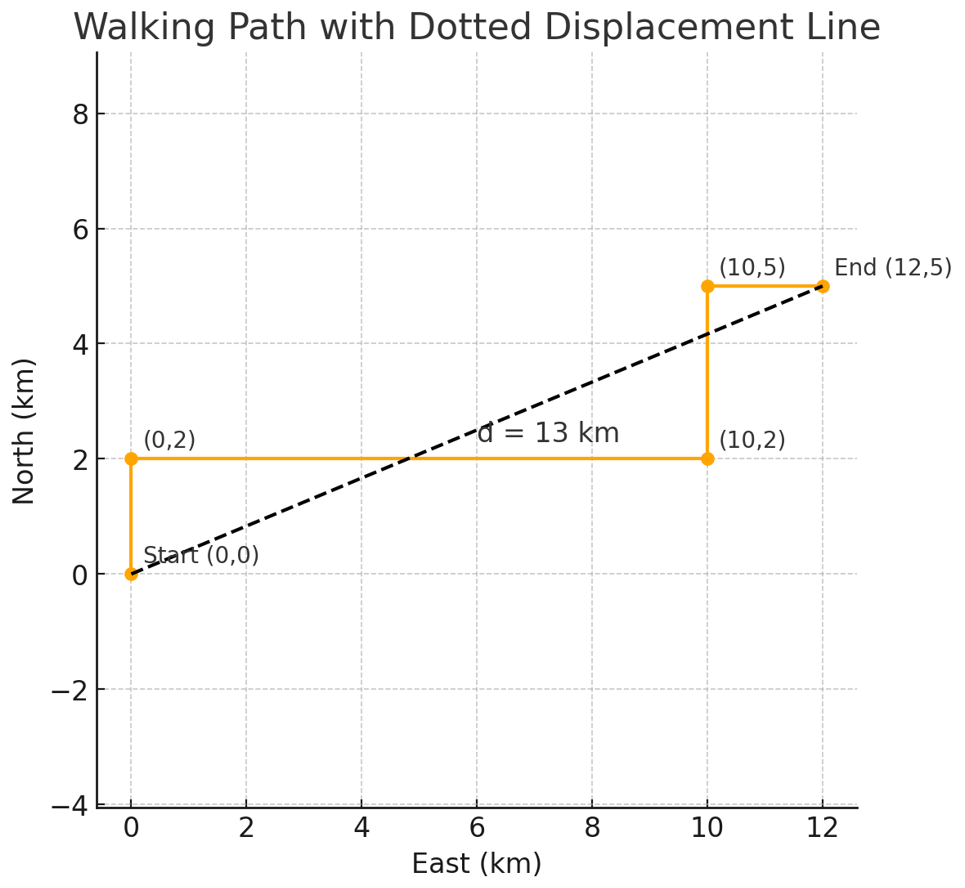
(c) A man walks 2km towards North. Then he turns to East and walks 10km. After this he turns to North and walks 3km. Again he turns towards East and walks 2km. How far is he from the starting point?
Solution
A person walks 2 km North, then 10 km East, then 3 km North, then 2 km East. Find the shortest distance from start to finish.
Break the Path into Net Components
- North: 2+3=52 + 3 = 52+3=5 km
- East: 10+2=1210 + 2 = 1210+2=12 km
So, displacement is a right-triangle with legs 5 (N) and 12 (E):
Distance=52+122=25+144=169=13 km
Answer: 13 km (straight-line distance).
Graph of Walking Path with Displacemnt Line
(d) In a certain code language COMPUTER is written as RFUVQNPC. How will MEDICINE be written in that code language?
Solution
First observe the pattern:
R → R (same)
E → F (+1)
T → U (+1)
U → V (+1)
P → Q (+1)
M → N (+1)
O → P (+1)
C → C (same)
Pattern:
Step 1: Reverse the original word.
Step 2: Keep the 1st and last letters (in the reversed word) unchanged.
Step 3: For all middle letters, shift one step forward in the alphabet (+1).
Apply same rule to MEDICINE:
Write MEDICINE and reverse it:
MEDICINE → ENICIDEM
Now encode each letter of ENICIDEM:
| Letter | Pos | Rule | Result |
|---|---|---|---|
| E | 1 | First letter → same | E |
| N | 2 | Middle letter → +1 | O |
| I | 3 | Middle letter → +1 | J |
| C | 4 | Middle letter → +1 | D |
| I | 5 | Middle letter → +1 | J |
| D | 6 | Middle letter → +1 | E |
| E | 7 | Middle letter → +1 | F |
| M | 8 | Last letter → same | M |
So ENICIDEM becomes EOJDJEFM.
Answer: EOJDJEFM
📘 Benefits of Practicing This Descriptive Paper
- ✅ These CSS Past Paper 2017 General Science and Ability Descriptive questions are compiled from authentic FPSC CSS past papers, following the real written exam format.
- 💬 Attempting this CSS Past Paper 2017 General Science and Ability Descriptive helps students master structured writing and analytical skills for CSS exams.
- 🧾 Every question in this CSS Past Paper 2017 General Science and Ability Descriptive strictly follows the official CSS exam syllabus approved by FPSC.
- 📊 Students preparing for CSS 2017 can rely on this CSS Past Paper 2017 General Science and Ability Descriptive to practice time management and topic selection.
- 🔍 The solved CSS Past Paper 2017 General Science and Ability Descriptive contains concise explanations to improve conceptual understanding and writing clarity.
- 🎯 Regular revision of this CSS Past Paper 2017 General Science and Ability Descriptive builds confidence and strengthens your preparation for the CSS written paper.
- 🏆 This CSS Past Paper 2017 General Science and Ability Descriptive is essential for mastering exam techniques and achieving success in the FPSC CSS examination.
🏁 Final Note
Keep revising these CSS Past Paper 2017 General Science and Ability Descriptive to strengthen your grip on important concepts and improve accuracy in upcoming CSS exams. Regular practice with these CSS Past Paper 2017 General Science and Ability Descriptive will help you score higher and build full command over the CSS exam syllabus.
📰 Check out other years’ past papers of General Science & Ability.
🔗 Check FPSC past papers directly from the official FPSC website.