
CSS Past Paper 2018 General Science and Ability Descriptive (Part 2)

CSS | Past Paper | Compulsory | 2018 | Part 2 | Descriptive
Below is the solution to PART-II (COMPULSORY) of the CSS Past Paper 2018 General Science and Ability Descriptive (Part 2).
Question 2
(a) Describe different methods to estimate the age of the Universe.
Several scientific methods are employed to estimate the age of the Universe, with the two most prominent and reliable being:
- The Age of the Oldest Stars (Stellar Dating): This method involves determining the age of the oldest star clusters in our galaxy, such as globular clusters. Astronomers use the Hertzsprung-Russell diagram, which plots stars’ brightness against their color, to estimate their age. By understanding stellar evolution, particularly how long a star of a specific mass takes to burn its hydrogen fuel and move off the main sequence, scientists can calculate a minimum age for the Universe. The oldest globular clusters are estimated to be around 12-13 billion years old, providing a lower limit for the Universe’s age.
- The Hubble Constant and the Expansion of the Universe: This is the most direct method. The Universe is expanding, and the rate of this expansion is given by the Hubble Constant (H₀). By measuring the recessional velocities and distances of distant galaxies (using standard candles like Cepheid variables and Type Ia supernovae), the value of H₀ is determined. The inverse of the Hubble Constant provides an estimate for the age of the Universe, known as the Hubble time. After accounting for the fact that the expansion has not been constant (it was slower in the past due to gravity and is now accelerating due to dark energy), a more accurate age is calculated through cosmological models. Data from the Planck satellite, which mapped the Cosmic Microwave Background (CMB) radiation, gives a highly precise age of approximately 13.787 ± 0.020 billion years.
(b) Explain the formation of Lunar Eclipse.
A lunar eclipse occurs when the Earth moves directly between the Sun and the Moon, causing the Earth’s shadow to fall upon the Moon’s surface. This can only happen during a full moon, when the Moon is on the opposite side of the Earth from the Sun. However, it does not happen every full moon because the Moon’s orbit is tilted about 5 degrees relative to Earth’s orbit around the Sun.
The Earth’s shadow consists of two parts: the darker, inner umbra and the lighter, outer penumbra. There are two types of lunar eclipses:
- Partial Lunar Eclipse: This occurs when only a portion of the Moon enters the Earth’s umbra.
- Total Lunar Eclipse: This occurs when the entire Moon passes through the Earth’s umbra. During totality, the Moon does not become completely black. Instead, sunlight is refracted and scattered through Earth’s atmosphere, filtering out blue light and allowing red light to reach the Moon. This causes the Moon to appear a coppery-red or orange color, often called a “Blood Moon”.
(c) Explain the terms Dark Energy and Dark Matter.
Dark Matter and Dark Energy are two enigmatic components that together constitute about 95% of the total mass-energy content of the universe, yet they are not directly observable.
- Dark Matter: This is a hypothetical form of matter that does not emit, absorb, or reflect light, making it invisible to electromagnetic observations. Its existence is inferred from its gravitational effects on visible matter. For instance, galaxies rotate at speeds that would tear them apart if only the gravity of their visible matter was holding them together. The gravitational lensing of light from distant objects also provides evidence for dark matter. It is thought to be a cold, collision-less substance that acts as a “cosmic scaffold”, providing the gravitational pull necessary for the formation of galaxies and galaxy clusters.
- Dark Energy: This is a more mysterious, repulsive force that is causing the expansion of the universe to accelerate. It is not a clumpy substance like dark matter but appears to be a smooth energy inherent to the fabric of space itself. The leading theory is that it is the “cosmological constant”—a property of vacuum energy. While its nature is one of the biggest mysteries in physics, its effect is dominant on the largest scales, counteracting gravity and driving galaxies apart from each other at an ever-increasing rate.
(d) Define the term Black Hole. What’s expected inside it?
Black Hole
A black hole is a region of spacetime where gravity is so immensely strong that nothing—no particles or even electromagnetic radiation such as light—can escape from it. The boundary beyond which no escape is possible is called the event horizon.
The theory of general relativity predicts that at the very center of a black hole lies a gravitational singularity. This is a point where density is predicted to become infinite, spacetime curvature becomes infinite, and the known laws of physics break down. It is a one-dimensional point containing a huge mass. However, this is a mathematical concept; a complete description requires a theory of quantum gravity, which is not yet established. Therefore, what exactly resides inside a black hole, especially within or at the singularity, remains one of the most profound unanswered questions in theoretical physics.
Question 3
(a) Describe different causes and preventions of ‘Polio’.
Causes
Polio (poliomyelitis) is a highly infectious viral disease caused by the poliovirus. It is primarily transmitted through the fecal-oral route, often by consuming food or water contaminated with the feces of an infected person. The virus multiplies in the intestine and can invade the nervous system, leading to paralysis.
Preventions
- Vaccination: This is the most effective and primary method of prevention. There are two types of vaccines:
- Inactivated Polio Vaccine (IPV): Given as an injection, it protects the individual from getting polio but does not prevent the spread of the virus.
- Oral Polio Vaccine (OPV): Given orally, it is highly effective at interrupting person-to-person transmission of the virus and provides herd immunity.
- Improved Sanitation and Hygiene: Ensuring access to clean water, proper sewage disposal, and promoting handwashing can significantly reduce the risk of transmission.
- Surveillance and Containment: Active monitoring for cases of acute flaccid paralysis (AFP) and rapid response to any detected polio cases to contain outbreaks.
(b) Define the term ‘Bio-Fuel’. How is it helpful to promote clean energy?
Biofuel
Biofuel is a type of fuel that is derived immediately from living matter, primarily plants, and is considered a renewable energy source. Examples include ethanol (often made from corn or sugarcane) and biodiesel (made from vegetable oils or animal fats).
It promotes clean energy in several ways:
- Carbon Neutrality: While biofuels release carbon dioxide (CO₂) when burned, the plants used to produce them absorb a roughly equivalent amount of CO₂ from the atmosphere during their growth. This creates a closed carbon cycle, making them far more carbon-neutral compared to fossil fuels, which release ancient, sequestered carbon.
- Reduced Greenhouse Gas Emissions: They generally produce lower levels of greenhouse gases and pollutants like sulfur, which causes acid rain.
- Renewability: Unlike finite fossil fuels, biofuels are produced from biomass that can be replenished through agriculture.
- Energy Security: They can be produced domestically, reducing a nation’s dependence on imported fossil fuels.
(c) Define ‘Carbohydrates’. Describe different steps to digest these in the human body.
Carbohydrates
Carbohydrates are organic compounds composed of carbon, hydrogen, and oxygen, serving as a primary source of energy for the body. They are classified as sugars, starches, and fibers.
Digestion Process
- Mouth: Digestion begins mechanically through chewing and chemically with the enzyme salivary amylase, which starts breaking down starch into smaller molecules like maltose.
- Stomach: The acidic environment halts the action of salivary amylase, so little carbohydrate digestion occurs here.
- Small Intestine: This is the primary site for carbohydrate digestion.
- The pancreas secretes pancreatic amylase into the duodenum, which continues the breakdown of starch.
- Enzymes embedded in the lining of the small intestine (e.g., maltase, sucrase, lactase) break down disaccharides (maltose, sucrose, lactose) into their monosaccharide components (glucose, fructose, galactose).
- Absorption: These simple sugars (monosaccharides) are then absorbed through the intestinal walls into the bloodstream, where they are transported to the liver and then to cells throughout the body to be used for energy.
(d) Describe the ‘Cell Structure’. Write down at least three differences between an animal cell and plant cell.
A cell is the basic structural and functional unit of life. A generalized cell structure includes:
- Cell Membrane: A semi-permeable lipid bilayer that encloses the cell contents and regulates the entry and exit of substances.
- Cytoplasm: A jelly-like substance within the cell that contains organelles and is the site for many metabolic reactions.
- Nucleus: The control center of the cell, enclosed by a nuclear membrane, containing DNA (genetic material).
- Organelles: Specialized structures within the cytoplasm that perform specific functions (e.g., mitochondria for energy production, endoplasmic reticulum for protein and lipid synthesis, Golgi apparatus for modification and packaging).
Differences between Animal and Plant Cells
| Feature | Animal Cell | Plant Cell |
| 1. Cell Wall | Absent | Present (made of cellulose); provides rigid structural support |
| 2. Chloroplasts | Absent | Present; contain chlorophyll for photosynthesis |
| 3. Vacuoles | Many small vacuoles | One large central vacuole for storage and maintaining turgor pressure |
| 4. Shape | Irregular and round | Fixed, rectangular shape |
Question 4
(a) What is ‘Acid Rain’. Describe its causes and how it can be prevented?
Acid Rain
Acid rain is a broad term referring to a mixture of wet and dry deposition from the atmosphere containing higher than normal amounts of nitric and sulfuric acids. It has a pH lower than 5.6.
Causes
The primary cause is the emission of sulfur dioxide (SO₂) and nitrogen oxides (NOₓ) into the atmosphere. These chemical compounds react with water, oxygen, and other substances to form sulfuric and nitric acids. The main sources of these emissions are:
- Burning of fossil fuels by coal-fired power plants, factories, and vehicles.
- Volcanic eruptions and decaying vegetation (natural sources, but human activity is the dominant cause).
Prevention
- Reducing Emissions: Using cleaner alternative energy sources (solar, wind, hydro). Installing flue-gas desulfurization systems (scrubbers) in power plants to remove SO₂. Using catalytic converters in vehicles to reduce NOₓ emissions.
- Energy Conservation: Using energy more efficiently reduces the demand for power generation and, consequently, fossil fuel combustion.
- International Cooperation: As acid rain can travel long distances, international treaties and agreements (e.g., the Air Quality Agreement between the US and Canada) are crucial for effective prevention.
(b) What is ‘Water Pollution’. Discuss its causes and measurement methods. Name the countries with the highest and lowest percentage of it.
Water Pollution
Water pollution is the contamination of water bodies (e.g., lakes, rivers, oceans, aquifers) usually as a result of human activities, making water unfit for its intended use.
Causes
- Point Source Pollution: Discharge from a single, identifiable source (e.g., a factory pipe or sewage treatment plant).
- Non-Point Source Pollution: Runoff from agricultural areas (containing pesticides, fertilizers), urban runoff (oil, grease, chemicals from paved surfaces), and atmospheric deposition.
Measurement Methods
Water quality is measured by testing samples for:
- Chemical Indicators: pH, Biochemical Oxygen Demand (BOD), Chemical Oxygen Demand (COD), concentration of nitrates, phosphates, heavy metals, and pesticides.
- Physical Indicators: Temperature, turbidity, and total suspended solids.
- Biological Indicators: Presence of certain bacteria (e.g., E. coli, coliform bacteria) indicates fecal contamination and potential pathogen presence.
Countries
It is difficult to rank countries definitively by “percentage of water pollution”. However, based on reports from organizations like the WHO and UNICEF on access to clean water and sanitation:
- Nations with severe water quality challenges often include highly populated, rapidly industrializing countries.
- Countries with the best water quality are typically developed nations with strong environmental regulations, such as Switzerland, Norway, Finland, and Canada.
(c) Write a comprehensive note on ‘Smog’.
Smog
Smog is a type of intense air pollution that reduces visibility. The term is a portmanteau of “smoke” and “fog”. There are two main types:
- Classical (London-type) Smog: This occurs in cool, humid climates and is primarily caused by the burning of coal and other fossil fuels. It is a mixture of sulfur dioxide (SO₂), soot, and fog (water droplets). It is characterized by its sulfurous, reducing nature and is often acidic.
- Photochemical (Los Angeles-type) Smog: This is the most common smog today and occurs in warm, sunny, and dry climates. It is not caused by coal but by the action of sunlight on a mixture of hydrocarbons and nitrogen oxides (NOₓ) released primarily from vehicle exhausts and industrial emissions. This reaction creates secondary pollutants like ozone (O₃), peroxyacyl nitrates (PAN), and aldehydes, which are powerful respiratory irritants and oxidants.
Smog has serious health effects (respiratory illnesses, eye irritation, aggravation of asthma) and environmental impacts (damage to plants, buildings, and materials).
(d) Describe different causes of ‘Tsunami’. Is there any difference between a Tsunami and a tidal wave? Name the worst Tsunami ever recorded.
Causes of a Tsunami
- Submarine Earthquakes: The most common cause. A sudden vertical displacement of the seafloor during an earthquake displaces a massive volume of water.
- Landslides: Underwater landslides or terrestrial landslides that enter a body of water can displace water and generate a tsunami.
- Volcanic Eruptions: Explosive volcanic eruptions, caldera collapses, or pyroclastic flows entering the sea can trigger tsunamis.
- Meteorite Impacts: A large meteorite striking an ocean would displace enormous amounts of water.
Difference from a Tidal Wave
Yes, there is a crucial difference. A tidal wave is a shallow water wave caused by the gravitational interactions between the Sun, Moon, and Earth (tides). A tsunami is a series of ocean waves with very long wavelengths caused by large-scale disturbances of the ocean floor. Tsunamis are unrelated to tides; the term “tidal wave” is a misnomer for tsunami.
Worst Tsunami Ever Recorded
The most devastating tsunami in recorded history was the Indian Ocean Tsunami of December 26, 2004. It was triggered by a 9.1–9.3 magnitude earthquake off the coast of Sumatra, Indonesia. The waves reached heights of over 30 meters and killed an estimated 230,000–280,000 people in 14 countries.
Question 5
(a) Write a note, how data is stored on a ‘Hard Disk’.
A hard disk drive (HDD) is a non-volatile magnetic storage device. Data is stored on it in the following way:
- Physical Components: The disk contains one or more rigid, rapidly rotating platters coated with a thin layer of magnetic material.
- Magnetization: Data is written and read by a read/write head that floats just above the spinning platters. The head magnetizes tiny, discrete sections of the magnetic surface. Each of these sections is called a magnetic domain.
- Binary Representation: The direction of the magnetization (north or south pole) of each domain represents a binary digit: a 0 or a 1.
- Organization: The platters are organized into concentric circles called tracks, which are further divided into sectors. This organization allows the read/write head to quickly locate any specific piece of data by moving to the correct track and waiting for the correct sector to spin beneath it.
- Permanence: The magnetic state remains even when the power is turned off, making it ideal for long-term storage.
(b) How an ‘Optical Fiber’ is constructed? How is it helpful in transmitting the electromagnetic radiations?
Construction
An optical fiber is a flexible, transparent strand made of high-quality glass (silica) or plastic. It has a sophisticated layered structure:
- Core: The innermost central region through which light travels. It has a high refractive index.
- Cladding: A layer of material surrounding the core that has a slightly lower refractive index than the core.
- Buffer Coating: A protective plastic coating that protects the fiber from damage and moisture.
Transmission Principle
The core and cladding work together based on the principle of Total Internal Reflection. When light enters the core at a suitable angle, it strikes the core-cladding boundary. Because the cladding has a lower refractive index, the light is completely reflected back into the core instead of being refracted out. This process repeats thousands of times per meter, guiding the light pulse along the fiber with minimal loss of signal strength over long distances. It is helpful because it allows for the transmission of vast amounts of data (as pulses of light) at speeds approaching the speed of light, with high bandwidth, immunity to electromagnetic interference, and enhanced security.
(c) Write a comprehensive note on ‘Balanced Diet’.
A balanced diet is one that provides all the essential nutrients in the correct proportions and quantities required for the body to function optimally, maintain health, and have enough energy for daily activities. It is not about a single meal but a pattern of eating over time.
Its key components include:
- Macronutrients:
- Carbohydrates: The body’s main source of energy (found in grains, fruits, vegetables).
- Proteins: Essential for growth, repair, and building tissues (found in meat, pulses, dairy, nuts).
- Fats: A concentrated source of energy, vital for hormone production and protecting organs (found in oils, butter, avocados; should be mostly unsaturated).
- Micronutrients:
- Vitamins: Organic compounds crucial for various metabolic processes (e.g., Vitamin C for immunity, Vitamin D for bones).
- Minerals: Inorganic elements needed for body structures and regulating processes (e.g., Calcium for bones, Iron for blood).
- Water and Dietary Fiber: Water is essential for all bodily functions. Fiber aids in digestion and prevents constipation.
A balanced diet, as visualized in tools like the “Healthy Eating Plate”, emphasizes a variety of fruits, vegetables, whole grains, lean proteins, and healthy fats while limiting processed foods, sugars, and saturated fats.
(d) What is ‘Artificial Intelligence’? How is it helpful for humanity?
Artificial Intelligence
Artificial Intelligence (AI) is a broad branch of computer science concerned with building smart machines capable of performing tasks that typically require human intelligence. These tasks include learning, reasoning, problem-solving, perception, and understanding language.
Help for Humanity
- Healthcare: AI algorithms can analyze medical images (X-rays, MRIs) to detect diseases like cancer earlier and more accurately than humans. It powers personalized medicine and accelerates drug discovery.
- Efficiency and Automation: AI automates repetitive tasks in manufacturing, data entry, and customer service (via chatbots), increasing productivity and freeing humans for more creative work.
- Smart Assistants and Accessibility: Voice-activated assistants (Siri, Alexa) and AI-powered translation services break down communication barriers and assist people with disabilities.
- Safety and Security: AI is used in fraud detection for banking, monitoring cybersecurity threats, and developing features like collision avoidance in autonomous vehicles.
- Scientific Research: AI can analyze vast, complex datasets in fields like astronomy, climate science, and physics, leading to new discoveries and insights.
Question 6
(a) It takes 3 liters of paint to cover an area of 24 square meters. What percentage increase in the quantity of paint would be required to cover an area of 50.4 square meters.
Solution
First, find the paint required per square meter:
Paint per m² = 3 liters / 24 m² = 0.125 liters/m²
Next, find the paint needed for 50.4 m²:
Paint required = 50.4 m² x 0.125 liters/m² = 6.3 liters
Now, find the increase in paint:
Increase = New quantity – Original quantity = 6.3 L – 3 L = 3.3 L
Finally, calculate the percentage increase:
Percentage Increase = (Increase / Original quantity) x 100%
= (3.3 / 3) x 100%
= 1.1 x 100%
= 110%
(b) An automobile travels 3 km towards south, 4 km towards west, 5 km towards north and 2 km towards south-east. How far is it from its starting position?
Solution
This is a problem of vector addition. We’ll break down the movements into North-South and East-West components. Let North and East be positive.
- 3 km South: S = -3 km, E = 0 km
- 4 km West: N = 0 km, E = -4 km
- 5 km North: N = +5 km, E = 0 km
- 2 km South-East: This is 45° between South and East.
- South Component = -2 x cos(45°) = -2 * (√2/2) = -√2 ≈ -1.414 km
- East Component = +2 x sin(45°) = +2 * (√2/2) = +√2 ≈ +1.414 km
Now, sum all the North-South components:
Net North = 0 + 0 + 5 + (-1.414) = +3.586 km
Sum all the East-West components:
Net East = 0 + (-4) + 0 + 1.414 = -2.586 km
The straight-line distance from the start is the hypotenuse:
Distance = √( (Net North)² + (Net East)² )
= √( (3.586)² + (-2.586)² )
= √(12.859 + 6.687)
= √(19.546)
≈ 4.421 km
Answer: The automobile is approximately 4.42 km from its starting position.
(c) Tahir started a business with a capital of Rs. 15,000. After 5 months Umar also joined him with an investment of Rs. 30,000. At the start of 9th month, Usman joined them by investing Rs. 45,000. At the end of the year they earned a profit of Rs. 406,000. Find the share of each one.
Solution
Profit sharing is based on the product of investment and time (investment-month).
- Tahir’s investment: Rs. 15,000 for 12 months = 15,000 x 12 = 180,000
- Umar’s investment: Rs. 30,000 for (12 – 5) = 7 months = 30,000 x 7 = 210,000
- Usman’s investment: Rs. 45,000 for (12 – 8) = 4 months = 45,000 x 4 = 180,000
Total Investment-Month = 180,000 + 210,000 + 180,000 = 570,000
Profit Share Ratio: Tahir : Umar : Usman = 180,000 : 210,000 : 180,000. Simplifying by dividing by 30,000:
Ratio = 6 : 7 : 6
Sum of Ratios = 6 + 7 + 6 = 19
- Tahir’s Share = (6/19) x Rs. 406,000 = Rs. 128,210.53
- Umar’s Share = (7/19) x Rs. 406,000 = Rs. 149,578.95
- Usman’s Share = (6/19) x Rs. 406,000 = Rs. 128,210.53
(d) A man left his property of Rs. 640,000. A debt of Rs. 40,000 was due to him and Rs. 5,000 was spent on his burial. Distribute the amount between his widow, one daughter and two sons according to the Islamic Law.
Solution
First, calculate the net estate.
- Property: Rs. 640,000
- Add Debt due to him: + Rs. 40,000
- Total Gross Estate = 640,000 + 40,000 = Rs. 680,000
- Subtract burial expenses: – Rs. 5,000
- Net Distributable Estate = 680,000 – 5,000 = Rs. 675,000
According to Islamic Law of Inheritance (Faraid):
- Widow: Gets 1/8 share (as there are children).
- Children: The residue (remaining 7/8) is distributed among the children. A son gets a share equal to that of two daughters.
Let the share of one daughter be x. Therefore:
- Two sons’ share = 2 * 2x = 4x (Each son gets 2x)
- One daughter’s share = x
- Total children’s share = 4x + x = 5x
This children’s share equals 7/8 of the estate.
So, 5x = 7/8 of Estate
Therefore, x = (7/8 * Estate) / 5 = (7/40) of Estate
Now, calculate the actual amounts:
- Widow’s Share (1/8): (1/8) * Rs. 675,000 = Rs. 84,375
- Total for Children (7/8): (7/8) * Rs. 675,000 = Rs. 590,625
- Share of One Daughter (x = 7/40): (7/40) * Rs. 675,000 = Rs. 118,125
- Share of One Son (2x = 7/20): (7/20) * Rs. 675,000 = Rs. 236,250
- Share of Second Son: Rs. 236,250
Summary of Distribution:
- Widow: Rs. 84,375
- Daughter: Rs. 118,125
- Son 1: Rs. 236,250
- Son 2: Rs. 236,250
Total: Rs. 675,000
Question 7
The breakdown of average monthly expenditure for a family is given in the following figure:
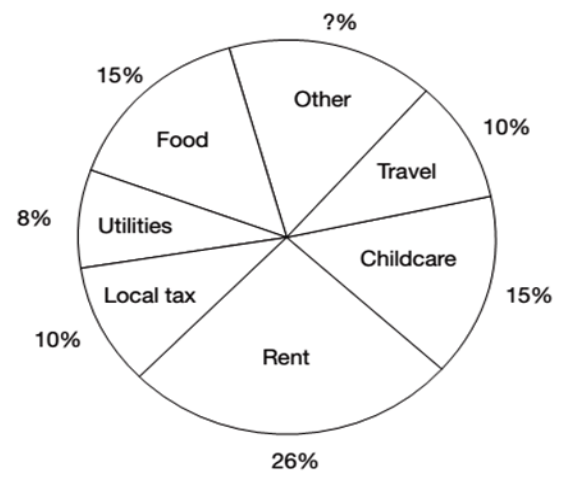
(a) Calculate from the figure what percentage of the family’s expenditure is on ‘other ’?
Solution
Add all visible percentages:
26% + 10% + 8% + 15% + 10% + 15%
= 84%
Since total = 100%:
Other = 100% − 84% = 16%
(b) Approximately what fraction of the family’s monthly expenditure do’ ‘utilities’, ‘rent’ and ‘food’ represent?
Solution
Utilities = 8%
Rent = 26%
Food = 15%
Total = 8 + 26 + 15 = 49%
Fraction = 49/100
Simplify:
49/100 ≈ 1/2 (approx.)
Answer: about one-half of the total expenditure
(c) If the family spends Rs. 11600 on utilities, how much is the family’s total expenditure?
Solution
Utilities percentage = 8%
So:
8% of Total = 11,600
0.08T = 11,600
T = 11,600 ÷ 0.08
T = Rs. 145,000
(d) ‘Other’ expenditure comprises savings, entertainment and luxury items, which are spent in the ratio 3 : 4 : 1. Calculate how much the family saves each month if monthly income is Rs. 24,000.
Solution
Total expenditure = Rs. 145,000
Amount for “Other”:
16% of 145,000
= 0.16 × 145,000
= Rs. 23,200
Total parts of ratio = 3 + 4 + 1 = 8
Savings = (3/8) × 23,200
= Rs. 8,700
FINAL ANSWERS
| Part | Answer |
|---|---|
| (A) | 16% |
| (B) | Approximately 1/2 of total expenditure |
| (C) | Rs. 145,000 total expenditure |
| (D) | Savings = Rs. 8,700 per month |
Question 8
(a) Police officers are in pursuit of a stolen vehicle. Officer Baker is directly behind the stolen car. Officer Lopez is behind Baker; Officer O’Malley is behind Lopez. Officer Reinhart is ahead of the stolen car and coming from the opposite direction. Officer Reinhart makes a U-turn and joins the pursuit. He pulls in behind Officer Lopez. Officer Baker pulls up on the driver’s side of the stolen vehicle and Officer Lopez pulls up on the other side. Which officer is directly behind the vehicle?
Let’s visualize the sequence:
- Initial Order (from front to back): Stolen Car -> Baker -> Lopez -> O’Malley
- Reinhart is ahead, coming opposite. After U-turn, he is now behind the last car in the pursuit. He pulls in behind Lopez.
New Order: Stolen Car -> Baker -> Lopez -> Reinhart -> O’Malley - Baker and Lopez move to the sides of the stolen car. This means they are no longer directly behind it.
- Therefore, the officer now directly behind the stolen car is the one who was behind Lopez, which is Officer Reinhart.
Answer: Officer Reinhart is directly behind the vehicle.
(b) Define a Histogram. How is it constructed? What information may be deduced from it?
Definition
A histogram is a graphical representation of the distribution of numerical data. It is an estimate of the probability distribution of a continuous variable.
Construction
- Determine the Range: Find the smallest and largest values in the data set.
- Create Intervals (Bins): Divide the entire range of data into a series of consecutive, non-overlapping intervals.
- Count Frequency: Count how many data points fall into each interval.
- Draw the Graph: On the horizontal axis (x-axis), place the intervals. On the vertical axis (y-axis), place the frequency count. For each interval, draw a bar whose height corresponds to its frequency. The bars are drawn adjacent to each other, unlike in a bar graph.
Information Deduced
- The shape of the distribution (e.g., symmetric, skewed left/right, bimodal).
- The central tendency (where the data is centered).
- The spread or variability of the data.
- It helps identify outliers and understand the underlying probability distribution of the data.
(c) Look at this series: F2, __, D8, C16, B32, What number should fill the blank?
This series has two patterns: one for the letter and one for the number.
- Letter Pattern: The letters are decreasing alphabetically: F, E, D, C, B.
- Number Pattern: The numbers are doubling (multiplying by 2): 2, 4, 8, 16, 32.
Therefore, the missing term is the combination of the missing letter and the missing number: E4.
Answer: E4
(d) In a certain code language LANDMINE is written as PYRBQGRC. How will HOMEMADE be written in that code language?
Solution
First observe the pattern:
L → P   (+4)
A → Y   (–2)
N → R   (+4)
D → B   (–2)
M → Q   (+4)
I → G   (–2)
N → R   (+4)
E → C   (–2)
Pattern:
Odd positions = +4
Even positions = –2
Apply same rule to HOMEMADE:
H O M E M A D E
8 letters → same pattern applies.
| Letter | Pos | Rule | Result |
|---|---|---|---|
| H | 1 | +4 | L |
| O | 2 | –2 | M |
| M | 3 | +4 | Q |
| E | 4 | –2 | C |
| M | 5 | +4 | Q |
| A | 6 | –2 → (1–2=–1 → +26=25) | Y |
| D | 7 | +4 | H |
| E | 8 | –2 | C |
Answer: LMQCQYHC
📘 Benefits of Practicing This Descriptive Paper
- ✅ These CSS Past Paper 2018 General Science and Ability Descriptive questions are compiled from authentic FPSC CSS past papers, following the real written exam format.
- 💬 Attempting this CSS Past Paper 2018 General Science and Ability Descriptive helps students master structured writing and analytical skills for CSS exams.
- 🧾 Every question in this CSS Past Paper 2018 General Science and Ability Descriptive strictly follows the official CSS exam syllabus approved by FPSC.
- 📊 Students preparing for CSS 2018 can rely on this CSS Past Paper 2018 General Science and Ability Descriptive to practice time management and topic selection.
- 🔍 The solved CSS Past Paper 2018 General Science and Ability Descriptive contains concise explanations to improve conceptual understanding and writing clarity.
- 🎯 Regular revision of this CSS Past Paper 2018 General Science and Ability Descriptive builds confidence and strengthens your preparation for the CSS written paper.
- 🏆 This CSS Past Paper 2018 General Science and Ability Descriptive is essential for mastering exam techniques and achieving success in the FPSC CSS examination.
🏁 Final Note
Keep revising these CSS Past Paper 2018 General Science and Ability Descriptive to strengthen your grip on important concepts and improve accuracy in upcoming CSS exams. Regular practice with these CSS Past Paper 2018 General Science and Ability Descriptive will help you score higher and build full command over the CSS exam syllabus.
📰 Check out other years’ past papers of General Science & Ability.
🔗 Check FPSC past papers directly from the official FPSC website.