CSS Past Paper 2019 General Science and Ability Descriptive (Part 2)
CSS | Past Paper | Compulsory | 2019 | Part 2 | Descriptive
Below is the solution to PART-II (COMPULSORY) of the CSS Past Paper 2019 General Science and Ability Descriptive (Part 2).
Question 2
(a) Deficiency of vitamins causes different human diseases some of which are given in the table below choose the correct type of vitamin from the box and write in front of each disease.
| Vit. A | Vit. B1 | Vit. C | Vit. D | Vit. E | Vit. K |
| Diseases caused duw to lack of vitaman | Name of the vitaman |
| 1. Poor night vision | Vitamin A |
| 2. Bleeding gums | Vitamin C |
| 3. Rickets in children | Vitamin D |
| 4. Beri-Beri | Vitamin B1 |
| 5. Anaemia | Vitamin E (or in some contexts, B12/B9, but based on the provided box, E is correct for certain anaemias) |
Explanation
- Vitamin A is crucial for the production of rhodopsin in the eyes, essential for low-light vision.
- Vitamin C (Ascorbic Acid) is necessary for collagen synthesis, and its deficiency weakens gum tissue causing bleeding.
- Vitamin D regulates calcium and phosphate absorption; its deficiency in children leads to soft, weak bones (Rickets).
- Beri-Beri is a neurological and cardiovascular disease directly caused by a deficiency of Thiamine (Vitamin B1).
- Vitamin E is a key antioxidant that protects red blood cells from damage (hemolysis); its deficiency can lead to a specific form of anaemia.
(b) People suffering from cardiovascular disease having high level of cholesterol in their blood, this often leads to build of fats on its internal arterial walls, suggests how this might be harmful to the heart.
The build-up of fats, primarily cholesterol, and other substances on arterial walls is a process called atherosclerosis. This is profoundly harmful to the heart through the following mechanisms:
- Narrowing of Arteries (Ischemia): The fatty deposits, known as plaques, gradually narrow the lumen (internal space) of the coronary arteries that supply oxygen-rich blood to the heart muscle. This reduces blood flow to the heart.
- Reduced Oxygen Supply: During physical exertion or stress, the heart muscle demands more oxygen. The narrowed arteries cannot supply sufficient blood to meet this increased demand, leading to chest pain known as angina pectoris.
- Complete Blockage (Heart Attack): A plaque can rupture, forming a blood clot (thrombus) at the site. This clot can completely block the coronary artery, cutting off blood supply to a part of the heart muscle. This results in the death of that heart tissue, a condition known as a myocardial infarction or heart attack.
- Increased Blood Pressure: The narrowed and hardened arteries (arteriosclerosis) lose their elasticity. This forces the heart to pump harder against increased resistance, leading to hypertension (high blood pressure), which further strains the heart and can lead to heart failure.
(c) Why the excessive use of chemical fertilizers should be avoided?
The indiscriminate use of chemical fertilizers, while boosting short-term crop yields, has severe long-term detrimental effects on the environment and soil health:
- Soil Degradation: Excessive use acidifies the soil, destroys its natural structure, and reduces its fertility over time by killing beneficial microorganisms and earthworms crucial for nutrient cycling.
- Water Pollution: Fertilizers are highly soluble. Rainwater leaches them (especially nitrates) into groundwater or carries them as runoff into rivers and lakes. This causes eutrophication—an explosive growth of algae that depletes oxygen in the water, killing aquatic life and creating “dead zones”.
- Health Hazards: High nitrate levels in drinking water are linked to serious health issues like methemoglobinemia (“blue baby syndrome”) and are potential carcinogens.
- Imbalance of Nutrients: Over-reliance on specific nutrients (N-P-K) can create deficiencies of other essential micronutrients in the soil, leading to weaker plants more susceptible to diseases.
- Economic Cost: It makes farming input-intensive and expensive for farmers, creating a cycle of dependency.
(d) Why are Scientists worried about the increase of CO2 in atmosphere?
Scientists are deeply concerned about the rising atmospheric CO₂ levels due to its role as the primary driver of anthropogenic climate change. The specific worries are:
- The Greenhouse Effect: CO₂ is a potent greenhouse gas. It allows incoming solar radiation to pass through but traps the outgoing infrared radiation (heat) from the Earth’s surface. Increased CO₂ concentrations intensify this natural greenhouse effect, leading to a rise in global average temperatures (global warming).
- Climate Change: This warming disrupts global climate patterns, leading to more frequent and intense extreme weather events like heatwaves, droughts, floods, hurricanes, and erratic rainfall.
- Ocean Acidification: A significant portion of atmospheric CO₂ is absorbed by the oceans, where it reacts with seawater to form carbonic acid. This lowers the ocean’s pH, making it more acidic. This acidity dissolves the calcium carbonate shells and skeletons of marine organisms like corals, oysters, and plankton, threatening the entire marine food web.
- Melting Ice and Sea Level Rise: Warming temperatures cause the melting of glaciers and polar ice sheets, contributing to rising sea levels that threaten coastal communities, ecosystems, and infrastructure.
- Ecosystem Disruption: Rapid climate change alters habitats faster than many species can adapt, leading to widespread biodiversity loss, species extinction, and shifts in ecological zones.
Question 3
(a) Differentiate between the renewable and non-renewable sources of energy giving example of each one of them.
| Feature | Renewable Energy Sources | Non-Renewable Energy Sources |
| Definition | Sources that are naturally replenished on a human timescale. | Sources that exist in finite quantities and cannot be replenished in a short period. |
| Sustainability | Sustainable and virtually inexhaustible. | Not sustainable; will eventually run out. |
| Environmental Impact | Generally have a low environmental impact and produce little to no greenhouse gases. | Cause significant environmental pollution (air, water) and are the main source of greenhouse gas emissions. |
| Cost & Infrastructure | Often higher initial setup cost, but lower running cost. Technology is rapidly evolving. | Established infrastructure, but fuel extraction and costs are volatile. |
| Examples | Solar energy (Sun), Wind energy, Hydropower, Geothermal energy. | Fossil Fuels: Coal, Petroleum, Natural Gas. Nuclear energy (Uranium). |
(b) Give a brief account of optic fibers. What is their importance in present day telecom system?
Optic Fibers
Optic fibers are thin, flexible, transparent strands made of high-quality glass (silica) or plastic. They are designed to transmit light signals over long distances with minimal loss. A fiber consists of a core (through which light travels), a cladding (with a lower refractive index to contain the light within the core via total internal reflection), and a protective buffer coating.
Importance in Telecom
- High Bandwidth & Speed: Optical fibers have an enormous data-carrying capacity (bandwidth) compared to metal cables. They form the backbone of the internet and modern telecommunications, enabling high-speed data, video, and voice transmission.
- Low Attenuation: Signals travel for dozens of kilometers before needing amplification, reducing the need for repeaters.
- Immunity to EMI: Unlike copper wires, they are immune to electromagnetic interference (EMI) from power lines, motors, or other cables, ensuring a clear signal.
- Security: Light signals do not radiate from the fiber, making them extremely difficult to tap into without detection, providing greater security for data transmission.
- Size and Weight: Fiber optic cables are thinner, lighter, and more durable than comparable copper cables.
(c) What is the most dangerous part of hurricane and how do cyclone affect humans?
The storm surge is widely considered the most dangerous and deadly part of a hurricane (or cyclone). It is an abnormal rise of water generated by a storm’s winds, pushing water onshore. This wall of water can reach over 6 meters (20 feet) high, leading to catastrophic flooding, eroding beaches and highways, and sweeping away buildings.
How Cyclones Affect Humans?
- Loss of Life and Injury: Directly through drowning (storm surge), flying debris, and collapsing structures.
- Destruction of Infrastructure: High winds and flooding destroy homes, schools, hospitals, roads, bridges, and power and communication lines.
- Economic Damage: The cost of rebuilding is enormous. Key industries like agriculture and fishing are often devastated.
- Displacement: Cyclones can render large areas uninhabitable, creating environmental refugees and overcrowding in relief shelters.
- Secondary Hazards: They can trigger landslides in hilly areas and lead to outbreaks of water-borne diseases (e.g., cholera, typhoid) due to contaminated water supplies and poor sanitation in the aftermath.
(d) What is the difference between vaccines and Antibiotics? How do antibiotics and vaccines contribute to health?
| Aspect | Vaccines | Antibiotics |
| Purpose | Prevention of disease. | Treatment of bacterial infections. |
| Mechanism | Train the immune system to recognize and fight specific pathogens (viruses/bacteria) by introducing a weakened or inactivated form of the germ. | Kill or inhibit the growth of existing bacteria in the body. |
| Time of Use | Administered before exposure to a disease to prevent infection. | Administered after a bacterial infection has already occurred. |
| Effect on Microbes | Do not kill pathogens directly; they prepare the body’s defenses. | Directly attack and kill bacteria. |
| Scope | Effective against both viral and bacterial diseases. | Ineffective against viral infections (e.g., cold, flu). |
Contribution to Health
- Vaccines are a cornerstone of public health. They have led to the eradication of smallpox and the near-eradication of polio. They prevent epidemics, protect vulnerable populations (herd immunity), and save millions of lives annually.
- Antibiotics have revolutionized medicine by making once-lethal bacterial infections (e.g., pneumonia, sepsis, tuberculosis) treatable. They are essential for modern procedures like surgery, chemotherapy, and organ transplants, where the risk of infection is high.
Question 4
(a) What is the importance of forests in the economy of a country?
Forests are a critical natural asset and play a multifaceted role in a nation’s economy:
- Direct Employment and Industry: They provide livelihoods for millions through forestry, the timber industry, paper production, and the manufacturing of furniture and other wood products.
- Non-Timber Forest Products (NTFPs): Forests are a source of valuable NTFPs like medicinal plants, resins, gums, fruits, nuts, honey, and fibers, which support local economies and industries.
- Water Security and Agriculture: Forests act as giant watersheds, regulating water cycles, recharging aquifers, and maintaining river flows. This ensures a steady supply of water for irrigation and agriculture, the backbone of many economies.
- Energy Source: In many developing countries, wood fuel is the primary source of energy for cooking and heating for a significant portion of the population.
- Tourism and Recreation: Forests are major attractions for ecotourism, hiking, and wildlife watching, generating significant revenue and creating jobs in the hospitality and service sectors.
- Ecosystem Services: Their role in climate regulation, soil conservation, pollination, and flood control has immense economic value by preventing losses from natural disasters and ensuring agricultural productivity.
(b) Give a brief account of biotechnology.
Biotechnology is a broad field of biology that involves harnessing living organisms, their systems, or their derivatives to develop or create products and technologies for improving human life and the health of the planet. It applies principles from genetics, microbiology, and biochemistry.
Its applications are vast and can be categorized by color codes:
- Red Biotechnology: Medical applications. This includes producing insulin and vaccines using genetically modified bacteria, gene therapy for genetic disorders, and developing advanced diagnostic kits.
- White Biotechnology: Industrial applications. It focuses on designing low-resource-consuming processes and products, such as using enzymes to create biofuels (bioethanol), bioplastics, and chemicals.
- Green Biotechnology: Agricultural applications. This involves developing Genetically Modified (GM) crops that are pest-resistant, drought-tolerant, or more nutritious (e.g., Golden Rice). It also includes tissue culture for plant propagation.
- Blue Biotechnology: Marine and aquatic applications, exploring the use of marine resources for pharmaceuticals, cosmetics, and food.
(c) Do the mammals always lay eggs? If yes, where in the world do they live? Write the name some of them.
No, the vast majority of mammals do not lay eggs. They are viviparous, giving birth to live young. However, there is a very rare and unique exception: the monotremes.
Monotremes are egg-laying mammals that are found exclusively in Australia and New Guinea.
Examples:
- Platypus (Ornithorhynchus anatinus)
- Echidnas (or Spiny Anteaters) – There are four species, including the Short-beaked Echidna (Tachyglossus aculeatus).
(d) How can the sun have such a strong gravitational field if its made of gases?
The strength of a gravitational field depends on mass, not the physical state (solid, liquid, or gas) of the object. The Sun is not a ball of Earth-like gases; it is an enormous sphere of superheated plasma (a fourth state of matter). Despite being gaseous, it possesses an immense mass—approximately 330,000 times the mass of Earth.
According to Newton’s Law of Universal Gravitation, the gravitational force is directly proportional to the product of the masses. The Sun’s colossal mass is what generates its incredibly powerful gravitational field, strong enough to:
- Hold all the planets, asteroids, and comets of the solar system in their orbits.
- Compress its own gaseous material with such tremendous pressure and temperature at its core (15 million °C) that it initiates and sustains nuclear fusion, the process that powers the star.
Question 5
(a) What does Ozone depletion mean and how can we protect the ozone layer?
Ozone Depletion
Ozone depletion refers to the thinning and reduction of the concentration of ozone (O₃) molecules in the stratosphere, particularly over the polar regions (known as the “ozone hole”). This layer acts as a shield, absorbing most of the sun’s harmful ultraviolet (UV-B) radiation.
Depletion is primarily caused by man-made ozone-depleting substances (ODS), such as:
- Chlorofluorocarbons (CFCs) (used in refrigerants, aerosols)
- Halons (used in fire extinguishers)
- Carbon Tetrachloride
How to Protect the Ozone Layer?
- Follow the Montreal Protocol: Strictly adhere to this international treaty designed to phase out the production and consumption of ODS. Its implementation is already leading to a slow recovery of the ozone layer.
- Responsible Consumer Choices: Avoid products that contain or were made using CFCs or other ODS. Properly dispose of old refrigerators and air conditioners to ensure CFCs are recovered and not released.
- Support and Develop Alternatives: Use and promote ODS-free technologies and natural alternatives in refrigeration, air conditioning, and insulation.
- Raise Awareness: Educate others about the causes and effects of ozone depletion and the importance of the Montreal Protocol.
(b) What are the different types of a network? Explain each briefly.
Computer networks are categorized based on their geographical span:
- PAN (Personal Area Network): A network for personal devices within a very short range (up to 10 meters). E.g., Connecting a wireless mouse, keyboard, or phone to a laptop via Bluetooth.
- LAN (Local Area Network): Connects devices within a limited geographic area like a home, school, office building, or laboratory. It is privately owned and offers high-speed connectivity. Ethernet and Wi-Fi are common LAN technologies.
- MAN (Metropolitan Area Network): Spans a larger area than a LAN, such as a city or a large campus. It often connects multiple LANs together. A cable TV network is a classic example of a MAN.
- WAN (Wide Area Network): Extends over a large geographical area, such as a country, continent, or the entire globe. The most prominent example is the Internet. WANs are often established using leased telecommunication circuits.
(c) Why an indiscriminate / causal use of antibiotic may prove dangerous?
The casual and improper use of antibiotics is one of the biggest threats to global health today, leading to Antimicrobial Resistance (AMR).
- Antibiotic Resistance: When antibiotics are overused or misused (e.g., for viral infections, not completing a course), bacteria are exposed to non-lethal doses. This creates selective pressure, allowing the survival and multiplication of resistant bacteria. These resistant strains can then spread.
- Ineffective Treatments: Infections caused by resistant bacteria become harder, and sometimes impossible, to treat. Standard antibiotics become ineffective, leading to prolonged illness, higher risk of death, and the need for more expensive and toxic second-line drugs.
- Threat to Modern Medicine: Procedures that rely on antibiotics to prevent infections—such as surgery, chemotherapy, organ transplants, and care for preterm babies—become much more dangerous.
- Economic Burden: AMR leads to longer hospital stays, more intensive care requirements, and costlier treatments, placing a huge burden on healthcare systems and families.
(d) Why do atoms form bonds? Name three major types of chemical bonds.
Atoms form chemical bonds to achieve a more stable, lower-energy electronic configuration. This stability is often attained by attaining a full outer shell of electrons, similar to the noble gases.
The three major types of chemical bonds are:
- Ionic Bond: Formed by the complete transfer of electrons from one atom (usually a metal) to another (usually a non-metal). This results in the formation of positively charged cations and negatively charged anions, which are held together by strong electrostatic forces. Example: Sodium Chloride (NaCl).
- Covalent Bond: Formed by the sharing of electron pairs between two atoms, typically non-metals. Each atom contributes one electron to the pair. Example: Water (H₂O), Methane (CH₄).
- Metallic Bond: Found in metals. It involves the attraction between positively charged metal ions and a “sea” of delocalized valence electrons that are free to move throughout the structure. This bond is responsible for the characteristic properties of metals, such as electrical conductivity and malleability. Example: Iron (Fe), Copper (Cu).
Question 6
(a) Moiz was trying to sleep at one night but there was too much noise around him. His clock ticked every 5 seconds; a tap was dipping every seventh seconds and a pet dog snored every 12th second. He noticed on his clock that all three things happened together on the stroke of midnight. Find after how may seconds are three things happened together.
Solution
This is a problem of finding the Least Common Multiple (LCM) of the time intervals: 5 seconds, 7 seconds, and 12 seconds.
- 5 is a prime number.
- 7 is a prime number.
- 12 = 2² × 3
The LCM is the product of the highest powers of all primes present:
LCM = 2² × 3 × 5 × 7 = 4 × 3 × 5 × 7 = 420 seconds.
Answer: All three things happen together every 420 seconds.
(b) One pipe can fill a pool 1.25 times as fast as second pipe. When both pipes are opened they can fill the pool in five hours. How long it will take the fill the pool if only slower pipe is used?
Solution
Let the rate of the slower pipe be R pools/hour.
Therefore, the rate of the faster pipe is 1.25R pools/hour.
Combined rate: R+1.25R=2.25R pools/hour.
They fill the pool in 5 hours, so their combined work done in one hour is 1/5 of the pool.
Therefore:
2.25R=1/5
Now, solve for R (the slower pipe’s rate):
R=1/5÷2.25=1/11.25=0.088 pools/hour.
Time for slower pipe alone: Time = 1/R=1/0.088=11.25 hours.
Answer: It will take the slower pipe 11.25 hours (or 11 hours and 15 minutes) to fill the pool alone.
(c) The cost of hiring a car for 2 days in 2018 was Rs.264 which was 20% more than in 2013. What was the cost of hiring a car in 2013?
Solution
Let the cost in 2013 be x rupees.
The cost in 2018 is 20% more than in 2013, so:
2018 Cost = 2013 Cost + 20% of 2013 Cost
264=x+0.20x
264=1.20x
x=264/1.20
x=220
Answer: The cost of hiring a car in 2013 was Rs. 220.
(d) What do you understand by measure central tendency? State its types.
A measure of central tendency is a single, central value that attempts to describe a set of data by identifying its typical, central, or average position. It is a way to summarize a large dataset with a single representative value.
The three main types are:
- Mean: The most common measure, often called the “average.” It is calculated by adding all the values in a dataset and dividing by the number of values. It is sensitive to extreme values (outliers).
- Median: The middle value when all data points are arranged in ascending or descending order. If there is an even number of observations, the median is the average of the two middle values. It is not affected by outliers and is better for skewed distributions.
- Mode: The value that appears most frequently in a data set. A dataset can have one mode (unimodal), more than one mode (bimodal, multimodal), or no mode at all if no number repeats. It is the only measure suitable for categorical data.
Question 7
(a) Moiz and Mair share a lottery win of Rs. 2000 in the ratio of 1:4. Moiz then share this part between himself, his wife and his son.in the ratio of 4:5:1. How much more his wife gets over his son?
Solution
Step 1: Find Moiz’s initial share.
Total parts in initial ratio = 1 + 4 = 5
Moiz’s share = 1/5×2000=Rs. 400
Step 2: Distribute Moiz’s share (Rs. 400) in the new ratio (4:5:1).
Total parts in new ratio = 4 + 5 + 1 = 10
- Wife’s share = 5/10×400=Rs. 200
- Son’s share = 1/10×400=Rs. 40
Step 3: Find the difference.
Difference = Wife’s share – Son’s share = 200 – 40 = Rs. 160
Answer: His wife gets Rs. 160 more than his son.
(b) A farmer keeps hens and rabbits on his farm. One day he counted the total of 70 heads and 196 legs. How many more hens than rabbits does he have?
Solution
Let h be the number of hens and r be the number of rabbits.
Each animal has 1 head: h+r=70 … (Equation 1)
Hens have 2 legs, rabbits have 4 legs: 2h+4r=196 … (Equation 2)
Simplify Equation 2 by dividing by 2: h+2r=98 … (Equation 3)
Now, subtract Equation 1 from Equation 3:
(Equation 3) h+2r=98
(Equation 1) −(h+r=70)
r=28
Substitute r=28 into Equation 1:
h+28=70
h=42
Find the difference: Hens – Rabbits = 42 – 28 = 14
Answer: There are 14 more hens than rabbits.
(c) What is polygon? Describe different types of regular polygon.
Polygon
A polygon is a closed two-dimensional figure formed by three or more straight line segments. The segments are called sides, and the points where two sides meet are called vertices.
A regular polygon is a polygon that is both equiangular (all angles are equal) and equilateral (all sides are equal).
Types of Regular Polygons (based on number of sides)
- Triangle (3 sides): Equilateral Triangle
- Quadrilateral (4 sides): Square
- Pentagon (5 sides)
- Hexagon (6 sides)
- Heptagon (7 sides)
- Octagon (8 sides)
- Nonagon (9 sides)
- Decagon (10 sides)
The interior and exterior angles of any regular polygon are always equal. As the number of sides increases, a regular polygon increasingly resembles a circle.
(d) In a certain code computer is written as FRUVQNPC. How will MEDICINE will be written in code language?
In the code, each letter is shifted 3 positions forward in the alphabet.
Example: C → F, O → R, R → U (each +3).
Apply the same to MEDICINE:
- M → P
- E → H
- D → G
- I → L
- C → F
- I → L
- N → Q
- E → H
So, MEDICINE is written as PHGLFLQH.
Question 8
(a) Seven Piano Students T U V W X Y & Z are given a recital and their instructor is deciding the order in which they will perform, each student will play exactly one piece, a piano solo. In deciding the order of performance the instructor must observer following restrictions.
i. X cannot play first or second
W cannot have played until X has played
Neither T nor Y can play Seventh
Either Y & Z must play immediately after W
V must play immediately after, or immediately U Played
We look for the region that lies:
- inside A (Americans)
- inside P (Politicians)
- outside S (Scientists)
From the diagram:
- Region a = A ∩ P ∩ S → includes scientists → not allowed
- Region b = A ∩ P but outside S → correct
- Region g = P only → not American → not correct
- Regions c, d, e, f are not matching the required condition
Answer is: b
ii. If V play first, which one of the following must be true
T plays sixth
X plays third
Z plays seventh
T plays after immediately after Y
W plays immediately After X
We need the region that is:
- inside S (Scientists)
- inside P (Politicians)
- outside A (Americans)
From the diagram:
- Region a = A ∩ S ∩ P → includes Americans → not correct
- Region f = S ∩ P but outside A → not correct
- Region d = A ∩ S → not politician → not correct
- Region e = S only → not politician → not correct
So only f fits the condition.
Answer is: f
(b) U = [Whole number from 10 to 24]
A = [Even Number]
B = [Number divisible by 5]
Write down the number elements of A∩B.
Solution
U = {10, 11, 12, 13, 14, 15, 16, 17, 18, 19, 20, 21, 22, 23, 24}
A = {10, 12, 14, 16, 18, 20, 22, 24}
B = {10, 15, 20}
A ∩ B = {10, 20}
Number of elements in A ∩ B = 2
(c) In the following diagram, A represent American, S represent scientist and P represents politicians.
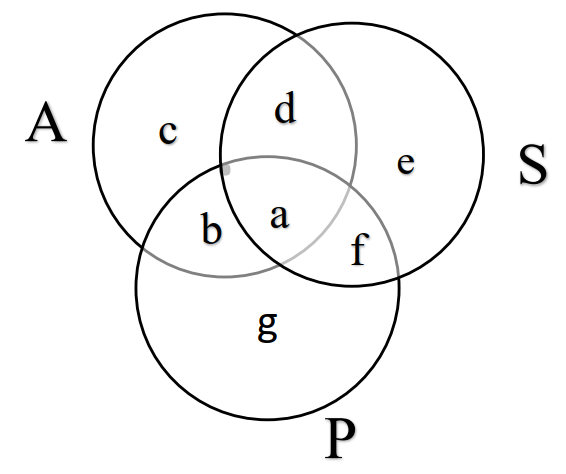
i. American those are politicians but not scientists will be.
ii. Scientists which are politicisms but not Americans will be.
Solution
Given seven students T, U, V, W, X, Y, Z with the rules:
- X cannot play first or second.
- W cannot play before X.
- Neither T nor Y can play seventh.
- Either Y or Z must play immediately after W (W–Y or W–Z).
- V must play immediately after U or U must play immediately after V.
If V plays first, then the pair must be V–U because U cannot come before V. So positions 1 and 2 become V and U.
X cannot be in positions 1 or 2, so X must be placed somewhere from position 3 to 7. Since W cannot play before X, W must be after X. Also, W must be immediately followed by Y or Z, but Y cannot be seventh. Therefore, W must have space after it for Y or Z.
When you try placing X and W in different non-adjacent positions, you find that the W–Y or W–Z requirement cannot be satisfied without violating another rule. The only placement that always works under these constraints is when W plays immediately after X.
Therefore, the one statement that must be true if V plays first is:
W plays immediately after X.
(d) Each packet of washing powder carries a token and 4 token can be exchanged for free packet, How many free packets will I receive if I buy sixty four packets?
Solution
This is a problem of cumulative free items.
Buy 64 packets → get 64 tokens.
64 tokens / 4 = 16 free packets.
These 16 free packets come with 16 tokens.
16 tokens / 4 = 4 more free packets.
These 4 free packets come with 4 tokens.
4 tokens / 4 = 1 more free packet.
This 1 free packet comes with 1 token, which is not enough for another packet.
Total free packets = 16 + 4 + 1 = 21
Answer: I will receive 21 free packets.
📘 Benefits of Practicing This Descriptive Paper
- ✅ These CSS Past Paper 2019 General Science and Ability Descriptive questions are compiled from authentic FPSC CSS past papers, following the real written exam format.
- 💬 Attempting this CSS Past Paper 2019 General Science and Ability Descriptive helps students master structured writing and analytical skills for CSS exams.
- 🧾 Every question in this CSS Past Paper 2019 General Science and Ability Descriptive strictly follows the official CSS exam syllabus approved by FPSC.
- 📊 Students preparing for CSS 2019 can rely on this CSS Past Paper 2019 General Science and Ability Descriptive to practice time management and topic selection.
- 🔍 The solved CSS Past Paper 2019 General Science and Ability Descriptive contains concise explanations to improve conceptual understanding and writing clarity.
- 🎯 Regular revision of this CSS Past Paper 2019 General Science and Ability Descriptive builds confidence and strengthens your preparation for the CSS written paper.
- 🏆 This CSS Past Paper 2019 General Science and Ability Descriptive is essential for mastering exam techniques and achieving success in the FPSC CSS examination.
🏁 Final Note
Keep revising these CSS Past Paper 2019 General Science and Ability Descriptive to strengthen your grip on important concepts and improve accuracy in upcoming CSS exams. Regular practice with these CSS Past Paper 2019 General Science and Ability Descriptive will help you score higher and build full command over the CSS exam syllabus.
📰 Check out other years’ past papers of General Science & Ability.
🔗 Check FPSC past papers directly from the official FPSC website.