CSS Past Paper 2019 Psychology Descriptive (Part 2)
CSS | Past Paper | Group 7 | 2019 | Part 2 | Descriptive
Below is the solution to PART-II (COMPULSORY) of the CSS Past Paper 2019 Psychology Descriptive (Part 2).
Question 2
Define emotion. Compare and contrast the theories of emotion.
Introduction
Emotion is a strong feeling that affects how we think, behave, and react. It is usually triggered by an internal thought or an external event. Emotions like happiness, fear, anger, sadness, surprise, and disgust are part of daily life and influence our decisions, relationships, and mental health.
Definition of Emotion
According to psychologist Robert Plutchik,
“Emotion is an intense feeling that is directed at someone or something and is a complex reaction pattern involving experiential, behavioral, and physiological elements”.
In simple words, emotions are feelings that involve both the mind and body.
Major Theories of Emotion
Different psychologists have tried to explain how emotions happen. These theories describe the order and connection between body reactions, thoughts, and feelings.
1. James-Lange Theory (1884)
- This theory says emotions come after physical reactions.
- We feel emotion because our body reacts first.
Example: We see a snake → Our heart races → Then we feel fear.
Criticism:
- If body responses are similar for different emotions, how do we know which emotion we feel?
2. Cannon-Bard Theory (1927)
- Body and emotion happen at the same time, not one after another.
- Brain sends signals to both body (arousal) and mind (emotion) at the same moment.
Example: You see a snake → You feel fear and your heart races at the same time.
Criticism:
- Does not explain how we label different emotions based on context.
3. Schachter-Singer Two-Factor Theory (1962)
- Emotion depends on two things:
- Physical arousal
- Cognitive label (how we interpret it)
Example: Your heart is racing after running → If someone shouts at you, you may label that arousal as anger.
Strength:
- Explains how same body reaction can be labeled differently based on situation.
4. Lazarus Cognitive Appraisal Theory (1982)
- Thought comes before emotion.
- We evaluate the situation first, then feel emotion.
Example: You see a dog → If you think it’s friendly, you feel happy. If you think it’s dangerous, you feel fear.
Strength:
- Explains why different people react differently to the same event.
5. Facial Feedback Theory
- Our facial expressions can influence our emotions.
Example: Smiling can make you feel happy even if you’re not.
Criticism:
- Only explains a small part of emotional experience.
Comparison Table of Theories
| Theory | Order of Emotion Process | Main Idea |
| James-Lange | Body → Emotion | Feelings come after body reacts |
| Cannon-Bard | Body + Emotion (Same time) | Brain sends signals to both |
| Two-Factor (Schachter-Singer) | Body → Thought → Emotion | Emotion depends on context |
| Lazarus Theory | Thought → Emotion → Body | Appraisal is most important |
| Facial Feedback | Expression → Emotion | Expression affects feelings |
Conclusion
All these theories help explain different parts of how emotions work. Some focus on body reactions, others on thoughts and labels. While none of them fully explains emotion alone, together they give us a better understanding of how humans feel and react. Emotions are complex, involving mind, body, and environment – and these theories show just how deep the subject is in modern psychology.
Question 3
Describe the attributes of psychological measures. Highlight the ethical and legal issues in psychological assessment.
Introduction
Psychological testing is a critical part of psychology. It permits the psychologist to experiment with human behavior, thought, and feeling via testing and measuring devices, which must be devoid of evil qualities. At the same time, there are certain legal and ethical considerations which must also be regarded in the giving of such tests in order to protect the rights of the person tested.
Attributes of Psychological Measures
Good psychological measures must have the following attributes:
1. Reliability
- Reliability means the test gives consistent results every time.
- If a person takes the same test again under similar conditions, the score should be similar.
Types of Reliability:
- Test-Retest Reliability: Same test, same person, different time.
- Inter-Rater Reliability: Two testers give same results.
- Internal Consistency: All questions in a test measures the same thing.
2. Validity
- Validity means the test measures what it claims to measure.
- For example, an intelligence test must measure intelligence, not memory or mood.
Types of Validity:
- Content Validity: Covers all parts of the topic.
- Construct Validity: Actually measures the concept (like anxiety).
- Criterion Validity: Matches with real-life behavior or other tests.
3. Standardization
- Standardization means the test is given and scored in the same way for everyone.
- It makes the test fair and removes bias.
- A proper psychological test has rules about time limit, instructions, and scoring.
4. Objectivity
- The test results should not depend on the opinion of the examiner.
- Scoring should be based on clear rules, not guesses.
5. Norms
- Norms are average scores collected from a big group.
- They help compare one person’s score with the general population.
- For example, IQ score of 100 is average.
6. Practicality
- The test should be easy to use, not too long or expensive.
- It should be suitable for the culture and age of the person.
Ethical Issues in Psychological Assessment
The psychologist is bound by ethics in order to protect the rights and dignities of persons. Some of the important considerations of ethics are:
1. Informed Consent
- The person should be told clearly about the test, purpose, and how results will be used.
- They must agree freely without pressure.
2. Confidentiality
- Test results should be kept private.
- Only authorized people should have access.
3. Fairness and Non-Discrimination
- Tests must not be biased against any gender, race, or religion.
- They should be suitable for people from different backgrounds.
4. Right to Refuse or Withdraw
- The person can refuse to take the test or stop at any time.
5. Feedback
- The person should be given proper feedback after the test in a clear and respectful way.
Legal Issues in Psychological Assessment
There are also legal responsibilities in using psychological tests, especially in jobs, schools, or courts.
1. Use by Qualified Professionals
- Only trained and licensed psychologists should give and interpret tests.
2. Test Misuse
- Using a test in the wrong way or for the wrong purpose can cause harm and is illegal.
- Example: Using an IQ test to judge mental illness without proper diagnosis.
3. Disability Laws
- Tests must follow laws like the Disability Act, which protects people with mental or physical issues.
- They should be given a fair chance (like extra time).
4. Informed Reporting
- Test results used in legal settings (like court) must be explained clearly and honestly.
- Misreporting can lead to serious legal action.
Conclusion
Psychological tests have been found very valuable in certain fields of science such as education, industry, and health. It is true that all psychological tests should possess certain qualities such as reliability, validity, and freedom from bias. It is essential that the psychologist should observe certain ethical and legal principles in giving the tests which preserve the person’s rights. This saves the dignity of psychology and gives a better understanding of human behavior.
Question 4
Describe in detail the structure and functions of central nervous system.
Introduction
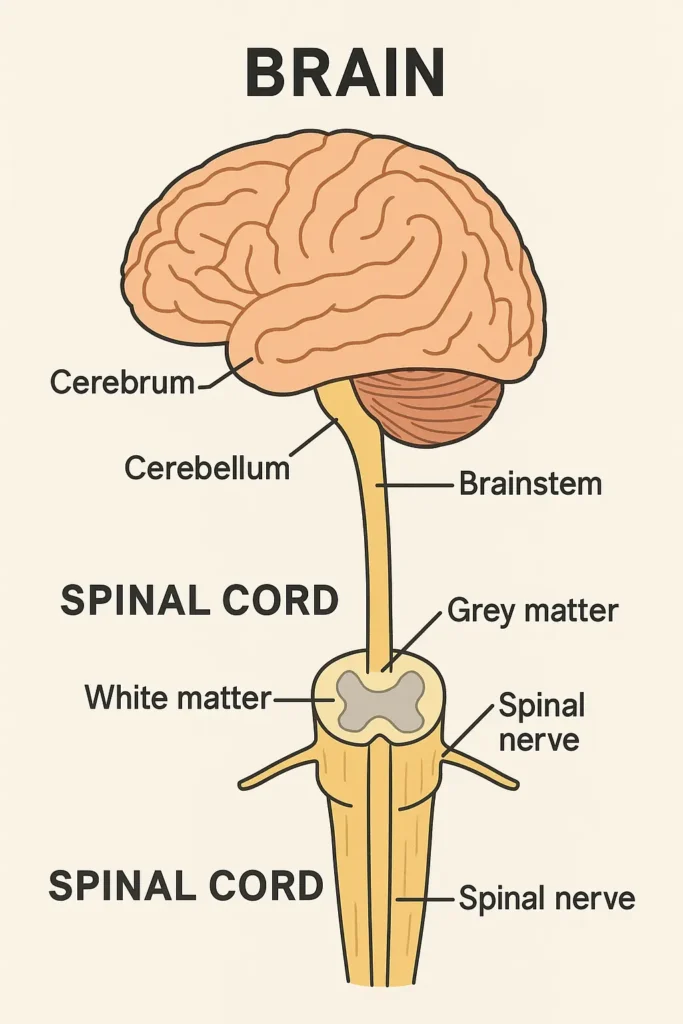
The central nervous mechanism (CNS) is the control mechanism of the body. It is responsible for thoughts, feelings, movements, and for practically all of the work of the body. It is made up of two parts, the brain and the spinal cord, which are intimately related, the two cooperating in receiving stimuli, working on the stimuli, throwing out commands to the body.
Main Structure of CNS
The CNS has two main parts:
1. Brain
The brain is the most complex organ. It is protected by the skull and covered with three layers called meninges. The brain is divided into three main parts:
a) Forebrain
- The largest part of the brain.
- Includes cerebrum, thalamus, hypothalamus.
i. Cerebrum
- Controls thinking, memory, emotions, and voluntary movements.
- Divided into right and left hemispheres, each controlling opposite sides of the body.
- Has four lobes:
- Frontal lobe (thinking, planning, speech)
- Parietal lobe (touch, pressure, pain)
- Temporal lobe (hearing, memory)
- Occipital lobe (vision)
ii. Thalamus
- Acts like a relay station.
- Sends sensory signals to the right areas in the brain.
iii. Hypothalamus
- Controls hunger, thirst, body temperature, and emotions.
- Also controls the endocrine system by working with the pituitary gland.
b) Midbrain
- Connects the forebrain and hindbrain.
- Controls vision, hearing, motor control, and alertness.
c) Hindbrain
- Includes cerebellum, pons, and medulla oblongata.
i. Cerebellum
- Controls balance, coordination, and fine muscle movements.
ii. Pons
- Helps in breathing and connects different parts of the brain.
iii. Medulla Oblongata
- Controls vital functions like heartbeat, breathing, and blood pressure.
2. Spinal Cord
- Long, thin structure inside the backbone.
- Connects the brain with the rest of the body.
- Protected by the vertebral column.
- Made up of grey matter (inside) and white matter (outside).
Functions of the Central Nervous System
The CNS controls and coordinates many body functions. Some main functions are:
1. Sensory Input
- The CNS receives signals from sensory organs (like eyes, ears, skin).
- Example: Touching something hot sends a signal to the brain.
2. Motor Output
- The CNS sends signals to muscles and glands to take action.
- Example: After seeing a ball, the brain sends a signal to hands to catch it.
3. Information Processing
- The brain interprets and analyzes incoming data.
- It makes decisions based on memory, logic, and emotion.
4. Reflex Actions
- The spinal cord controls reflexes, which are quick automatic responses.
- Example: Pulling your hand away from fire without thinking.
5. Memory and Learning
- The CNS stores past experiences and helps in learning new things.
- Different brain areas store short-term and long-term memory.
6. Emotions and Behavior
- The limbic system in the brain controls emotions like anger, fear, happiness.
- Also helps in social behavior and personality.
7. Body Regulation
- The brain controls body temperature, hunger, thirst, and hormone release.
- Maintains homeostasis, which means keeping balance inside the body.
Diagram of CNS
Conclusion
The central nervous system is the most important part of the human body. It works like a boss, receiving messages, making decisions, and sending commands. From moving muscles to feeling emotions, the CNS plays a role in every activity. Without a healthy CNS, normal life would not be possible.
Question 5
Differentiate between sensation and perception. Describe different determinants of perception.
Introduction
Sensation and perception are two basic psychological processes. They help us experience and understand the world. Even though they are closely linked, they are not the same. Sensation is the raw data, and perception is how our brain understands that data. Let’s discuss both in detail.
Difference Between Sensation and Perception
| Point | Sensation | Perception |
| Definition | Process of sensing through sense organs | Process of interpreting sensory information |
| Involves | Eyes, ears, skin, nose, tongue | Brain and past experience |
| Type of Process | Biological | Psychological |
| Happens in | Sensory organs | Brain (especially cerebral cortex) |
| Example | Seeing light | Understanding it’s a red traffic signal |
| Same in everyone? | Mostly same | Can be different based on person and culture |
What is Sensation?
- Sensation is the process of receiving information from the environment through sense organs.
- It is automatic and usually the same for most people.
- Examples: Hearing a sound, feeling heat, tasting sweetness.
What is Perception?
- Perception is how the brain organizes and interprets the sensory data.
- It gives meaning to what we sense.
- People may perceive the same thing differently based on experience, attention, and mood.
- Example: Two people hear the same music — one enjoys it, the other doesn’t.
Determinants of Perception
Perception is not always based only on what we see or hear. Many factors affect how we perceive things. These are called determinants of perception.
1. Attention
- We can’t notice everything around us.
- We focus only on some things — this is called attention.
- What we pay attention to affects how we perceive.
- Example: A hungry person may notice food signs more.
2. Past Experience
- Our past shapes our present perception.
- If we had a bad experience with a dog before, we may now feel scared when we see any dog.
3. Expectations
- What we expect to see can change what we actually see.
- Our brain tries to match new information with what it already knows.
- Example: Reading messy handwriting becomes easier when we already know the topic.
4. Cultural Background
- Culture influences how people see and understand things.
- Some cultures focus more on detail, others on the whole picture.
5. Motivation and Needs
- What we need or want can change perception.
- A thirsty person may see a glass of water as more attractive than others do.
6. Emotions and Mood
- Emotions strongly affect perception.
- When we are sad, everything seems dull.
- When we are happy, even small things feel exciting.
7. Context or Situation
- The surrounding environment affects what we see.
- Example: A person running with a bag in a bank is seen as a thief. The same person in a race is seen as an athlete.
8. Gestalt Principles of Perception
These are rules that explain how we group things in our mind. Main Gestalt principles:
- Figure and Ground: We see objects (figure) as separate from background (ground).
- Proximity: Things close together are seen as a group.
- Similarity: Similar-looking items are grouped together.
- Closure: Our brain fills in missing parts to complete the image.
- Continuity: We prefer smooth, continuous patterns over broken ones.
Conclusion
Both sensation and perception are necessary for understanding the environment about us. Sensation takes the information into the body, while perception allows for its interpretation of the brain. Many things such as past experience, interest, and culture enter into the perception of the brain. The better understanding of the processes of sensation and perception may be of importance in psychology, as one realizes these processes of importance in the fields of marketing, education, and mental health.
Question 6
Define learning. Discuss classical and operant conditioning.
Introduction
Learning is a basic subject in psychology. It means a change in behavior as a result of experience or practice. It is not due to disease, drugs, or maturity. Psychologists have studied for learning in detail and two well-known kinds are classical conditioning and operant conditioning.
Definition of Learning
Learning is defined as:
“Any relatively permanent change in behavior due to experience”.
This change may be good or bad. It may come about through observation, practice, or training.
Types of Learning
There are many types of learning, like:
- Classical Conditioning
- Operant Conditioning
- Observational Learning
- Cognitive Learning
In this answer, we will explain classical and operant conditioning in detail.
1. Classical Conditioning
Introduction
- Discovered by Ivan Pavlov, a Russian physiologist.
- It is learning through association.
- A natural stimulus is paired with a new stimulus until the new one causes the same response.
Pavlov’s Experiment
- Pavlov studied dogs. He noticed they salivated when they saw food.
- He rang a bell before giving food many times.
- After some time, the bell alone made the dogs salivate.
Key Terms
- Unconditioned Stimulus (UCS): Food (causes salivation naturally)
- Unconditioned Response (UCR): Salivation (natural response)
- Neutral Stimulus (NS): Bell (before learning, had no effect)
- Conditioned Stimulus (CS): Bell (after pairing with food)
- Conditioned Response (CR): Salivation to bell
Example in Daily Life
- A child hears a loud sound (UCS) and cries (UCR).
- A balloon pops with a loud sound → child sees balloon and cries even before it pops next time.
- Balloon becomes CS, crying becomes CR.
Uses of Classical Conditioning
- Treatment of phobias and addictions
- Advertising: Pairing products with pleasant music or celebrities
- Training animals
2. Operant Conditioning
Introduction
- Discovered by B.F. Skinner, an American psychologist.
- It is learning through rewards and punishments.
- Behavior becomes stronger if followed by a reward, or weaker if followed by punishment.
Skinner’s Experiment
- Skinner used a rat in a box (Skinner Box).
- If the rat pressed a lever, it got food.
- The rat learned to press the lever to get food (reward).
Key Concepts
- Reinforcement: Increases behavior
- Positive Reinforcement: Giving something good (e.g. praise, food)
- Negative Reinforcement: Removing something bad (e.g. stopping a loud noise when homework is done)
- Punishment: Decreases behavior
- Positive Punishment: Adding something bad (e.g. scolding)
- Negative Punishment: Taking away something good (e.g. taking away phone)
Example in Real Life
- Positive Reinforcement: A student studies hard and gets praise from teacher.
- Negative Reinforcement: A person takes painkiller to remove headache.
- Positive Punishment: A child touches fire and gets burned.
- Negative Punishment: A teenager breaks rules and loses gaming time.
Differences Between Classical and Operant Conditioning
| Point | Classical Conditioning | Operant Conditioning |
| Discovered by | Ivan Pavlov | B.F. Skinner |
| Type of behavior | Involuntary (automatic) | Voluntary (controlled) |
| Learning through | Association between stimuli | Consequences (rewards/punishments) |
| Example | Bell causes salivation | Lever press gives food |
| Organism is | Passive | Active |
Conclusion
Both classical and operant conditioning are important in understanding how we learn. Classical conditioning is about automatic responses through association, while operant conditioning is about voluntary actions through rewards or punishment. These theories are widely used in education, behavior therapy, parenting, and training.
Question 7
List and describe the various characteristics of mood disorders, including major depression and bipolar disorder.
Introduction
Mood disorders are mental health problems that mainly affect a person’s emotions and mood. People with these disorders often feel too sad or too happy for long periods, and it becomes hard for them to function in daily life. The two most common types are Major Depressive Disorder (Depression) and Bipolar Disorder.
What Are Mood Disorders?
Mood disorders are also called affective disorders. They cause extreme emotional states that are not normal compared to everyday ups and downs. These moods affect a person’s thinking, behavior, sleep, appetite, and ability to work or enjoy life.
Types of Mood Disorders
A. Major Depressive Disorder (MDD)
Also called clinical depression, this is one of the most common mental disorders.
Key Characteristics:
- Deep sadness or low mood almost every day.
- Loss of interest in hobbies and activities once enjoyed.
- Fatigue or low energy, even after resting.
- Changes in appetite or weight (either gain or loss).
- Sleep problems – either sleeping too much or too little.
- Feelings of worthlessness or guilt, even when there’s no reason.
- Trouble concentrating or making decisions.
- Suicidal thoughts or attempts in serious cases.
Duration:
- These symptoms must last for at least two weeks to be called major depression.
B. Bipolar Disorder
Earlier known as manic-depressive illness, this disorder includes mood swings from extreme highs (mania) to extreme lows (depression).
Types of Bipolar Disorder:
- Bipolar I: Full manic and depressive episodes.
- Bipolar II: Hypomania (less severe mania) and depression.
- Cyclothymia: Mild mood swings for two years or more.
Manic Episode Symptoms:
- Very high energy, talking fast, and racing thoughts.
- Little sleep, but still feeling active.
- Inflated self-esteem or feeling “on top of the world”.
- Doing risky things (spending too much, driving fast, etc.).
- Easily distracted or overconfident.
- Can also become irritable or aggressive.
Depressive Episode Symptoms:
- Same as in major depression (sadness, low energy, sleep issues, etc.).
Difference Between Depression and Bipolar Disorder
| Feature | Major Depression | Bipolar Disorder |
| Mood pattern | Only low mood (sadness) | Both high (mania) and low (depression) |
| Energy level | Always low | High in mania, low in depression |
| Sleep | Too much or too little | Little sleep during mania |
| Risk-taking | Rare | Common in manic phase |
| Onset age | Usually in late teens to early 30s | Can begin in late teens or early adulthood |
Causes of Mood Disorders
Mood disorders can be caused by many factors:
- Biological: Changes in brain chemicals (neurotransmitters like serotonin, dopamine).
- Genetic: Runs in families.
- Psychological: Negative thinking, trauma, stress.
- Environmental: Loss of job, death of a loved one, abuse, etc.
- Medical issues: Chronic illness, hormonal imbalance, drugs.
Effects of Mood Disorders
- Poor performance at work or school.
- Problems in relationships.
- Increased risk of suicide.
- Physical health problems like headaches or body pain.
- Substance abuse as a way to cope.
Treatment of Mood Disorders
- Medication: Antidepressants for depression, mood stabilizers for bipolar.
- Psychotherapy: Like Cognitive Behavioral Therapy (CBT).
- Lifestyle changes: Exercise, sleep routine, avoiding drugs/alcohol.
- Hospitalization: In severe cases, to prevent harm to self or others.
Conclusion
Mood disorders are serious but treatable mental conditions. Major depression brings long-lasting sadness, while bipolar disorder includes both depression and mania. Early diagnosis, proper treatment, and support from family and society can help people with mood disorders live a healthy life.
Question 8
Write comprehensive notes on any TWO of the following:
a. Endocrine system
b. Models of stress
c. Roles and Responsibility of Forensic Psychologist
a. Endocrine System
Introduction
The endocrine system is a system of glands that control body functions by releasing hormones. Hormones are chemical messengers that travel in the blood and affect growth, mood, metabolism, reproduction, and more.
Major Glands and Their Functions
| Gland | Location | Main Hormone(s) | Function |
| Pituitary Gland | Base of the brain | Growth hormone, ACTH, etc. | Called “Master Gland”; controls others |
| Thyroid Gland | Neck (throat area) | Thyroxine | Controls metabolism and energy |
| Adrenal Glands | Above kidneys | Adrenaline, Cortisol | Manages stress, blood pressure, heart rate |
| Pancreas | Near stomach | Insulin, Glucagon | Controls blood sugar |
| Pineal Gland | Middle of brain | Melatonin | Regulates sleep cycle |
| Ovaries/Testes | Lower abdomen/genitals | Estrogen, Testosterone | Controls sexual development and function |
Importance of the Endocrine System
- Maintains homeostasis (internal balance).
- Helps in growth and development.
- Controls mood, emotions, and stress.
- Regulates sleep-wake cycles, body temperature, hunger.
Disorders of Endocrine System
- Diabetes (problem with insulin)
- Hyperthyroidism/Hypothyroidism
- Growth disorders (due to pituitary issues)
Conclusion
The endocrine system is essential for the smooth working of the body. Its hormones influence nearly every organ and function. Any imbalance can lead to serious health issues.
b. Models of Stress
Introduction
Stress is a mental and physical response to a challenging or threatening situation. Psychologists have developed different models to explain how stress works and how it affects the body and mind.
General Adaptation Syndrome (GAS) – by Hans Selye
Describes how the body reacts to long-term stress in three stages:
- Alarm Stage: Fight or flight response starts. Body prepares to deal with danger (heart rate increases).
- Resistance Stage: Body tries to cope with stress. Hormones remain high.
- Exhaustion Stage: Body’s energy is drained. Weak immune system, illness may occur.
Transactional Model of Stress – by Lazarus and Folkman
Focuses on how individuals evaluate and cope with stress.
- Primary Appraisal: Is the situation threatening or not?
- Secondary Appraisal: Can I handle it or not?
- Coping: Based on the answers above, person uses problem-focused or emotion-focused strategies.
Diathesis-Stress Model
- Says stress alone doesn’t cause mental illness.
- A person must also have a biological or psychological vulnerability (diathesis).
- Stress triggers the illness only if the vulnerability is present.
- Common in explaining depression, schizophrenia.
Fight or Flight Model – by Walter Cannon
- When under stress, body prepares to either fight or run away.
- Adrenaline and cortisol are released.
- Useful for short-term danger, but harmful if activated too often.
Conclusion
Stress models help us understand how stress works and affects our health. Each model gives a different view — from physical reactions to psychological evaluations. These models are useful in creating better ways to manage stress.
c. Roles and Responsibility of Forensic Psychologist
Introduction
Forensic psychology is the application of psychology in the legal and criminal justice system. A forensic psychologist helps courts, lawyers, and police understand the psychological aspects of crimes and legal issues.
Key Roles and Responsibilities
1. Criminal Profiling
- Studying crime scenes and suspect behavior to create a profile of the criminal (age, personality, habits).
2. Psychological Assessment
- Conducting tests and interviews to understand mental state of accused persons.
- Help decide if the person is fit to stand trial.
3. Expert Testimony in Court
- Giving opinions in court about mental illness, child custody, memory, or behavior.
- Must present findings in a clear and unbiased way.
4. Risk Assessment
- Predicting if a criminal might commit crimes again (recidivism).
- Helps judges make decisions on bail, parole, or sentencing.
5. Counseling and Rehabilitation
- Working with victims of crime, helping them recover emotionally.
- Also helping criminals to change behavior and reintegrate into society.
6. Research
- Studying criminal behavior, eyewitness memory, lie detection, etc.
- Research helps in making better laws and justice procedures.
Conclusion
Forensic psychologists play a very important part in establishing the link between psychology and law. They promote justice through an understanding of human behavior in crime and give expert testimony to courts. They do much in promoting fairness and safety in the law.
📘 Benefits of Practicing This Descriptive Paper
- ✅ These CSS Past Paper 2019 Psychology Descriptive questions are compiled from authentic FPSC CSS past papers, following the real written exam format.
- 💬 Attempting this CSS Past Paper 2019 Psychology Descriptive helps students master structured writing and analytical skills for CSS exams.
- 🧾 Every question in this CSS Past Paper 2019 Psychology Descriptive strictly follows the official CSS exam syllabus approved by FPSC.
- 📊 Students preparing for CSS 2019 can rely on this CSS Past Paper 2019 Psychology Descriptive to practice time management and topic selection.
- 🔍 The solved CSS Past Paper 2019 Psychology Descriptive contains concise explanations to improve conceptual understanding and writing clarity.
- 🎯 Regular revision of this CSS Past Paper 2019 Psychology Descriptive builds confidence and strengthens your preparation for the CSS written paper.
- 🏆 This CSS Past Paper 2019 Psychology Descriptive is essential for mastering exam techniques and achieving success in the FPSC CSS examination.
🏁 Final Note
Keep revising these CSS Past Paper 2019 Psychology Descriptive to strengthen your grip on important concepts and improve accuracy in upcoming CSS exams. Regular practice with these CSS Past Paper 2019 Psychology Descriptive will help you score higher and build full command over the CSS exam syllabus.
📰 Check out other years’ past papers of Psychology.
🔗 Check FPSC past papers directly from the official FPSC website.