CSS Past Paper 2021 General Science and Ability Descriptive (Part 2)
CSS | Past Paper | Compulsory | 2021 | Part 2 | Descriptive
Below is the solution to PART-II (COMPULSORY) of the CSS Past Paper 2021 General Science and Ability Descriptive (Part 2).
Question 2
(a) Differentiate between a star and a planet. What is the magnitude of a star and how the color of stars is correlated with their temperatures?
Difference between a Star and a Planet
| Feature | Star | Planet |
| Light | Produces its own light and heat via nuclear fusion. | Does not produce its own light; reflects light from its parent star. |
| Position | Relative position to other stars is fixed. | Orbits a star; position changes relative to the background stars. |
| Size | Extremely massive and large. | Relatively very small. |
| Composition | Primarily composed of hydrogen and helium plasma. | Composed of solid, liquid, and gaseous matter (rock, metal, gas). |
| Twinkling | Twinkles due to atmospheric refraction of its point-like light. | Does not twinkle noticeably as its light is a less-pointlike disk. |
Magnitude of a Star
Magnitude is a logarithmic scale that measures the brightness of a celestial object as seen from Earth.
- Apparent Magnitude: How bright the star appears to an observer on Earth. The lower the number, the brighter the star (e.g., Sun: -26.7, Sirius: -1.46).
- Absolute Magnitude: The intrinsic brightness of a star, defined as its apparent magnitude if it were placed at a standard distance of 10 parsecs from Earth. This allows for a direct comparison of stars’ true luminosities.
Color and Temperature Correlation
The color of a star is a direct indicator of its surface temperature, governed by Wien’s Law (hotter objects emit more light at shorter wavelengths).
- Blue Stars: Hottest (e.g., > 30,000 K – Rigel)
- White Stars: Hot (e.g., 10,000 K – Vega)
- Yellow Stars: Medium temperature (e.g., 6,000 K – Sun)
- Orange Stars: Cooler (e.g., 4,000 K – Arcturus)
- Red Stars: Coolest (e.g., < 3,500 K – Betelgeuse)
(b) “Semiconductors are the Brains of Modern Electronics”. Explain in detail what this quotation means.
This quotation is profoundly accurate. The “brain” of any electronic device is its processor or central processing unit (CPU), which is built upon integrated circuits (ICs). These ICs are made from semiconductor materials, primarily silicon.
Semiconductors are the fundamental building blocks because their electrical conductivity can be precisely controlled. This is achieved through a process called doping, where impurities are added to pure silicon to create:
- n-type semiconductors (with an excess of electrons).
- p-type semiconductors (with a deficiency of electrons, or “holes”).
When these two types are joined, they form a p-n junction, the heart of the transistor. A transistor acts as a switch or an amplifier. Billions of these microscopic transistors are etched onto a single silicon chip to create a microprocessor.
This miniaturized, complex network of transistors is what performs the logical operations, calculations, and data processing—the “thinking”—in every computer, smartphone, smart appliance, and modern vehicle. Therefore, without the unique and controllable properties of semiconductors, the digital revolution and the creation of these “electronic brains” would be impossible.
(c) Briefly describe the most popular and accepted theory about the origin of the Universe.
The most widely accepted scientific theory for the origin and evolution of the universe is the Big Bang Theory.
It posits that the universe began approximately 13.8 billion years ago from an infinitely hot, dense, and small point known as a singularity. This singularity suddenly began to expand at an incredible rate.
Key evidence supporting this theory includes:
- The Expansion of the Universe (Hubble’s Law): Edwin Hubble observed that galaxies are moving away from us, and the farther they are, the faster they recede. This implies the universe is expanding from a single point.
- Cosmic Microwave Background (CMB) Radiation: This is the “afterglow” of the Big Bang—a faint, uniform microwave radiation permeating the entire universe. It was discovered accidentally in 1965 and provides a snapshot of the universe when it was only 380,000 years old, hot, and opaque.
- Abundance of Light Elements: The observed ratios of hydrogen, helium, and lithium in the universe match the predictions of nuclear fusion processes that occurred in the first few minutes after the Big Bang.
The theory does not describe an explosion into space but rather the rapid expansion of space itself.
(d) What are the advantages and limitations of renewable energy resources? Briefly explain the prospects of non-conventional energy resources in Pakistan.
Advantages of Renewable Energy
- Sustainability: Inexhaustible on a human timescale.
- Environmentally Friendly: Produce little to no greenhouse gases or air pollutants during operation.
- Energy Security: Reduce dependence on imported fossil fuels.
- Decentralization: Can be deployed in remote areas without connection to a central grid.
Limitations of Renewable Energy
- Intermittency: Sources like solar and wind are not constant; they require energy storage solutions or backup power.
- High Initial Cost: The upfront investment for technology and installation is often high.
- Land Use: Some technologies (like large solar farms) require significant land area.
- Resource Location: The best resources are often located in remote areas far from population centers.
Prospects in Pakistan
Pakistan has immense potential for non-conventional energy, crucial for its energy security and economic stability.
- Solar Energy: With over 300 sunny days per year, especially in Sindh and Balochistan, solar power has enormous potential for both large-scale plants and rooftop installations.
- Wind Energy: The Gharo-Jhimpir Wind Corridor in Sindh is considered one of the best in the world. Current projects are operational, and capacity can be expanded significantly.
- Hydropower (Small-scale): Besides large dams, there is great potential for small-scale, run-of-the-river hydro projects in the northern mountainous regions with minimal environmental impact.
- Geothermal: Potential exists in the Himalayan region and Balochistan, though it is largely unexplored.
The government’s Alternative and Renewable Energy Policy aim to harness this potential, but challenges like investment, infrastructure development, and grid modernization need to be addressed proactively.
Question 3
(a) Explain with examples the relationship between cells, tissues and organs.
The relationship between cells, tissues, and organs represents the hierarchical organization of life, moving from simplicity to complexity.
- Cells: The basic structural and functional unit of all living organisms. (e.g., a muscle cell, a neuron).
- Tissues: A group of similar cells that work together to perform a specific function. (e.g., a collection of muscle cells forms muscle tissue; a group of neurons forms nervous tissue).
- Organs: A structure composed of two or more different types of tissues that work together to perform a specific, complex function. (e.g., the heart is an organ made of muscle tissue, connective tissue, and nervous tissue, all working together to pump blood).
Example: The stomach is an organ. It is made of:
- Epithelial tissue (lines the inside for secretion and absorption).
- Muscle tissue (churns and mixes food).
- Connective tissue (holds everything together).
- Nervous tissue (controls muscle contraction and gland secretion).
All these tissues are, in turn, made of their respective specialized cells.
(b) Explain the differences in structure & function between a cell wall and a cell membrane.
| Feature | Cell Wall | Cell Membrane (Plasma Membrane) |
| Structure | A rigid, thick, non-living outer layer. Primarily made of cellulose in plants. | A thin, flexible, living layer. Made of a phospholipid bilayer with embedded proteins. |
| Presence | Found only in plants, fungi, algae, and bacteria. | Found in ALL types of cells (plant, animal, prokaryotic). |
| Permeability | Fully permeable; allows water and solutes to pass through freely. | Semi-permeable (selectively permeable); controls what enters and exits the cell. |
| Function | Provides structural support, protection, and prevents bursting from water uptake. | Regulates transport, protects the cell contents, and allows for cell recognition and communication. |
(c) What is meant by transpiration? Explain in detail the significance of leaf structure in the process of transpiration.
Transpiration
It is the process of water movement through a plant and its evaporation from aerial parts, primarily from the leaves through pores called stomata.
The leaf is perfectly adapted for this process:
- Stomata: Microscopic pores, mostly on the underside of the leaf, that open to allow gas exchange (CO2 in, O2 out). When they are open, water vapor diffuses out.
- Guard Cells: Two bean-shaped cells that surround each stoma. They control the opening and closing of the stomatal pore in response to environmental factors like light and water availability.
- Large Surface Area: The broad, flat shape of leaves maximizes the surface area for both light absorption for photosynthesis and for transpiration.
- Thinness: Leaves are thin, ensuring that water vapor has a short distance to travel from the mesophyll cells to the outside air.
- Spongy Mesophyll: This layer inside the leaf has large air spaces that are saturated with water vapor, facilitating the diffusion of water out through the stomata.
(d) What is meant by the term double circulation? Briefly describe how the heart is adapted to keep blood flowing in a double circulation.
Double Circulation
Double circulation is a circulatory system in which blood passes through the heart twice for each complete circuit of the body. It consists of two separate loops:
- Pulmonary Circulation: The right side of the heart pumps deoxygenated blood to the lungs to pick up oxygen and release carbon dioxide.
- Systemic Circulation: The left side of the heart pumps the now oxygenated blood to the rest of the body.
Adaptations of the Heart
- Complete Septum: The heart has a complete muscular wall (septum) that separates the right and left sides. This prevents the mixing of oxygenated and deoxygenated blood, which is essential for efficient oxygen delivery.
- Four Chambers: The two atria receive blood, and the two thicker, more muscular ventricles pump blood out. The left ventricle has the thickest wall because it must generate enough pressure to pump blood throughout the entire systemic circuit.
- Valves: The heart contains valves (atrioventricular and semilunar) that ensure blood flows in only one direction, preventing backflow and maintaining the pressure needed for the two circuits.
Question 4
(a) What is the sequence of strata of atmosphere and on what factors does it depends?
The atmosphere is divided into layers based primarily on temperature gradients. The sequence from Earth’s surface upward is:
- Troposphere: (0-12 km) Temperature decreases with altitude. Contains weather.
- Stratosphere: (12-50 km) Temperature increases due to ozone absorption of UV radiation.
- Mesosphere: (50-85 km) Temperature decreases again; meteors burn up here.
- Thermosphere: (85-600 km) Temperature increases dramatically due to absorption of high-energy solar radiation.
- Exosphere: (>600 km) The outermost layer, where atoms and molecules escape into space.
The stratification depends on two main factors:
- Temperature: The change in temperature with altitude is the primary criterion for defining the layers.
- Composition: The concentration of certain gases, like ozone in the stratosphere, directly influences the temperature profile and thus defines the layer’s characteristics.
(b) Describe water cycle and briefly explain the major processes involved in water cycle?
Water Cycle
The water cycle (or hydrological cycle) is the continuous movement of water on, above, and below the surface of the Earth. It is a closed system with no beginning or end.
Major Processes
- Evaporation: The process where liquid water from oceans, lakes, and rivers is heated by the sun and turns into water vapor, entering the atmosphere.
- Transpiration: The release of water vapor from plants into the atmosphere.
- Condensation: As water vapor rises and cools in the atmosphere, it condenses into tiny water droplets or ice crystals, forming clouds.
- Precipitation: When these water droplets in clouds become too heavy, they fall to the ground as rain, snow, sleet, or hail.
- Runoff/Infiltration: Precipitation that falls on land either flows over the surface (runoff) into rivers and lakes or soaks into the ground (infiltration) to become groundwater.
This groundwater can later emerge through springs or be taken up by plants, continuing the cycle.
(c) What is the Difference between asthenosphere and lithosphere? Explain various components of lithosphere.
| Feature | Lithosphere | Asthenosphere |
| State/Rigidity | Rigid, brittle outer shell of the Earth. | Plastic, ductile, and semi-fluid layer beneath the lithosphere. |
| Location | Comprises the crust and the uppermost, solid part of the mantle. | The upper part of the mantle, directly below the lithosphere. |
| Function | Broken into tectonic plates that move over the asthenosphere. | Allows for the slow, convective flow that drives the movement of the tectonic plates. |
Components of the Lithosphere
The lithosphere is composed of the crust and the rigid top part of the upper mantle.
- Crust:
- Oceanic Crust: Basaltic in composition, thinner (~5-10 km), denser.
- Continental Crust: Granitic in composition, thicker (~20-70 km), less dense.
- Upper Mantle (rigid part): Composed of ultramafic rocks like peridotite. This portion, along with the crust, behaves as a rigid mechanical layer.
(d) Differentiate between food contaminants and food adulterants.
| Aspect | Food Contaminants | Food Adulterants |
| Definition | Any substance unintentionally present in food. | Substances intentionally added to food for deceptive or fraudulent purposes. |
| Intent | Unintentional entry into the food chain. | Intentional act to increase quantity, hide defects, or reduce cost. |
| Examples | Pesticide residues, insect fragments, bacteria, toxins from mold. | Adding water to milk, chalk powder to flour, harmful colors to sweets, argemone oil to mustard oil. |
| Primary Concern | Often related to safety (health hazards from pathogens or toxins). | Often related to fraud (economic deception) but can also be a major safety issue. |
Question 5
(a) Define the term “malnutrition”. Elaborate its major causes and consequences.
Malnutrition
Malnutrition refers to deficiencies, excesses, or imbalances in a person’s intake of energy and/or nutrients. It encompasses both undernutrition (stunting, wasting, underweight) and overnutrition (overweight, obesity).
Major Causes
- Poverty: The primary cause, leading to inability to afford nutritious food.
- Lack of Knowledge: Poor understanding of nutritional needs and appropriate feeding practices.
- Disease: Conditions like diarrhea, infections, and parasites can prevent nutrient absorption or increase nutrient needs.
- Food Insecurity: Lack of consistent access to enough safe and nutritious food.
- Poor Sanitation & Water: Leads to repeated infections that worsen nutritional status.
Consequences
- Health: Increased risk of disease and death, impaired physical and mental development in children, micronutrient deficiencies (e.g., anemia, blindness).
- Economic: Reduced productivity and earning potential, increased healthcare costs.
- Social: Hinders cognitive development and educational achievement, perpetuating a cycle of poverty.
(b) Explain how a slice of bread after few days decomposes due to the growth of fungi.
Bread is an ideal food source for fungi (e.g., Rhizopus stolonifer, common bread mold) because it is rich in carbohydrates and other nutrients. Decomposition occurs in stages:
- Spore Landing: Microscopic fungal spores, ubiquitous in the air, land on the bread’s surface.
- Germination: In the presence of moisture and warmth, the spores germinate and produce thread-like structures called hyphae.
- Mycelium Formation: The mass of hyphae, called mycelium, grows rapidly across and into the bread. It secretes digestive enzymes (exoenzymes) that break down the bread’s complex starches and proteins into simpler molecules.
- Absorption: The fungus then absorbs these digested nutrients for its own growth.
- Visible Mold: Soon, the fungal colony becomes visible as a fuzzy growth, often black, green, or white. This is the reproductive structure, releasing new spores into the air to continue the cycle.
This process is a form of decomposition where the fungus recycles the organic matter of the bread.
(c) What is a computer memory? Describe its units and discuss various types of memories.
Computer Memory
Computer memory is any physical device capable of storing information temporarily or permanently for later use by a computer.
Units
The basic unit is a bit (binary digit, 0 or 1). Larger units are:
- Nibble (4 bits)
- Byte (8 bits) – fundamental unit
- Kilobyte (KB) (1024 Bytes)
- Megabyte (MB) (1024 KB)
- Gigabyte (GB) (1024 MB)
- Terabyte (TB) (1024 GB)
Types of Memory
- Primary Memory (Main Memory):
- RAM (Random Access Memory): Volatile memory used to store data and programs currently in use by the CPU. It is very fast. (e.g., DDR4, DDR5).
- ROM (Read Only Memory): Non-volatile memory that contains permanent, unchangeable data (e.g., BIOS firmware).
- Secondary Memory (Storage Memory): Non-volatile memory used for long-term storage of data. It is slower than RAM. (e.g., HDD – Hard Disk Drive, SSD – Solid State Drive, USB drives).
- Cache Memory: A very fast type of volatile memory placed between the CPU and RAM to speed up access to frequently used data.
(d) Differentiate between natural and artificial satellites. Briefly describe the working of communication satellites with some applications.
| Feature | Natural Satellite | Artificial Satellite |
| Origin | Created by natural processes. | Man-made, launched into orbit by rockets. |
| Example | Moon (orbiting Earth). | International Space Station (ISS), Hubble Space Telescope, GPS satellites. |
Working of Communication Satellites
Communication satellites are placed in geostationary orbit (GEO), approximately 35,786 km above the equator. At this altitude, their orbital period matches Earth’s rotation, so they remain fixed over the same spot on the globe.
They work on the principle of a microwave repeater in the sky:
- A ground station (uplink) sends a signal to the satellite.
- The satellite receives the signal, amplifies it (to overcome signal loss over distance), and changes its frequency.
- The satellite then retransmits the signal (downlink) back to a different receiving ground station on Earth.
Applications
- Television Broadcasting: Direct-to-Home (DTH) TV services.
- Telephony: Long-distance international phone calls.
- Internet Data: Providing internet access to remote and rural areas.
- Military Communications: Secure and reliable communication networks.
- Disaster Management: Restoring communication links quickly in affected areas.
Question 6
(a) A man is now 3 times as old as his son. In ten (10) years time, the sum of their ages will be 76. How old was the man when his son was born?
Solution
Let the son’s current age be s years.
Therefore, the man’s current age is 3s years.
In 10 years:
Son’s age will be s+10
Man’s age will be 3s+10
Sum of ages: (s+10)+(3s+10)=76
4s+20=76
4s=56
s=14 (Son’s current age)
Man’s current age = 3×14=42 years
The man was 42−14=28 years old when his son was born.
Answer: The man was 28 years old.
(b) How many tiles of 20cm2 will be required to have a footpath 1m wide carried around the outside of grassy plot 24m long and 14m broad?
Solution
First, convert all units to meters. Tile area = 20 cm² = 20 / 10,000 = 0.002 m² (since 1 m² = 10,000 cm²).
The plot is a rectangle. The footpath surrounds it, so the outer dimensions will be increased by 2m (1m on each side).
Length of plot, L = 24 m
Breadth of plot, B = 14 m
Width of path, W = 1 m
Outer Length = L + 2W = 24 + 2 = 26 m
Outer Breadth = B + 2W = 14 + 2 = 16 m
Area of the entire structure (plot + path) = Outer Length × Outer Breadth = 26 × 16 = 416 m²
Area of the grassy plot = 24 × 14 = 336 m²
Area of the footpath = Total Area – Plot Area = 416 – 336 = 80 m²
Number of tiles required = Area of path / Area of one tile = 80 / 0.002 = 40,000 tiles
Answer: 40,000 tiles are required.
(c) Mr. Faheem has dinner with his family at a restaurant which offers a 10% discount on food. The marked price of the food that they order was Rs.15000/-. Given that there was a service charges of 10% and GST is 17%, calculate the total amount of money he has to pay.
Solution
Calculate step-by-step:
- Marked Price (MP) = Rs. 15,000
- Discount = 10% of MP = 0.10 × 15000 = Rs. 1,500
- Price after Discount = MP – Discount = 15000 – 1500 = Rs. 13,500
Now, charges are applied on this discounted price.
- Service Charge = 10% of 13500 = 0.10 × 13500 = Rs. 1,350
- GST = 17% of 13500 = 0.17 × 13500 = Rs. 2,295
Total Amount to Pay = Price after Discount + Service Charge + GST
= 13500 + 1350 + 2295
= Rs. 17,145
Answer: The total amount to pay is Rs. 17,145.
(d) Mr. Khawaja walked for 45 minutes at the rate of 3km/h and then ran for half an hour at a certain speed. At the end of that time he was 6km away from the starting point. How fast did he run?
Solution
First, find the distance covered while walking.
Time walked = 45 minutes = 4560=0.756045=0.75 hours
Speed walked = 3 km/h
Distance walked = Speed × Time = 3 km/h × 0.75 h = 2.25 km
Let his running speed be r km/h.
Time ran = 30 minutes = 3060=0.56030=0.5 hours
Distance ran = r×0.5=0.5r×0.5=0.5r km
Total distance from start = Distance walked + Distance ran = 2.25 + 0.5r
This total distance is given as 6 km.
Therefore:
2.25+0.5r=6
0.5r=6−2.25
0.5r=3.75
r=3.75/0.5
r=7.5 km/h
Answer: He ran at a speed of 7.5 km/h.
Question 7
(a) A child went 90m towards East, and then he turned Right and went 20m. Subsequently he turned Right and after going 30m he reached his uncle’s house. From there he went 100m to his North. Determine how far he is from his starting point.
Solution
Let’s plot the movements on a coordinate plane. Assume starting point is Origin (0, 0), East is +x, North is +y.
- 90m East → Point A: (90, 0)
- Turn Right (now facing South), 20m South → Point B: (90, -20)
- Turn Right (now facing West), 30m West → Uncle’s House, Point C: (90 – 30, -20) = (60, -20)
- 100m North from Uncle’s House → Final Point D: (60, -20 + 100) = (60, 80)
The starting point was O (0, 0).
The final point is D (60, 80).
The straight-line distance is the hypotenuse of a right-angled triangle with sides 60m and 80m.
Distance = √((60)2+(80)2) = √(3600+6400) = √10000 = 100 m
Answer: He is 100 meters away from his starting point.
(b) The average of 11 numbers is 63, that of the first 6 numbers are 60 and that of the last 6 numbers are 65. Find the 6th number.
Solution
Sum of all 11 numbers = 11 × 63 = 693
Sum of first 6 numbers = 6 × 60 = 360
Sum of last 6 numbers = 6 × 65 = 390
If we add the sum of the first 6 and the sum of the last 6, we have included the 6th number twice.
Therefore: (Sum of first 6) + (Sum of last 6) = Sum of all 11 + (6th number)
360 + 390 = 693 + (6th number)
750 = 693 + (6th number)
6th number = 750 – 693 = 57
Answer: The 6th number is 57.
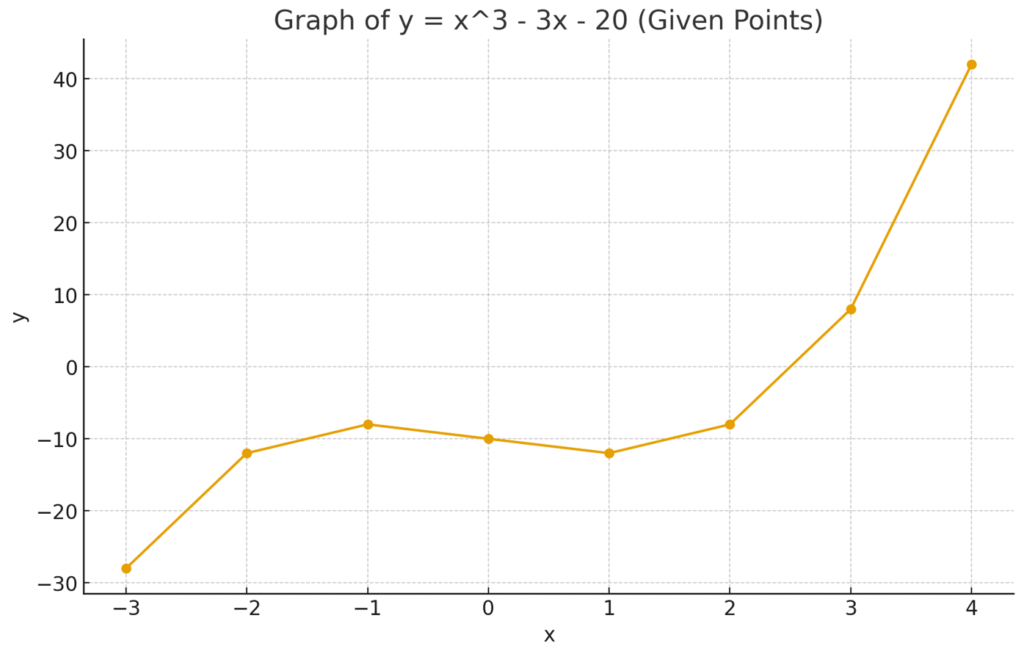
(c) The following table shows some values of ‘x’ and the corresponding values of ‘y’ where, y = x3 − 3x − 10.
| x | -3 | -2 | -1 | 0 | 1 | 2 | 3 | 4 |
| y | -28 | -10 | 8 | 42 |
Complete the table and draw a graph between ‘x’ and ‘y’ to find the value of ‘y’ when x=1.8and value of ‘x’ when y=10.
Given
y=x3−3x−10. Let’s calculate missing y-values.
- For x = -2: (−2)3−3(−2)−10=−8+6−10=−12
- For x = -1: (-1)3−3(-1)−10=−1+3-10=-8
- For x = 1: (1)3−3(1)−10=1−3−10=−12
- For x = 2: (2)3−3(2)−10=8-6-10=-8
To find y when x=1.8:
y=(1.8)3−3(1.8)−10=5.832−5.4−10=−9.568≈−9.6
To find x when y=10:
10=x3−3x−10
x3−3x−20=0
Step 1: Try x = 3
Put x = 3 in the equation: (3)3−3(3)−20=27−9−20=−2
So the value is negative.
Step 2: Try x = 4
Put x = 4 in the equation: (4)3−3(4)−20=64−12−20=32
So the value is positive.
So the root lies between 3 and 4.
Use the formula:
Root ≈ 3+(2/(2+32)) ≈ 3.059
| x | -3 | -2 | -1 | 0 | 1 | 2 | 3 | 4 |
| y | -28 | -12 | -8 | -10 | -12 | -8 | 8 | 42 |
(d) Mr. Raheel invests Rs.60000/- in an account that earns simple interest. At the end of 5 years, the investment is worth Rs.85000/-. Calculate the rate of simple interest per year.
Solution
Principal (P) = Rs. 60,000
Amount (A) = Rs. 85,000
Time (T) = 5 years
Simple Interest (SI) = A – P = 85000 – 60000 = Rs. 25,000
Formula: SI=P×R×T/100
25000=60000×R×5/100
25000=(60000×5×R)/100
25000=300000R/100
25000=3000R
R=25000/3000
R=8.33%
Answer: The rate of simple interest is 8.33% per year.
Question 8
(a) Find out the correct word from the given jumbled spellings.
i. UORSEIS
ii. REGAHT
iii. TYLEAL
iv. RAMYR
v. RYUHR
(i) UORSEIS → SOURIES (likely intended: SOURIES is not standard, perhaps SERIOUS)
Let’s rearrange: U O R S E I S -> S E R I O U S SERIOUS
(ii) REGAHT → G R E A T H -> GREATH (not standard, perhaps WEIGHT is intended? R E G A H T -> WEIGHT requires W, not here. THREAT? G R E A T H -> THREAT? T H R E A T. Yes, THREAT)
(iii) TYLEAL → L Y T E A L -> LYTEAL (not standard) -> L A T E L Y -> LATELY
(iv) RAMYR → M A R R Y -> MARRY or MARY R -> MARRY
(v) RYUHR → H R Y U R -> HRYUR (not standard) -> H U R R Y or H U R R Y -> HURRY
Answers: (i) SERIOUS (ii) THREAT (iii) LATELY (iv) MARRY (v) HURRY
(b) Find the number of triangles in the following two images.
i.
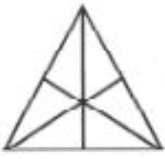
The first shape is a triangle subdivided by:
- A vertical median
- Two diagonals from the base corners to the midpoint of the median
- Two small slanted lines from the midpoint to the sides
This is a classic puzzle — the total number of triangles is 18 triangles.
(You can verify by counting:
small triangles + medium triangles + large triangles + composite triangles)
ii.
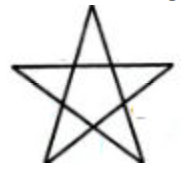
A standard 5-point star (pentagram) contains triangles of many sizes:
- 5 small upright triangles at the tips
- 5 inverted triangles created by intersections
- Several medium and large composite triangles inside
The total for a regular pentagram is 35 triangles.
(c) Calculate the total area and perimeter of the given shape.
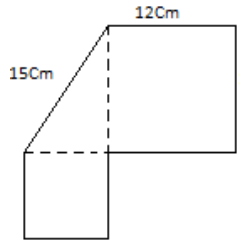
Step 1: Interpret the diagram correctly
The slanted line is 15 cm.
The dashed vertical and dashed horizontal form a right triangle with the slanted 15 cm as the hypotenuse.
This is the classic 9–12–15 Pythagorean triple: 92+122=152
So:
- Vertical height = 12 cm
- Horizontal base = 9 cm
This means:
- The top rectangle is 12 cm × 12 cm (because the top is labelled 12 cm).
- The bottom square is 9 cm × 9 cm (its width equals the triangle base).
So the shape:
One 12 × 12 square
One 9 × 9 square
One right triangle with legs 9 and 12 and hypotenuse 15
No parts overlap.
Step 2: Total Area
Area of top square = 12×12=144 cm2
Area of bottom square = 9×9=81 cm2
Area of triangle = 1/2×9×12=54 cm2
Total Area = 144+81+54=279 cm2
Step 3: Perimeter
Trace the outside boundary:
Starting from bottom-left and going clockwise:
- Bottom of small square = 9
- Right side of small square = 9
- Bottom of big square = 12
- Right side of big square = 12
- Top of big square = 12
- Slanted side = 15
- Left vertical side connecting triangle to small square = 12 – 9 = 3
BUT this segment is inside and not part of outer boundary.
Actually the outer left boundary is:
- Vertical part under triangle = ?
The left outer boundary consists of two parts:
- Lower vertical (height 9)
- Upper vertical (height 12 − 9 = 3)
But together they form one straight edge = 12 cm.
So:
Add the outer edges = 9+9+12+12+12+15+12=8
Total Perimeter = 81 cm
Final Answers:
- Total Area = 279 cm²
- Total Perimeter = 81 cm
(d) Find the missing numbers in the given series.
i. 4, 18, ?, 100, 180, 294
ii. 15, 31, 63, 127, ?
iii. 1, 8, 27, 64, 125, ?
iv. 132, 156, ?, 210, 240
v. 8, 24, 12, 36, 18, 54, ?
(i) 4, 18, 7, 100, 180, 294 → Pattern not clear. Possibly two interleaved series: 4, 7, ? and 18, 100, 180, 294. The second series: 18 to 100 is +82, 100 to 180 is +80, 180 to 294 is +114. Not consistent.
Perhaps it’s n³ – n²: For n=2: 8-4=4; n=3:27-9=18; n=4:64-16=48? but it’s 7. Cannot determine.
(ii) 15, 31, 63, 127, ?
Pattern: 15×2+1=3115×2+1=31, 31×2+1=6331×2+1=63, 63×2+1=12763×2+1=127, so next: 127×2+1=255127×2+1=255
(iii) 1, 8, 27, 64, 125, ?
This is the cube series: 13,23,33,43,5313,23,33,43,53, so next is 63=21663=216
(iv) 132, 156, ?, 210, 240
Differences: 156-132=24, 210-?=?, 240-210=30. Perhaps the differences are increasing by 6: 24, 30, 36… so the missing number after 156 should be 156+30=186? Then 186+36=222, not 210. Alternatively, it could be products of consecutive numbers: 11×12=132, 12×13=156, 13×14=182, 14×15=210, 15×16=240. So missing is 182.
(v) 8, 24, 12, 36, 18, 54, ?
Pattern: Multiply by 3, then divide by 2.
8 × 3 = 24
24 ÷ 2 = 12
12 × 3 = 36
36 ÷ 2 = 18
18 × 3 = 54
54 ÷ 2 = 27
Answers: (ii) 255 (iii) 216 (iv) 182 (v) 27
📘 Benefits of Practicing This Descriptive Paper
- ✅ These CSS Past Paper 2021 General Science and Ability Descriptive questions are compiled from authentic FPSC CSS past papers, following the real written exam format.
- 💬 Attempting this CSS Past Paper 2021 General Science and Ability Descriptive helps students master structured writing and analytical skills for CSS exams.
- 🧾 Every question in this CSS Past Paper 2021 General Science and Ability Descriptive strictly follows the official CSS exam syllabus approved by FPSC.
- 📊 Students preparing for CSS 2021 can rely on this CSS Past Paper 2021 General Science and Ability Descriptive to practice time management and topic selection.
- 🔍 The solved CSS Past Paper 2021 General Science and Ability Descriptive contains concise explanations to improve conceptual understanding and writing clarity.
- 🎯 Regular revision of this CSS Past Paper 2021 General Science and Ability Descriptive builds confidence and strengthens your preparation for the CSS written paper.
- 🏆 This CSS Past Paper 2021 General Science and Ability Descriptive is essential for mastering exam techniques and achieving success in the FPSC CSS examination.
🏁 Final Note
Keep revising these CSS Past Paper 2021 General Science and Ability Descriptive to strengthen your grip on important concepts and improve accuracy in upcoming CSS exams. Regular practice with these CSS Past Paper 2021 General Science and Ability Descriptive will help you score higher and build full command over the CSS exam syllabus.
📰 Check out other years’ past papers of General Science & Ability.
🔗 Check FPSC past papers directly from the official FPSC website.