CSS Past Paper 2023 General Science and Ability Descriptive (Part 2)

CSS | Past Paper | Compulsory | 2023 | Part 2 | Descriptive
Below is the solution to PART-II (COMPULSORY) of the CSS Past Paper 2023 General Science and Ability Descriptive (Part 2).
Question 2
(a) Define ceramic and nano-ceramic materials. Why the nano-ceramics show better properties than their ceramic counterparts? Write the applications of ceramic materials.
Ceramic Materials
Ceramics are inorganic, non-metallic solids, typically comprising a combination of metallic and non-metallic elements (e.g., oxides, carbides, nitrides). They are known for their high hardness, high melting points, excellent chemical resistance, and brittleness. They are formed by heating and subsequent cooling, a process known as firing or sintering. Examples include clay products, porcelain, bricks, and refractory materials.
Nano-ceramic Materials
Nano-ceramics are a class of ceramics where the crystalline grains or particles are engineered to be on the nanoscale (typically 1-100 nanometers). This manipulation at the atomic or molecular level fundamentally changes their properties.
Why Nano-ceramics Show Better Properties?
The superior properties of nano-ceramics stem from their dramatically increased grain boundary area due to the nanoscale size of their particles.
- Enhanced Mechanical Strength: Smaller grain size impedes the propagation of cracks, making them less brittle and significantly stronger (following the Hall-Petch relationship).
- Improved Ductility: Some nano-ceramics can exhibit super plasticity, meaning they can be deformed to a large extent without fracturing, which is unheard of in conventional ceramics.
- Superior Electrical and Thermal Properties: Properties like electrical conductivity and thermal resistance can be finely tuned and often enhanced for specific applications like solid oxide fuel cells or thermal barrier coatings.
Applications of Ceramic Materials
- Structural: Bricks, tiles, roofing, cement, and glass in construction.
- Refractories: Linings for furnaces, kilns, and incinerators due to high melting points.
- Electrical and Magnetic: Insulators, semiconductors, capacitors, ferrites in transformers, and superconductors.
- Biomedical: Dental implants (porcelain crowns), bone implants (bio-inert ceramics like alumina), and bone grafts (bioactive ceramics like hydroxyapatite).
- Consumer Products: Tableware, cookware, and abrasive materials (e.g., sandpaper).
- Advanced Applications: Heat-resistant tiles for space shuttles, coatings for jet engine turbines, and components in fuel cells.
(b) What is ‘Black Hole’? How black holes are formed and discovered?
Black Hole
A black hole is a region in space where the gravitational pull is so immensely powerful that nothing, not even particles or electromagnetic radiation such as light, can escape from it. The boundary beyond which no escape is possible is called the event horizon.
Formation
Black holes are formed when a massive star (typically many times the mass of our Sun) reaches the end of its life cycle. The star exhausts its nuclear fuel, leading to a catastrophic collapse under its own gravity. This collapse causes the core to be compressed into an infinitely dense point known as a singularity, surrounded by the event horizon. This process is often triggered by a supernova explosion.
Discovery
Black holes cannot be observed directly because no light escapes them. They are discovered and studied through their effects on their surroundings:
- Gravitational Influence: Astronomers can detect a black hole by observing the orbit of stars or gas clouds around an invisible, massive object (e.g., at the center of our galaxy, Sagittarius A*).
- Accretion Disk: As matter is pulled toward a black hole, it forms a superheated, spinning structure called an accretion disk. The intense friction and magnetic fields heat this matter to millions of degrees, causing it to emit powerful X-rays that telescopes can detect.
- Gravitational Waves: The collision and merger of two black holes create ripples in spacetime called gravitational waves, which were first directly detected by LIGO in 2015, providing the most direct evidence for their existence.
(c) Write two applications of each of the following electromagnetic radiations:
(i) Ultraviolet
- Sterilization: Used to kill bacteria and viruses in water purifiers, air filters, and for sterilizing medical equipment.
- Forensics: Used to detect forged documents and analyze crime scenes (bodily fluids and fingerprints fluoresce under UV light).
(ii) Infra-red
- Thermal Imaging: Used in night-vision equipment, weather forecasting, and medical diagnostics to detect heat signatures.
- Remote Controls & Data Transfer: Used in TV remotes, short-range communication between devices (e.g., older mobile phones), and fiber optic communication.
(iii) Microwaves
- Radar & Communication: Used in radar technology for aircraft and ship navigation, speed guns, and satellite communication.
- Microwave Ovens: Used to heat food by causing water molecules in food to vibrate.
(iv) Radio waves
- Broadcasting: Used for transmitting radio and television signals over long distances.
- MRI (Magnetic Resonance Imaging): Used in medicine to create detailed images of the inside of the human body.
(v) X-rays
- Medical Imaging: Used to view bone structures and diagnose fractures, dental problems, and tumors.
- Security Screening: Used in airports to scan luggage for prohibited items.
- Industrial Radiography: Used to inspect welds and detect cracks in metal structures.
(d) What is Wildfire? Explain its types, causes, spread and preventions.
Wildfire
A wildfire, also known as a forest fire or bushfire, is an uncontrolled fire that burns in a forest, grassland, or other vegetated area.
Types
- Surface Fire: Burns along the forest floor, consuming leaf litter, fallen branches, and low-lying vegetation.
- Ground Fire: Burns organic matter in the soil itself, such as peat or coal seams. These fires are slow-moving but very difficult to extinguish.
- Crown Fire: Advances through the tops of trees and shrubs. It is extremely intense and spreads rapidly, driven by wind.
Causes
- Natural: Lightning strikes, volcanic eruptions, and spontaneous combustion of dry vegetation.
- Human-Induced (Anthropogenic): Carelessly discarded cigarettes, unattended campfires, arson, burning debris, and sparks from equipment or power lines.
Spread
The spread of a wildfire is influenced by the Fire Triangle: Fuel (dry vegetation), Oxygen (wind), and Heat (ignition source). Strong winds supply oxygen, carry embers ahead of the main fire (spotting), and push the flames forward. Steep terrain can preheat uphill fuel, causing fires to spread faster uphill. Dry weather and drought conditions provide ample fuel.
Preventions
- Public Education: Campaigns like “Smokey Bear” to prevent human-caused ignitions.
- Fuel Management: Creating firebreaks (gaps in vegetation), and conducting controlled or prescribed burns to reduce available fuel.
- Legislation & Enforcement: Enforcing laws against burning during dry seasons and penalizing arson.
- Community Planning: Designing fire-resistant landscapes around homes (defensible space) and using fire-resistant building materials.
Question 3
(a)
(i) Why the bat and whale are considered as mammals?
Despite their flight (bat) and aquatic (whale) adaptations, bats and whales share the key defining characteristics of mammals:
- Mammary Glands: They both produce milk to nourish their young.
- Hair or Fur: Bats have fur on their bodies. Whales are born with a small amount of hair (e.g., on their snout), which they may lose as adults, but the genetic trait is present.
- Endothermy (Warm-Blooded): They are warm-blooded and maintain a constant internal body temperature.
- Live Birth: They give birth to live young (viviparous), rather than laying eggs.
- Three Ear Bones: They possess the three characteristic middle ear bones (malleus, incus, stapes) found only in mammals.
(ii) Write a note on liver juice ‘Bile’.
Bile is a bitter-tasting, greenish-yellow alkaline fluid secreted by the liver and stored and concentrated in the gallbladder. It is not an enzyme but plays a critical role in digestion, primarily of lipids (fats).
- Composition: It consists of water, bile salts, bile pigments (bilirubin and biliverdin, which give feces its brown color), cholesterol, and phospholipids.
- Functions:
- Emulsification of Fats: Its primary function is to break down large globules of fat into smaller droplets (emulsification). This drastically increases the surface area for the enzyme lipase to act upon, enabling efficient digestion of fats.
- Neutralization: Being alkaline, it neutralizes the acidic chyme (partially digested food) coming from the stomach into the duodenum (small intestine), providing an optimal pH for pancreatic and intestinal enzymes to function.
- Excretion: It serves as a pathway for the excretion of waste products from the body, particularly bilirubin (a breakdown product of old red blood cells) and excess cholesterol.
(b) How the urine is formed? Describe the role of kidney in excretion.
Formation of Urine
Urine formation is a complex process that occurs in the nephrons, the functional units of the kidneys. It involves three main steps:
- Glomerular Filtration: Blood enters the kidney under pressure through the glomerulus, a tight knot of capillaries. Due to this high pressure, water, ions, glucose, urea, and other small molecules are forced out of the blood and into the Bowman’s capsule. This filtered fluid is called the glomerular filtrate. Large molecules like proteins and blood cells remain in the blood.
- Tubular Reabsorption: The filtrate then passes through the renal tubule. Here, essential substances needed by the body—such as glucose, amino acids, most water, and essential ions (like Na⁺, K⁺, Cl⁻)—are actively reabsorbed back into the surrounding capillaries (peritubular network).
- Tubular Secretion: This is the opposite process. Additional waste products, such as hydrogen ions, potassium ions, and drugs like penicillin, are actively secreted from the blood in the capillaries into the renal tubule. This process further purifies the blood.
The fluid that remains after these processes is urine, which is concentrated and passed to the ureter, then to the bladder for storage, and finally excreted from the body via the urethra.
Role of Kidney in Excretion
The kidney is the primary organ of the excretory system. Its role is to:
- Remove nitrogenous wastes (mainly urea) produced by the metabolism of proteins.
- Regulate the water and electrolyte (salt) balance of the body (osmoregulation).
- Regulate the acid-base balance (pH) of the blood.
- Secrete the hormone erythropoietin, which stimulates red blood cell production.
(c)
(i) How a bacterial cell is different from a plant cell?
| Feature | Bacterial Cell (Prokaryote) | Plant Cell (Eukaryote) |
| Nucleus | Absent. DNA is in a region called nucleoid. | Present. Well-defined, membrane-bound nucleus. |
| Membrane-bound Organelles | Absent (e.g., no mitochondria, ER, Golgi). | Present (e.g., mitochondria, ER, Golgi apparatus). |
| Cell Wall | Made of peptidoglycan. | Made of cellulose. |
| Ribosomes | Smaller (70S). | Larger (80S). |
| Chromosome | Single, circular chromosome. | Multiple, linear chromosomes. |
| Reproduction | Asexual (binary fission). | Asexual and sexual (mitosis & meiosis). |
| Size | Generally very small (1-10 μm). | Generally larger (10-100 μm). |
(ii) What do you think cold-blooded animals are slowed down by low temperatures?
Cold-blooded animals (ectotherms), such as reptiles, amphibians, and fish, rely on external environmental heat sources to regulate their body temperature. Their metabolic rate is directly dependent on the ambient temperature.
- At low temperatures, their metabolic processes (like enzyme activity, nerve signal transmission, and muscle contraction) slow down significantly. This reduces their energy levels, movement, digestion, and overall activity.
- They become lethargic and sluggish as their bodies cannot generate internal heat to maintain optimal metabolic function. This is why they are often seen basking in the sun to warm up.
(d) What is hepatitis, its types, causes, prevention, and cure?
Hepatitis
Hepatitis is the medical term for inflammation of the liver. It can be self-limiting or can progress to fibrosis (scarring), cirrhosis, or liver cancer.
Types and Causes
- Hepatitis A (HAV): Caused by the Hepatitis A virus. Spread through ingestion of contaminated food or water (fecal-oral route).
- Hepatitis B (HBV): Caused by the Hepatitis B virus. Spread through contact with infectious body fluids (blood, semen, etc.) e.g., unprotected sex, sharing needles, from mother to baby during childbirth.
- Hepatitis C (HCV): Caused by the Hepatitis C virus. Primarily spread through blood-to-blood contact (e.g., sharing needles, unsterilized medical equipment).
- Hepatitis D (HDV): Occurs only in people who are already infected with HBV.
- Hepatitis E (HEV): Similar to HAV, spread through contaminated water. Common in areas with poor sanitation.
- Alcoholic Hepatitis: Caused by excessive alcohol consumption.
- Autoimmune Hepatitis: occurs when the body’s immune system attacks the liver.
Prevention
- Vaccination: Highly effective vaccines are available for HAV and HBV.
- Good Hygiene: Washing hands thoroughly helps prevent HAV and HEV.
- Safe Practices: Avoiding sharing needles, practicing safe sex, and ensuring blood products are screened prevent HBV and HCV.
- Safe Water and Food: Especially in endemic areas.
- Moderation in Alcohol Consumption.
Cure/Treatment
- HAV & HEV: Usually acute and resolve on their own with supportive care (rest, hydration). No specific antiviral therapy.
- HBV: Can be chronic. Treatment involves antiviral medications (e.g., entecavir, tenofovir) to suppress the virus, but a complete cure is rare.
- HCV: Chronic HCV is now curable in over 95% of cases using direct-acting antiviral (DAA) medications over a short course (8-12 weeks).
- Alcoholic & Autoimmune: Treatment involves stopping alcohol and using immunosuppressant drugs (like corticosteroids), respectively.
Question 4
(a) What is the difference between fog and smog? What are the causes of smog and its effects on human health? Write short note on any one of the latest technologies to eliminate smog to avoid atmospheric pollution.
Difference between Fog and Smog
- Fog is a natural meteorological phenomenon where tiny water droplets are suspended in the air near the Earth’s surface, reducing visibility. It is essentially a cloud at ground level.
- Smog (a portmanteau of “smoke” and “fog”) is a type of intense air pollution. It is a mixture of pollutants, primarily ground-level ozone (O₃), particulate matter (PM), nitrogen oxides (NOx), volatile organic compounds (VOCs), and other chemicals. It is hazy and often has a brownish hue.
Causes of Smog
Smog is primarily caused by the reaction of sunlight with certain chemicals in the atmosphere (photochemical smog). The primary precursors are:
- Emissions from Vehicles: Nitrogen oxides (NOx) and hydrocarbons (VOCs) from burning gasoline and diesel.
- Industrial Emissions: Factories and power plants release NOx, SO₂, and particulate matter.
- Consumer Products: VOCs from solvents, paints, and chemical solvents.
Effects on Human Health
- Irritation of eyes, nose, and throat.
- Aggravation of asthma and other respiratory diseases like bronchitis and emphysema.
- Long-term exposure can lead to reduced lung function and chronic respiratory illness.
- Increased risk of heart attacks and strokes due to inflammation caused by fine particulate matter (PM2.5).
- It is particularly dangerous for children, the elderly, and people with pre-existing health conditions.
Latest Technology: Smog-Free Tower
One innovative technology is the Smog-Free Tower, conceived by Dutch artist Daan Roosegaarde. It is the world’s largest outdoor air purifier.
- How it works: The 7-meter-tall tower uses patented positive ionization technology. It sucks in polluted air from the top. Inside, it gives smog particles a positive charge. These charged particles are then attracted to a negatively charged surface inside the tower (a ground electrode). The cleaned air is then released through vents on the six sides of the tower, creating a localized bubble of clean air.
- Efficiency: It can clean over 30,000 cubic meters of air per hour and uses a small amount of green electricity. The collected carbon particles are even compressed under high pressure to create “Smog Free Jewellery”, like rings and cufflinks, to raise awareness.
(b) What is the role of oxygen-demanding wastes in water pollution? How it can be prevented?
Role of Oxygen-Demanding Wastes
Oxygen-demanding wastes are biodegradable organic materials (e.g., sewage, food processing waste, fertilizer runoff) that are decomposed by aerobic (oxygen-requiring) bacteria present in water bodies.
During decomposition, these bacteria consume a large amount of dissolved oxygen (DO) in the water. If the input of such wastes is excessive, the bacteria can deplete the DO levels to a point where it becomes insufficient for aquatic life, such as fish and insects. This leads to the death of these organisms and transforms the water body into an anaerobic (without oxygen) system, producing foul-smelling gases like methane and hydrogen sulfide. This process is called eutrophication.
Prevention
- Wastewater Treatment: Properly treating sewage and industrial effluent in treatment plants before discharging it into rivers or lakes is the most critical step. This reduces the Biological Oxygen Demand (BOD) of the effluent.
- Reducing Runoff: Implementing better agricultural practices to reduce the runoff of fertilizers and animal waste into waterways.
- Regulation and Monitoring: Enforcing strict environmental laws and regularly monitoring the BOD levels in industrial discharges and water bodies.
- Public Awareness: Educating the public about the proper disposal of organic wastes and the dangers of dumping sewage.
(c) What is the biosphere? Write a note on the ‘Energy Resources’ available in the biosphere.
Biosphere
The biosphere is the global ecological system that integrates all living beings (biota) and their relationships, including their interactions with the lithosphere (earth), hydrosphere (water), and atmosphere (air). It is the narrow zone of life on Earth, extending from the deep ocean vents to the upper reaches of the atmosphere.
Energy Resources in the Biosphere
The energy resources in the biosphere can be categorized as renewable and non-renewable, with the ultimate source for almost all being the Sun.
- Renewable Resources:
- Solar Energy: The most fundamental source, captured directly through photovoltaic cells or solar thermal systems.
- Wind Energy: Caused by the uneven heating of the Earth’s surface by the sun, harnessed by wind turbines.
- Hydropower: Energy from flowing water, driven by the solar-powered water cycle.
- Biomass Energy: Energy stored in organic material (plants, agricultural waste) which originally captured solar energy through photosynthesis. It can be burned directly or converted into biofuels (e.g., biogas, ethanol).
- Geothermal Energy: Although not solar-derived, it is renewable. It harnesses the heat from the Earth’s interior.
- Tidal & Wave Energy: Driven by the gravitational pull of the moon and sun.
- Non-Renewable Resources: These are essentially stored solar energy from ancient biospheres, converted over millions of years.
- Fossil Fuels: Coal, petroleum, and natural gas are formed from the decomposed remains of prehistoric plants and animals.
- Nuclear Energy: Derived from radioactive minerals like uranium, which are part of the Earth’s crust.
(d) What are the different layers of the atmosphere? On what basis these layers are classified? In which layer ‘Auroras’ are formed and where do satellites orbit?
The Earth’s atmosphere is divided into five main layers based on temperature gradient (how temperature changes with altitude).
- Troposphere: (0 to ~12 km) The lowest layer where we live and weather occurs. Temperature decreases with altitude.
- Stratosphere: (~12 to 50 km) Contains the ozone layer which absorbs UV radiation. Temperature increases with altitude due to this absorption.
- Mesosphere: (~50 to 85 km) The coldest layer. Temperature decreases with altitude. Meteors burn up here.
- Thermosphere: (~85 to 600 km) Temperature increases dramatically with altitude due to absorption of highly energetic solar radiation. This layer is where the Auroras (Northern and Southern Lights) occur. Charged particles from the sun collide with gas molecules here, causing them to emit light.
- Exosphere: (600 km and beyond) The outermost layer, where atoms and molecules escape into space. It merges with the vacuum of space.
Satellites orbit primarily within the Thermosphere and the upper reaches of the Mesosphere. However, for practical purposes, this region is often referred to as Low Earth Orbit (LEO), which extends from about 160 km to 2,000 km above the Earth.
Question 5
(a) What are antioxidants and why are they used in foods? Write a short note on natural and synthetic antioxidants.
Antioxidants
Antioxidants are molecules that inhibit or slow down the oxidation of other molecules. Oxidation is a chemical reaction that can produce free radicals, leading to chain reactions that damage cells (in the body) or cause food to spoil (rancidity in fats and oils) and discolor.
Why Used in Foods?
They are added to foods as preservatives to:
- Increase Shelf Life: Prevent or delay the oxidative deterioration of food, such as fat rancidity and browning of fruits.
- Maintain Nutritional Quality: Protect vitamins (like A, C, and E) and other nutrients from being destroyed by oxidation.
- Preserve Color and Flavor: Prevent undesirable changes in the appearance and taste of food.
Natural Antioxidants
These are derived from plant sources.
- Examples: Vitamin C (Ascorbic acid – found in citrus fruits), Vitamin E (Tocopherols – found in nuts and seeds), carotenoids (e.g., beta-carotene – found in carrots), flavonoids (found in tea, cocoa, berries), and rosemary extract.
- Usage: Often labeled as “clean label” ingredients and are preferred by health-conscious consumers.
Synthetic Antioxidants
These are manufactured chemicals that are highly effective and stable.
- Examples: Butylated hydroxyanisole (BHA), Butylated hydroxytoluene (BHT), Propyl gallate, and Tertiary butylhydroquinone (TBHQ).
- Usage: They are cost-effective and potent, used extensively in processed foods, oils, snacks, and cosmetics. Their use is regulated by food safety authorities (like the FDA) as high doses may have health concerns.
(b) How the carbohydrates, proteins, and fats are digested in humans?
Digestion is the process of breaking down large, insoluble food molecules into small, water-soluble molecules so they can be absorbed into the blood.
Carbohydrates (e.g., Starch)
- Mouth: Digestion begins with salivary amylase enzyme breaking down starch into smaller sugars (maltose).
- Small Intestine: The primary site. Pancreatic amylase continues the breakdown. Enzymes (maltase, sucrase, lactase) on the lining of the small intestine (brush border) break down disaccharides into monosaccharides (glucose, fructose, galactose) for absorption.
Proteins
- Stomach: The enzyme pepsin (activated from pepsinogen by HCl) breaks proteins into large peptides.
- Small Intestine: Pancreatic enzymes (trypsin and chymotrypsin) break peptides into smaller peptides. Enzymes on the brush border (peptidases) break these down into amino acids for absorption.
Fats (Lipids)
- Small Intestine: Fats are insoluble in water, making them difficult to digest. Bile from the liver emulsifies fats, breaking them into tiny droplets.
- The enzyme pancreatic lipase can then efficiently break down the fat droplets into fatty acids and glycerol (monoglycerides), which are absorbed by the intestinal lining.
(c) How does the Navstar GPS system work for different applications?
The Navstar Global Positioning System (GPS) is a satellite-based radio-navigation system owned by the United States government. It provides geolocation and time information to a GPS receiver anywhere on or near the Earth.
How it Works?
- Constellation: The system consists of a network of at least 24 satellites orbiting the Earth, distributed so that a minimum of 4 are visible from any point on the globe at any time.
- Triangulation: Each satellite continuously transmits a radio signal that includes its location and the precise time the signal was sent.
- Distance Calculation: The GPS receiver calculates its distance from each satellite by measuring the time it took for the signal to travel from the satellite to the receiver (Distance = Speed of Light × Time).
- Position Fix: By knowing its precise distance from at least three satellites, the receiver can pinpoint its location on Earth in two dimensions (latitude and longitude). With a fourth satellite, it can also determine altitude (3D positioning).
Applications
- Navigation: Turn-by-turn directions for cars, ships, and aircraft.
- Mapping & Surveying: Creating accurate maps and land surveys.
- Timing: Providing precise time synchronization for networks like banking systems, power grids, and cellular networks.
- Tracking: Monitoring the movement of vehicles (fleet management), wildlife, and valuable assets.
- Precision Agriculture: Guiding farm equipment for efficient planting, fertilizing, and harvesting.
- Search and Rescue: Locating people in distress quickly and accurately.
- Recreation: Used in hiking, geocaching, and fitness trackers.
(d) What are longitudinal waves, electromagnetic and Gamma radiations? Discuss them.
(i) Differentiate between network and internet.
Network
A network is a general term for a collection of two or more computers connected together to share resources (like files, printers) and communicate. It can be as small as a home Wi-Fi network connecting a laptop and a phone (LAN – Local Area Network) or as large as a bank’s private network across a city (WAN – Wide Area Network).
Internet
The Internet is a specific, massive global network of networks. It is the public, interconnected network that uses standardized communication protocols (TCP/IP) to link billions of devices worldwide. A network can exist without the Internet, but the Internet cannot exist without networks.
(ii) What is the difference among application, program and software?
These terms are often used interchangeably but have subtle differences in scope.
Software
This is the broadest term. It refers to a complete set of programs, procedures, and documentation that perform a specific task on a computer system. It includes system software (e.g., Windows OS, device drivers) and application software.
Program
A program is a specific set of instructions written in a programming language that tells the computer how to perform a particular task. It is a single entity. Software is comprised of one or more programs. Example: notepad.exe is a program.
Application (App)
An application is a type of software designed for the end-user to perform a specific, user-oriented task. It is a subset of software. All applications are software, but not all software is an application (e.g., an operating system is software but not an application). Example: Microsoft Word is an application (software) composed of many programs.
Question 6
(a) A telephone company charges initially Rs.0.50 and then Rs. 0.11 for every minute. Write an expression that gives the cost of a call that lasts N minutes.
Solution
The cost consists of a fixed initial charge plus a variable charge based on minutes.
- Fixed cost = Rs. 0.50
- Variable cost = (Number of minutes) × (Cost per minute) = N × 0.11
Therefore, the expression for the total cost C is:
C = 0.50 + 0.11N
(b) Find the missing number in the series below:
(i) 1, 8, 4, 27, 9, ?
Pattern: The series alternates between cubes and squares.
1³=1, 2²=4, 2³=8, 3²=9, 3³=27, so the next should be 4²=16.
Answer: 16
(ii) 3, 6, 8, 16, 18, ?
Pattern: Multiply by 2, then add 2. Repeat.
3 × 2 = 6; 6 + 2 = 8; 8 × 2 = 16; 16 + 2 = 18; 18 × 2 = 36.
Answer: 36
(iii) 2, 8, 512, ?
Pattern: Each term is the cube of the previous term.
2³ = 8; 8³ = 512; 512³ = 134,217,728.
Answer: 134217728
(iv) 81, 9, 64, 8, ?, 12
Pattern: The series shows a square followed by its square root, then a different square and its root.
81 (which is 9²), then 9 (its root); 64 (which is 8²), then 8 (its root). Following this, the next square should be 144 (which is 12²), followed by its root 12.
Answer: 144
(v) 6, 11, 21, 36, 56, ?
Pattern: Examine the differences between consecutive terms:
11 – 6 = 5
21 – 11 = 10
36 – 21 = 15
56 – 36 = 20
The differences are increasing by 5 each time. Therefore, the next difference will be 20 + 5 = 25.
So, the next number is 56 + 25 = 81.
Answer: 81
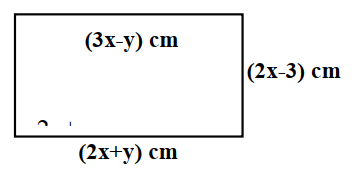
(c) The perimeter of the rectangle given below is 114 cm. Find the area of the rectangle.
Solution
(Assume the sides are labeled: Length = (2x + y) cm, Width = (3x – y) cm, and another side is given as (2x – 3) cm. For a rectangle, opposite sides are equal. Therefore, we can assume:
Width: (3x – y) cm and (2x – 3) cm are equal.
Length: (2x + y) cm is the other side.
So:
- 3x – y = 2x – 3 => x – y = -3 … (Equation 1)
- Perimeter = 2(Length + Width) = 2[(2x + y) + (3x – y)] = 2(5x) = 10x
Given Perimeter = 114 cm.
So, 10x = 114 => x = 11.4
Plug x = 11.4 into Equation 1:
11.4 – y = -3 => -y = -3 – 11.4 => -y = -14.4 => y = 14.4
Now, find Length and Width:
Length (L) = 2x + y = 2(11.4) + 14.4 = 22.8 + 14.4 = 37.2 cm
Width (W) = 3x – y = 3(11.4) – 14.4 = 34.2 – 14.4 = 19.8 cm
Area of rectangle = L × W = 37.2 cm × 19.8 cm
Let’s calculate this:
37.2 × 19.8 = 37.2 × (20 – 0.2) = (37.2 × 20) – (37.2 × 0.2) = 744 – 7.44 = 736.56 cm²
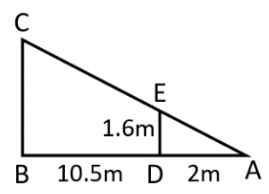
(d) Ahmad stands at point D, 2m in front of a spotlight at point A. He is 1.6m tall and is facing the wall of a building which is 10.5m away from him. How tall (BC) is his shadow on the wall of the building.
Solution
Let’s interpret the setup based on the description and typical geometry:
- Spotlight at A.
- Ahmad is at D, 2m in front of A, so AD = 2m.
- Ahmad’s height, DE = 1.6m.
- The wall is 10.5m away from Ahmad, so the distance from D to the wall (let’s say point B vertically below the shadow’s head) is DB = 10.5m.
- We need the height of the shadow on the wall, BC.
This creates two similar triangles: Triangle (ADE) and Triangle (ABC).
- Triangle ADE: Right-angled at D? Actually, A, D, and E are points. Assume A to D is horizontal, and D to E is vertical (Ahmad’s height).
- Triangle ABC: A to B is horizontal (along the ground to the wall), and B to C is vertical (the shadow height).
The light rays travel from A, past the top of Ahmad’s head (E), and hit the wall at C.
So, Triangles ADE and ABC are similar (by AA similarity: both right-angled and share angle at A).
Therefore, the ratios of corresponding sides are equal:
(Height of Ahmad) / (Distance from light to Ahmad) = (Height of Shadow) / (Distance from light to wall)
Let’s define the distances clearly:
- Distance from light (A) to Ahmad (D) = AD = 2m.
- Distance from light (A) to the wall (B) = AD + DB = 2m + 10.5m = 12.5m.
- Height of Ahmad = DE = 1.6m.
- Height of Shadow = BC = ? (Let’s call it H).
Using similarity:
DE / AD = BC / AB
1.6 / 2 = H / 12.5
Now solve for H:
0.8 = H / 12.5
H = 0.8 × 12.5
H = 10 meters
Therefore, the height of his shadow on the wall (BC) is 10 meters.
Question 7
(a) Ali is standing 10 meters away from a tree. The distance of his eyes from his feet is 1.5 meter. Given that the distance from his eyes to the top of the tree is 15 meters, find the height of the tree.
Solution
This scenario forms a right-angled triangle. To find the total height of the tree, we must calculate the height from Ali’s eye level to the top of the tree and then add his own height.
- The horizontal distance from Ali to the tree forms the base of the triangle: 10 m.
- The line of sight from his eyes to the top of the tree is the hypotenuse: 15 m.
- Let ‘h’ be the vertical height from his eye level to the top of the tree.
Using the Pythagorean Theorem:
(Hypotenuse)² = (Base)² + (Height)²
(15)² = (10)² + (h)²
225 = 100 + h²
h² = 225 – 100
h² = 125
h = √125
h = 5√5 meters (which is approximately 11.18 meters)
This value h is the height of the tree above Ali’s eye level. To find the total height of the tree (H), we must add the height from the ground to his eyes:
H = h + 1.5
H = 5√5 + 1.5 meters
Therefore, the height of the tree is (5√5 + 1.5) meters, or approximately 12.68 meters.
(b) Find out the correct word from the jumbled spellings given below:
LNUGEF, CKANS, CIREFE, EERAANMOGTP, MNIKPPU
The task is to unscramble the letters to form meaningful English words.
1. LNUGEF
The correct arrangement is F L U N G E. The word is FLUNGE (a rare or archaic word for a sudden plunge or rush), but more commonly, this jumble is intended to form LUNGFE, which is a misspacing. The correct word is LUNGE, meaning a sudden forward movement.
Correct Word: LUNGE
2. CKANS
The correct arrangement is S N A C K. The word is SNACK.
Correct Word: SNACK
3. CIREFE
The correct arrangement is F I E R C E. The word is FIERCE.
Correct Word: FIERCE
4. EERAANMOGTP
This is a longer word. The correct arrangement is M A N O E U V E R (British English) or M A N E U V E R (American English). The extra letters ‘G’ and ‘T’ are likely a red herring or a typo. The core word is MANOEUVRE, meaning a movement or series of moves requiring skill and care.
Correct Word: MANOEUVRE (or MANEUVER)
5. MNIKPPU
The correct arrangement is P U M P K I N. The word is PUMPKIN.
Correct Word: PUMPKIN
(c) Draw and write the total number of lines of symmetry in a regular hexagon and octagon. How many lines of symmetry are there in a circle?
A line of symmetry is a line that divides a shape into two identical halves, each being a mirror image of the other.
Regular Hexagon (6 sides)
A regular hexagon has 6 lines of symmetry. These lines can be drawn through opposite vertices and through the midpoints of opposite sides.
Number of Lines of Symmetry: 6
Regular Octagon (8 sides)
A regular octagon has 8 lines of symmetry. These lines can be drawn through opposite vertices and through the midpoints of opposite sides.
Number of Lines of Symmetry: 8
Circle
A circle has an infinite number of lines of symmetry. Any straight line that passes through the center of the circle (a diameter) will divide it into two identical semicircles. Since there are an infinite number of diameters, there are an infinite number of lines of symmetry.
Number of Lines of Symmetry: Infinite
(d) The height of the Egyptian pyramid is 146.6 meters and a base length is 230.6 meters. Find the volume of that pyramid.
Solution
The pyramid has a square base. The formula for the volume (V) of a pyramid is:
V = (1/3) × Base Area × Height
Step 1: Calculate the Area of the Square Base
Area of square = side × side = (230.6 m) × (230.6 m)
Let’s calculate this:
230.6 × 230.6 = (230 + 0.6)² = (230)² + 2×230×0.6 + (0.6)² = 52900 + 276 + 0.36 = 53176.36 m²
Step 2: Apply the Volume Formula
V = (1/3) × Base Area × Height
V = (1/3) × 53176.36 m² × 146.6 m
First, multiply the base area by the height:
53176.36 × 146.6 ≈ 7,795,000 (Let’s calculate precisely: 53176.36 × 100 = 5,317,636; 53176.36 × 40 = 2,127,054.4; 53176.36 × 6 = 319,058.16; 53176.36 × 0.6 = 31,905.816. Sum: 5,317,636 + 2,127,054.4 = 7,444,690.4; + 319,058.16 = 7,763,748.56; + 31,905.816 = 7,795,654.376)
Now, multiply by 1/3:
V = (1/3) × 7,795,654.376
V ≈ 2,598,551.4587 m³
Therefore, the volume of the pyramid is approximately 2,598,551.46 cubic meters.
For a more precise and clean answer:
V = (1/3) × (230.6) ² × 146.6
This is the exact form. Calculating it yields ~2,598,551.46 m³.
Question 8
(a) Ali buys an oven for Rs. 36800 and sells it at a gain of 8.5%. For how much does he sell it?
Solution
A gain or profit is calculated as a percentage of the Cost Price (C.P.).
- Cost Price (C.P.) = Rs. 36,800
- Gain Percentage = 8.5%
The formula for Selling Price (S.P.) when there is a gain is:
S.P. = C.P. + (Gain% × C.P.)
This can be factored as:
S.P. = C.P. × (1 + Gain%/100)
Applying the values:
S.P. = 36800 × (1 + 8.5/100)
S.P. = 36800 × (1 + 0.085)
S.P. = 36800 × 1.085
Now, let’s calculate this:
36800 × 1 = 36800
36800 × 0.085 = 36800 × (85/1000) = (36800 × 85) / 1000 = 3,128,000 / 1000 = 3128
Therefore, S.P. = 36800 + 3128 = Rs. 39,928
Alternatively, direct multiplication:
36800 × 1.085 = 36800 × (1085/1000) = (36800 × 1085) / 1000
First, 36800 × 1000 = 36,800,000
36800 × 85 = 3,128,000
So, 36800 × 1085 = 36,800,000 + 3,128,000 = 39,928,000
Now, divide by 1000: 39,928,000 / 1000 = 39,928
Therefore, Ali sells the oven for Rs. 39,928.
(b) A card is drawn at random from a box containing 12 cards numbered 1,2,3,4,5,….,12. Find the probability of drawing (i) ‘8’, (ii) an even number, (iii) a perfect square, (iv) a negative number and (v) a number less than 13.
Solution
Probability is calculated as:
Probability (P) = (Number of Favorable Outcomes) / (Total Number of Possible Outcomes)
Here, the total number of possible outcomes (cards) is 12.
(i) Drawing ‘8’
Favorable outcome: Only 1 card (the card numbered ‘8’).
P(8) = 1/12
(ii) Drawing an Even Number
Even numbers between 1 and 12: 2, 4, 6, 8, 10, 12. → 6 favorable outcomes.
P(Even) = 6/12 = 1/2
(iii) Drawing a Perfect Square
Perfect squares between 1 and 12: 1 (1²), 4 (2²), 9 (3²). → 3 favorable outcomes.
P(Perfect Square) = 3/12 = 1/4
(iv) Drawing a Negative Number
The cards are numbered from 1 to 12. There are no negative numbers.
P(Negative) = 0/12 = 0
(v) Drawing a Number Less Than 13
All cards are numbered from 1 to 12, meaning every number is less than 13. → 12 favorable outcomes.
P(<13) = 12/12 = 1
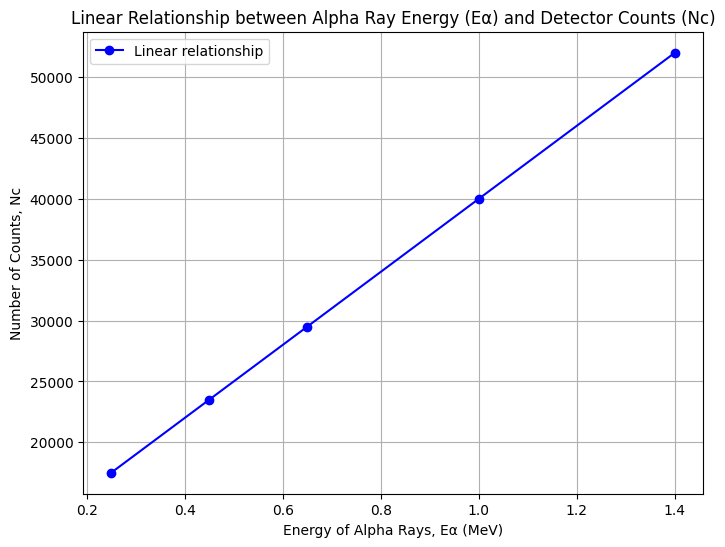
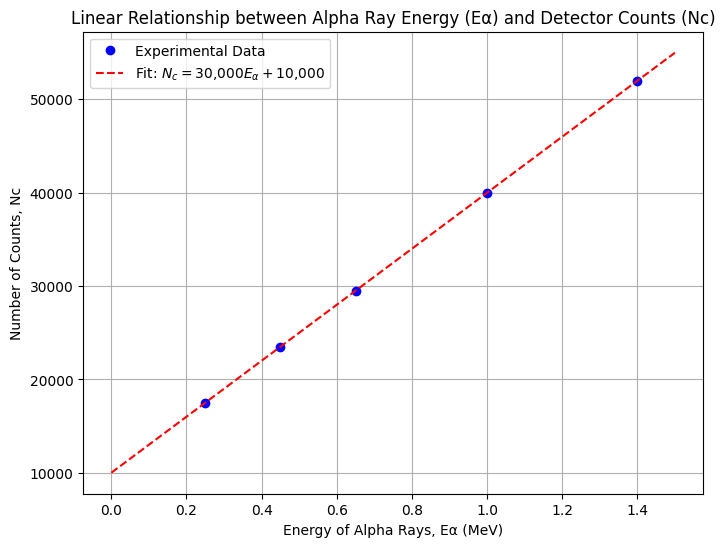
(c) The scintillation nuclear radiation detector detects the alpha rays per second. When the energy of the alpha rays (Eα) in MeV increases, the number of counts (Nc) on the detector also increases linearly as shown in the table below:
| Eα (MeV) | 0.25 | 0.45 | 0.65 | 1 | 1.4 |
| Nc | 17500 | 23500 | 29500 | 40000 | 52000 |
Draw the graph of Nc as a function of Eα (MeV) and find the energy of unknown alpha ray if the number of counts are 31600.
Solution
Step 1: Plot the Graph
Since the relationship is linear, we plot the points (Eα, Nc) on a graph and draw the line of best fit that passes through them. The independent variable (Eα) is on the x-axis, and the dependent variable (Nc) is on the y-axis.
- The points would be: (0.25, 17500), (0.45, 23500), (0.65, 29500), (1.0, 40000), (1.4, 52000).
- These points will align perfectly on a straight line, confirming the linear relationship.
Step 2: Find the Equation of the Line
We can find the slope (m) using any two points. Let’s use (0.25, 17500) and (1.4, 52000).
Slope (m) = (y₂ – y₁) / (x₂ – x₁) = (52000 – 17500) / (1.4 – 0.25) = (34500) / (1.15) = 30,000
The equation of a line is y = mx + c. We can find the y-intercept (c) by plugging in one point, say (0.25, 17500):
17500 = (30000)(0.25) + c
17500 = 7500 + c
c = 17500 – 7500 = 10,000
Therefore, the linear equation is:
Nc = 30,000 × Eα + 10,000
Step 3: Find Eα for Nc = 31,600
Plug the given Nc value into the equation and solve for Eα.
31,600 = 30,000 × Eα + 10,000
31,600 – 10,000 = 30,000 × Eα
21,600 = 30,000 × Eα
Eα = 21,600 / 30,000
Eα = 0.72 MeV
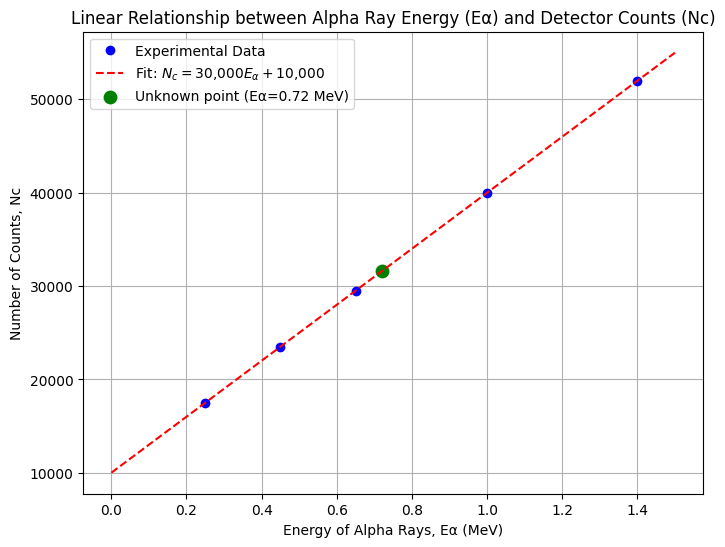
Therefore, the energy of the unknown alpha ray is 0.72 MeV.
(d) The y is directly proportional to x2 and y = m for a particular value of x. Find an expression for y in terms of m, when this value of x is doubled.
Solution
The statement “y is directly proportional to x²” is written mathematically as:
y ∝ x²
This can be written as an equation by introducing a constant of proportionality, k:
y = kx² … (1)
We are told that for a particular value of x (let’s call it x₁), y = m.
So, from equation (1):
m = k(x₁)² … (2)
Now, the value of x is doubled. So the new value is x₂ = 2x₁.
We need to find the new value of y, let’s call it y₂.
Using the proportionality equation (1) again:
y₂ = k(x₂)²
y₂ = k(2x₁)²
y₂ = k × 4(x₁)²
y₂ = 4 × [k(x₁)²]
Notice from equation (2) that k(x₁)² = m. We can substitute this:
y₂ = 4 × m
Therefore, the expression for y in terms of m, when x is doubled, is y = 4m. This means the value of y becomes four times its original value m.
📘 Benefits of Practicing This Descriptive Paper
- ✅ These CSS Past Paper 2023 General Science and Ability Descriptive questions are compiled from authentic FPSC CSS past papers, following the real written exam format.
- 💬 Attempting this CSS Past Paper 2023 General Science and Ability Descriptive helps students master structured writing and analytical skills for CSS exams.
- 🧾 Every question in this CSS Past Paper 2023 General Science and Ability Descriptive strictly follows the official CSS exam syllabus approved by FPSC.
- 📊 Students preparing for CSS 2023 can rely on this CSS Past Paper 2023 General Science and Ability Descriptive to practice time management and topic selection.
- 🔍 The solved CSS Past Paper 2023 General Science and Ability Descriptive contains concise explanations to improve conceptual understanding and writing clarity.
- 🎯 Regular revision of this CSS Past Paper 2023 General Science and Ability Descriptive builds confidence and strengthens your preparation for the CSS written paper.
- 🏆 This CSS Past Paper 2023 General Science and Ability Descriptive is essential for mastering exam techniques and achieving success in the FPSC CSS examination.
🏁 Final Note
Keep revising these CSS Past Paper 2023 General Science and Ability Descriptive to strengthen your grip on important concepts and improve accuracy in upcoming CSS exams. Regular practice with these CSS Past Paper 2023 General Science and Ability Descriptive will help you score higher and build full command over the CSS exam syllabus.
📰 Check out other years’ past papers of General Science & Ability.
🔗 Check FPSC past papers directly from the official FPSC website.